
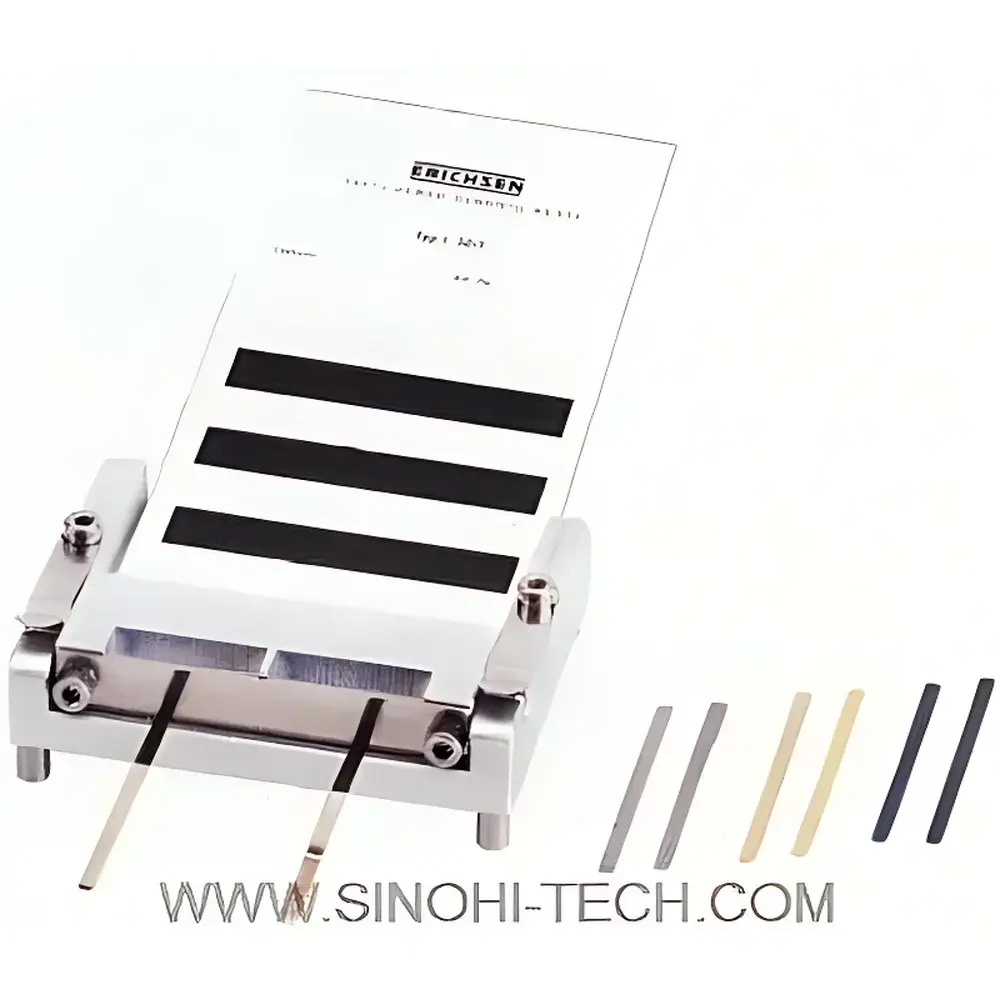
Erichsen #238 Dual and Triple Film Applicator per Biddle Standard
| Origin | Germany |
|---|---|
| Manufacturer Type | Authorized Distributor |
| Origin Category | Imported |
| Model | #238 |
| Pricing | Upon Request |
Overview
The Erichsen #238 Dual and Triple Film Applicator is a precision-engineered laboratory instrument designed in strict compliance with the Biddle standard for controlled, reproducible wet-film deposition on standardized test cards. Based on the principle of fixed-gap drawdown, this applicator utilizes calibrated metallic spacer bars to define the gap between the doctor blade and substrate surface—enabling consistent, parallel film formation under gravity-assisted shear flow. It operates without motorized drive or electronic control, relying instead on manual, steady-speed withdrawal of the substrate through a reservoir-loaded applicator bar. This passive, mechanical architecture ensures high inter-laboratory reproducibility and eliminates variability introduced by motor speed drift or operator-dependent acceleration. The device serves as a foundational tool in paint, ink, coating, and adhesive R&D and QC laboratories where traceable, standardized film thickness generation is essential for comparative evaluation of optical, rheological, and drying behavior.
Key Features
- Two distinct configurations: #238/II (triple-film) and #238/III (dual-film), each optimized for simultaneous multi-track deposition
- Adjustable gap system using color-coded, certified stainless-steel spacer bars (100 µm, 150 µm, 200 µm, and 250 µm nominal thicknesses)
- Spring-clamped linear guide rails ensure stable substrate alignment and repeatable positioning prior to drawdown
- Dedicated blade carrier rod with integrated storage groove for rapid blade exchange and safe handling
- Compact, robust aluminum alloy chassis with machined flatness tolerance ≤ ±5 µm across the rail interface surface
- Supplied with ISO-compliant test cards (Type 107D smooth white; Type 108D contrast-patterned) and calibration-grade hex key
Sample Compatibility & Compliance
The Erichsen #238 is compatible with Newtonian and moderately shear-thinning liquid coatings—including solvent-based paints, aqueous dispersions, UV-curable resins, and pigment-loaded inks—provided viscosity remains within the practical range of 10–500 mPa·s at application shear rates (~10–100 s⁻¹). It conforms to ASTM D823, ISO 2808 (Clause 4.2, drawdown method), and DIN 53157 for wet-film thickness generation. While not itself a measuring instrument, its geometry and operational protocol are referenced in ASTM D2805 (gloss), ASTM D2806 (hiding power), and ISO 6504 (color difference assessment) as the prescribed film-forming method. All supplied spacer bars are traceable to national metrology institutes (e.g., PTB Germany) and documented per ISO/IEC 17025 calibration requirements.
Software & Data Management
This is a purely mechanical, non-digital instrument with no embedded electronics, firmware, or connectivity. Consequently, it requires no software installation, driver configuration, or cybersecurity validation. However, its use supports GLP- and GMP-aligned quality documentation workflows: each film application can be logged manually or via LIMS-integrated worksheets referencing lot-specific spacer bar IDs, test card serial numbers, ambient temperature/humidity (per ISO 291), and observer identification. For audit readiness, laboratories routinely retain archived film cards alongside raw data sheets—providing physical evidence for dispute resolution, regulatory review, or internal process validation per FDA 21 CFR Part 11 principles (where paper records serve as original source data).
Applications
- Colorimetric comparison against master standards using spectrophotometric measurement on dried films
- Wet-film hiding power evaluation via visual or instrumental contrast ratio analysis on Type 108D cards
- Correlation of wet-film thickness (via spacer selection) to final dry-film properties (gloss, DOI, microhardness)
- Assessment of pigment dispersion stability by monitoring film uniformity and mottle development after drying
- Batch-to-batch consistency verification during production line release testing
- Formulation screening for binder-pigment compatibility and rheology modifiers’ efficacy
FAQ
What is the actual wet-film thickness achieved relative to the selected spacer height?
Empirical validation shows that for typical architectural and industrial coatings, the resulting wet-film thickness equals approximately 50–60% of the nominal spacer height due to fluid contraction during drawdown and solvent evaporation onset.
Can the same spacer set be used interchangeably between #238/II and #238/III models?
Yes—the spacer bars are dimensionally identical and fully interchangeable; only the blade geometry and rail spacing differ between the two models.
Is calibration certification included with the spacer bars?
Each set is supplied with a manufacturer’s declaration of conformity and dimensional verification report; full ISO/IEC 17025 calibration certificates are available upon request.
How should the applicator be cleaned between formulations?
Immediate rinsing with appropriate solvent followed by lint-free wipe-down is required; ultrasonic cleaning of spacers is permissible but must avoid thermal shock or abrasive contact.
Are replacement blades available separately?
Yes—Erichsen offers OEM-specified hardened stainless-steel blades (Order No. 0073.01.31) with guaranteed edge straightness ≤ 2 µm over 100 mm length.



