
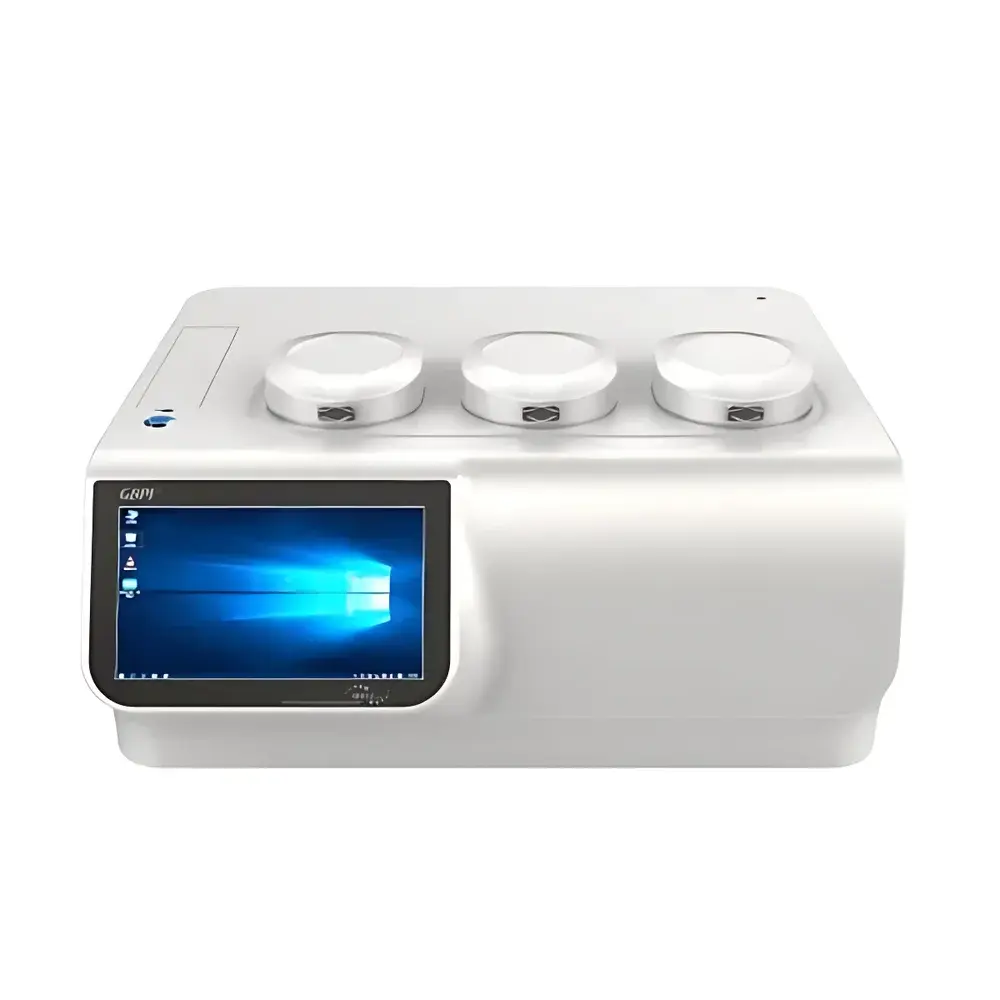
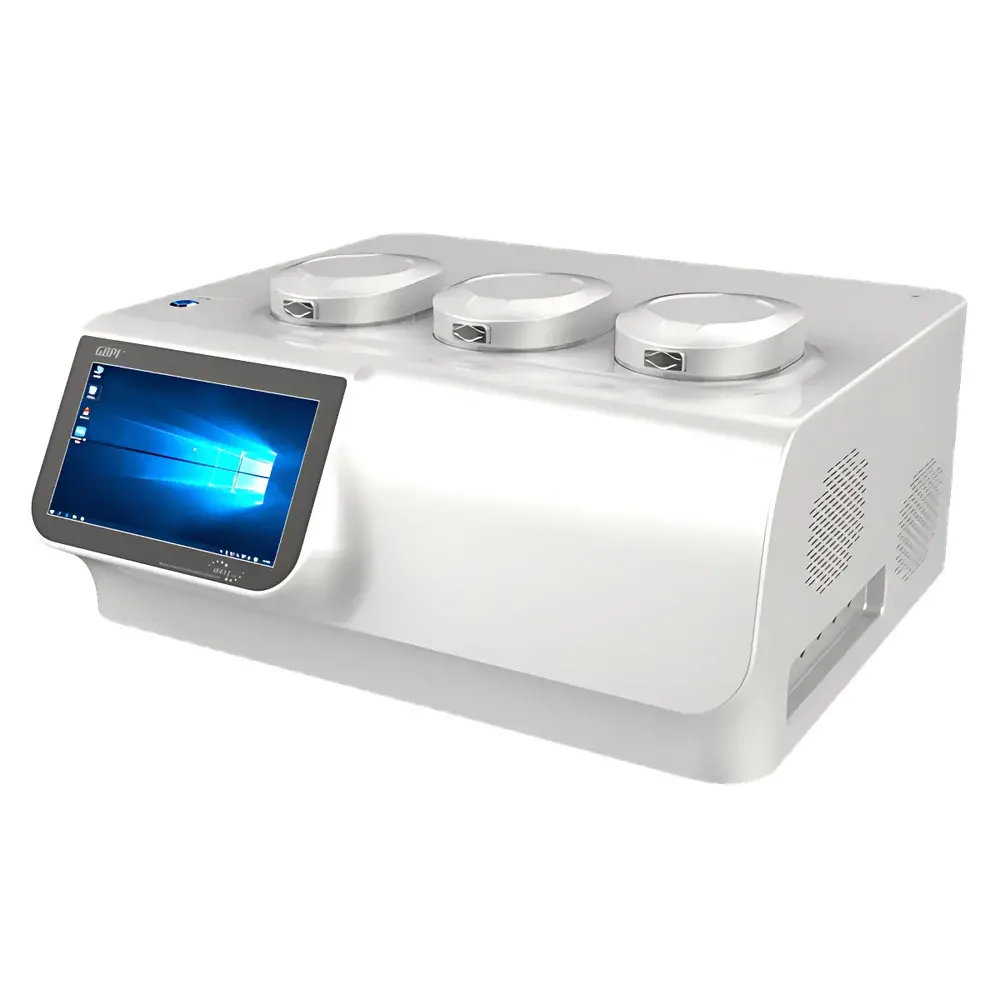
GBPI W413 2.0 Infrared Water Vapor Transmission Rate (WVTR) Analyzer
| Brand | GBPI |
|---|---|
| Origin | Guangdong, China |
| Manufacturer Type | Manufacturer |
| Origin Category | Domestic |
| Model | W413 2.0 |
| Price | ¥368,000 |
Overview
The GBPI W413 2.0 Infrared Water Vapor Transmission Rate (WVTR) Analyzer is a high-precision, multi-chamber instrumentation platform engineered for quantitative determination of water vapor permeation through packaging materials under controlled temperature and humidity conditions. It operates on the principle of infrared detection—where water vapor molecules permeating across a test specimen are swept by ultra-pure nitrogen carrier gas into a calibrated non-dispersive infrared (NDIR) sensor. The sensor measures absorbance at the characteristic 2.7 µm vibrational band of H₂O, enabling direct, real-time quantification of vapor flux without chemical reagents or consumables. This method delivers inherent linearity, long-term stability, and immunity to interference from CO₂ or hydrocarbons—critical advantages over coulometric or gravimetric alternatives. Designed in strict alignment with ASTM F1249, ISO 15106-2, GB/T 26253, and YBB 00092003, the W413 2.0 serves as a reference-grade instrument for R&D labs, QC departments, and regulatory-compliant manufacturing facilities across pharmaceutical, food, medical device, photovoltaic, and personal care industries.
Key Features
- Triple independent test chambers: Enables parallel, statistically robust measurement of up to three specimens simultaneously—each with fully autonomous environmental control and data acquisition.
- High-sensitivity NDIR moisture sensor: Developed in collaboration with international sensor specialists; achieves resolution of 0.0001 g/(m²·24h) and drift <±0.5% FS/30 days.
- Precision climate control: Dual-stream humidity generation (dry/wet air mixing) ensures ±2% RH accuracy across 30–90% RH range; electromagnetic PID temperature regulation maintains ±0.1°C stability from 15°C to 45°C (optional extension to 60°C).
- Automated pneumatic clamping system: One-touch sealing with programmable clamping force (≥0.3 MPa), eliminating operator-induced variability and ensuring leak-tight integrity for specimens up to 3 mm thick.
- Integrated 11.6-inch capacitive touchscreen HMI: Full local operation without external PC; supports five real-time trending plots—WVTR vs. time, temperature vs. time, RH vs. time, carrier flow vs. time, and sensor voltage vs. time—with zoom, hide, and overlay functions.
- GMP-aligned software architecture: Compliant with FDA 21 CFR Part 11 requirements; includes role-based user access control, electronic signatures, full audit trail (system events, test parameters, raw data edits), and configurable report templates exportable in PDF, CSV, and XML formats.
Sample Compatibility & Compliance
The W413 2.0 accommodates flat and formed packaging geometries via modular fixtures. Standard configuration supports circular specimens (Φ100 mm, max thickness 3 mm) with effective test area of 50.24 cm². Optional mini-cells reduce active area to 0.785 cm² for micro-scale films (e.g., barrier-coated PET, ALU-PVC blisters). Custom fixtures enable testing of rigid containers—including HDPE bottles, aluminum foil pouches, laminated tubes, and thermoformed trays—without compromising measurement traceability. All test protocols adhere to ISO/IEC 17025 principles. GBPI holds CNAS accreditation (L8185) for third-party WVTR verification and manufactures certified reference materials (GBW(E)130543 / GBW(E)130544) traceable to NIM (National Institute of Metrology, China), supporting instrument calibration, validation, and inter-laboratory comparison.
Software & Data Management
The embedded operating system features a modular GUI built on a deterministic real-time kernel, ensuring deterministic response during critical test phases. Test methods are defined as reusable templates with parameter constraints enforced per standard (e.g., mandatory dwell time ≥24 h per ASTM F1249). Raw sensor data (10 Hz sampling) is stored with metadata including ambient lab conditions, gas purity logs, and hardware diagnostics. Statistical analysis tools compute mean WVTR, coefficient of variation (CV%), confidence intervals (95%), and trend significance (linear regression p-value). Data export supports LIMS integration via TCP/IP or RS-232; optional OPC UA server enables enterprise-level connectivity. Audit trails record all user actions—including login/logout, parameter changes, result approvals, and firmware updates—with immutable timestamps and operator IDs.
Applications
- Pharmaceutical packaging: Quantifying moisture ingress into blister packs (PVC/PVDC, Alu-Alu), sachets (PET/AL/PE), and vial stoppers to ensure drug stability per ICH Q1A(R3) and USP <671>.
- Food packaging development: Evaluating barrier performance of multilayer films (BOPP/PA/PE), metallized papers, and compostable substrates (PLA/PBAT) under accelerated shelf-life conditions.
- Medical device packaging: Validating seal integrity and material permeability of Tyvek®-based sterile barriers and peel-open pouches per ISO 11607-1.
- Photovoltaic encapsulation: Measuring WVTR of EVA, POE, and silicone-based encapsulants to predict delamination risk and module lifetime per IEC 61215.
- Regulatory submission support: Generating GLP-compliant datasets for FDA 510(k), CE MDR technical files, and PMDA dossiers—fully traceable from raw signal to final report.
FAQ
What carrier gas specifications are required for optimal performance?
Ultra-high-purity nitrogen (≥99.999% N₂) is mandatory; oxygen and moisture content must be <1 ppm. Supply pressure ≥0.1 MPa and adjustable flow rate (5–120 mL/min) are enforced via integrated mass flow controllers.
Can the instrument validate compliance with FDA 21 CFR Part 11?
Yes. The system implements electronic signatures, audit trails with immutable timestamps, role-based permissions, and data integrity safeguards—including write-protection of raw datasets and cryptographic hashing of exported reports.
Is calibration traceable to national standards?
Absolutely. GBPI supplies NIM-traceable certified reference materials (GBW(E)130543/130544) and provides on-site calibration services accredited under CNAS L8185, with documented uncertainty budgets per ISO/IEC 17025.
How does the triple-chamber design improve measurement reliability?
Independent environmental control per chamber eliminates cross-talk; statistical comparison of replicate results enables outlier detection, CV% calculation, and confidence interval estimation—essential for GMP process validation.
Does the system support remote monitoring and diagnostics?
Yes. Via optional IoT gateway, users access live instrument status, historical trends, diagnostic logs, and firmware update notifications through a secure web portal—enabling proactive maintenance and global lab coordination.






