
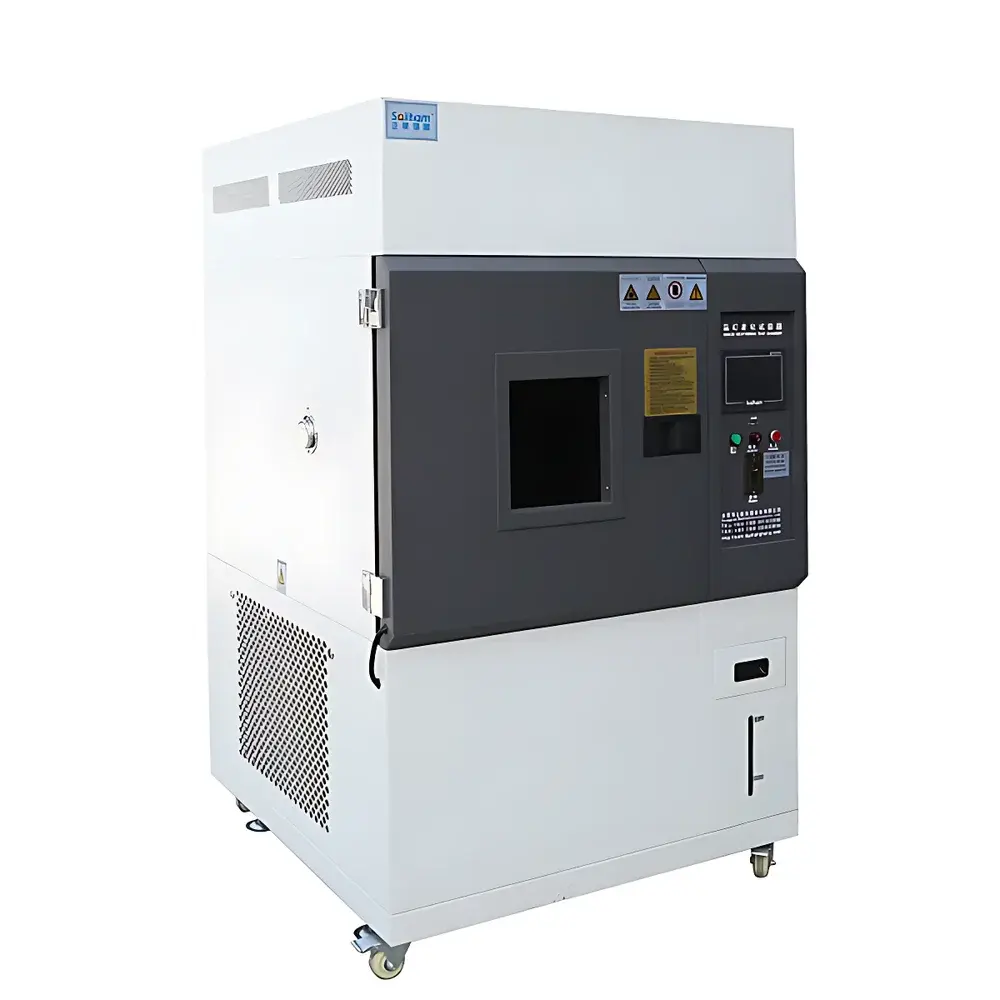
GBPI OXD-150P Flat-Panel Xenon Arc Weathering Chamber
| Brand | GBPI |
|---|---|
| Origin | Guangdong, China |
| Manufacturer Type | OEM Manufacturer |
| Country of Origin | China |
| Model | OXD-150P |
| Pricing | Upon Request |
Overview
The GBPI OXD-150P Flat-Panel Xenon Arc Weathering Chamber is an engineered environmental simulation system designed to replicate the photodegradative effects of natural sunlight under controlled laboratory conditions. It employs a wind-cooled, full-spectrum long-arc xenon lamp (1800 W, rated life ≥1600 h) emitting continuous irradiance across 280–800 nm—closely matching terrestrial solar spectral distribution. Unlike vertical or cylindrical configurations, the flat-panel design ensures uniform irradiance distribution across horizontally oriented specimens, minimizing angular dependence and enabling precise, reproducible exposure geometry for packaging materials, films, laminates, inks, adhesives, and coated substrates. The chamber integrates calibrated irradiance control (150–1200 W/m²), black panel temperature regulation (45–85 °C ±3 °C), programmable rain cycles (1–999 min duration; 1–240 min interval), and simultaneous temperature/humidity conditioning (0–80 °C; 20–98% RH) to accelerate aging mechanisms including photooxidation, hydrolysis, pigment fading, and polymer chain scission. Compliance with ISO 4892-2, ASTM G155, GB/T 16422.1–2006, GJB 150.7A, and GB/T 2423.24–2013 ensures data traceability for regulatory submissions and internal quality assurance protocols.
Key Features
- Flat-panel irradiation architecture with horizontal specimen mounting—optimized for sheet, film, and flexible packaging samples requiring consistent exposure geometry.
- Programmable 7-inch touchscreen controller supporting multi-segment ramp-soak profiles for irradiance, temperature, humidity, and spray timing.
- Precision climate control: temperature accuracy ±2 °C (dark condition), humidity accuracy ±3% RH (≥75% RH) / ±5% RH (<75% RH), black panel sensor (PT100) with ±3 °C tolerance.
- Integrated rain simulation system with adjustable nozzle array, electromagnetic valve control, and programmable wet/dry cycling intervals.
- Robust thermal management: French Tecumseh hermetic compressor (R404A refrigerant), forced-air condenser cooling, ceramic heating elements with SSR solid-state relay control.
- Stainless steel (SUS304) interior chamber with polyurethane + ultra-fine glass fiber insulation; external cold-rolled steel cabinet with phosphated & electrostatically sprayed finish.
- Safety-certified architecture: overtemperature protection, phase-loss/leakage detection, motor overcurrent cutoff, refrigeration high-pressure lockout, heater short-circuit monitoring, and fuse-level circuit protection.
Sample Compatibility & Compliance
The OXD-150P accommodates flat, rigid, or semi-flexible specimens up to 150 mm × 150 mm (standard sample area), mounted on a fixed-distance sample rack (300–350 mm from xenon arc center). It supports standardized test coupons per ISO 4892-2 Annex A, ASTM D7869, and GB/T 16422 series. Chamber validation includes irradiance uniformity mapping (±15% across test plane), black panel temperature homogeneity assessment, and humidity distribution profiling per ASTM E2075. Full compliance with GLP documentation requirements is enabled via audit-trail-capable software (see Software & Data Management). All electrical components meet CE, FCC, and RoHS directives; mechanical design conforms to IEC 61000-4 EMC immunity standards. CNAS-accredited calibration services are available through GBPI’s ISO/IEC 17025-certified metrology lab.
Software & Data Management
The embedded control system logs real-time parameters—including irradiance (W/m²), black panel temperature (°C), chamber air temperature (°C), relative humidity (%RH), spray status, and elapsed exposure time—at user-defined intervals (1 s to 60 min). Data export is supported via USB 2.0 to CSV or Excel-compatible formats. Optional PC-based software provides advanced analysis tools: spectral irradiance integration (300–400 nm, 340 nm, or 420 nm band-selectable filters available as add-ons), cumulative dose calculation (kJ/m²), trend charting with statistical deviation overlays, and automated report generation compliant with FDA 21 CFR Part 11 (electronic signature support requires optional validation package). Audit trails record all operator actions, parameter changes, and alarm events with timestamps and user IDs—fully traceable for ISO 9001, ISO 13485, or pharmaceutical stability program audits.
Applications
This chamber serves critical roles in packaging R&D and QC workflows: evaluating UV resistance of barrier coatings on PET/ALU laminates; quantifying color shift (ΔE*ab) in printed flexible packaging after accelerated light exposure; validating shelf-life claims for medical device pouches per ISO 11607; assessing ink adhesion durability on HDPE containers under cyclic wet/dry UV stress; benchmarking photostability of biodegradable films (PLA, PHA) against conventional polymers; and supporting formulation development for UV-stabilized adhesives used in label applications. Its flat-panel geometry eliminates edge-shadowing artifacts common in cylindrical chambers—making it especially suitable for comparative testing of multi-layer structures where interfacial degradation must be isolated.
FAQ
What is the maximum specimen thickness accommodated by the flat-panel configuration?
The standard sample holder supports specimens up to 10 mm thick; custom fixtures for thicker substrates (e.g., molded plastic parts) are available upon request.
Is spectral filtering capability included as standard equipment?
No—bandpass filtering (340 nm, 420 nm, or 300–400 nm) is an optional upgrade requiring installation of calibrated interference filters and recalibration of irradiance sensors.
Does the system support remote monitoring or network integration?
Yes—Ethernet port enables Modbus TCP communication for SCADA integration; remote access via secure HTTPS requires optional firmware license and IT infrastructure alignment.
What maintenance intervals are recommended for the xenon lamp and optical components?
Lamp replacement is advised at 1600 h or when irradiance output falls below 90% of initial calibration; quartz filter and reflector cleaning is required every 200 h of operation.
Can the chamber operate continuously for extended stability studies?
Yes—designed for unattended 24/7 operation with redundant safety interlocks, automatic water level management, and predictive fault diagnostics logged to non-volatile memory.






