
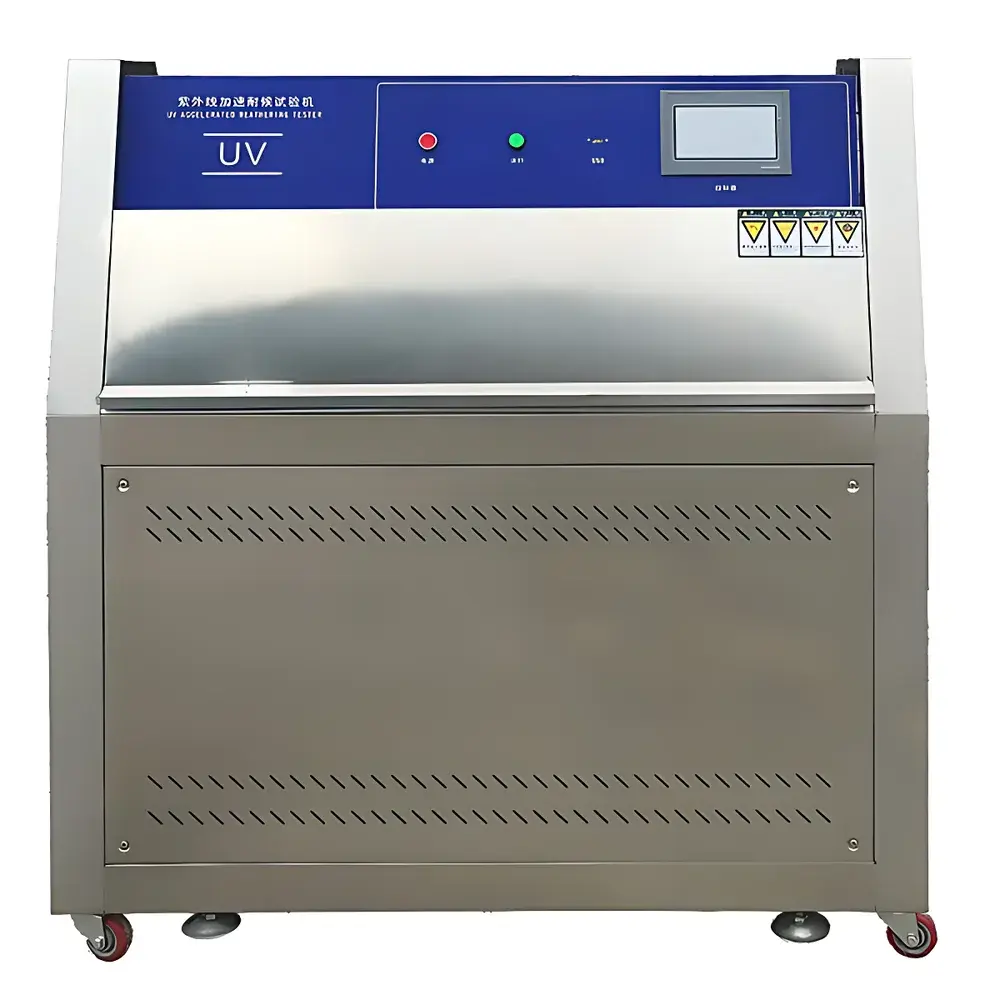
GBPI OUV-263 Tilted-Tower UV Accelerated Weathering Chamber
| Brand | GBPI |
|---|---|
| Origin | Guangdong, China |
| Manufacturer Type | Original Equipment Manufacturer (OEM) |
| Country of Origin | China |
| Model | OUV-263 |
| Pricing | Upon Request |
| Irradiance Range | 0.35–1.0 W/m² (at 340 nm) |
| UV Lamps | 8 × UVA-340 fluorescent tubes (L = 1200 mm, Ø38 mm, 40 W |
| Optional Lamps | UVB-313 or UVA-351 |
| Spectral Range | UVA-340: 315–400 nm |
| UVB-313 | 280–315 nm |
| Lamp Center Spacing | 70 mm |
| Temperature Range | RT+10°C to 70°C |
| Temperature Uniformity | ±3.0°C |
| Humidity Level | ≥93% RH (non-regulated display) |
| Exposure Cycle Duration | 0–999 h 99 min (programmable) |
| Sample Capacity | 48 pcs (24 positions × 2 tiers |
| max. sample size | 280 × 75 mm) |
| Internal Dimensions | W280 × D75 × H? mm (per tier |
| External Dimensions | W1300 × H1560 × D600 mm |
| Power Supply | AC 220 V, 50/60 Hz, single-phase, protected earth required (ground resistance <4 Ω) |
| Installed Power | 4 kW (typical operating power: 2.8 kW) |
| Compliance Standards | GB/T 16585–1996, GB/T 14522–2008, GB/T 16422.3–2014 |
Overview
The GBPI OUV-263 Tilted-Tower UV Accelerated Weathering Chamber is an engineered solution for simulating the photochemical degradation effects of natural sunlight—specifically ultraviolet radiation—combined with condensation and thermal cycling. Designed in accordance with established fluorescent UV exposure methodologies, it employs a tilted-tower configuration to optimize irradiance distribution and specimen exposure geometry, enabling reproducible, high-fidelity acceleration of polymer, coating, ink, and packaging material aging under controlled laboratory conditions. Unlike flat-panel UV chambers, the tilted-tower architecture ensures uniform angular incidence across vertically mounted test specimens, minimizing shadowing artifacts and enhancing correlation with real-world outdoor exposure behavior—particularly for flexible packaging films, laminates, and printed labels where orientation-dependent degradation is critical. The system operates on the principle of controlled UV irradiation (UVA-340 dominant spectrum), cyclic condensation (via water-heated stainless-steel trough), and programmable thermal modulation, all integrated into repeatable exposure cycles compliant with national and industrial standards for artificial weathering.
Key Features
- Tilted-tower optical design with dual-sided lamp arrays (4 UVA-340 lamps per side) for symmetrical, high-uniformity irradiance distribution across vertically oriented samples
- Stainless-steel construction: SUS 304 interior and exterior walls (or electrostatic powder-coated steel option) for corrosion resistance and long-term stability in humid, UV-intensive environments
- Integrated water-heated condensation trough with auto-refill function and dry-run protection to prevent heater element damage
- 7-inch full-color TFT touch-screen controller supporting both programmable multi-step cycles and fixed-value operation modes
- PID auto-tuning with SSR output for precise temperature regulation (RT+10°C to 70°C, ±3.0°C uniformity)
- Single-loop air circulation system driven by axial fans, engineered to maintain consistent thermal and humidity gradients throughout the test chamber
- Bidirectional hinged lid for ergonomic access and secure sealing during operation
- Comprehensive safety suite: grounded chassis protection, overcurrent circuit breakers, thermal cutouts for heating elements, low-water level detection, and dry-burn prevention logic
- USB interface for direct export of time-stamped test data (CSV/Excel format) and graphical history logs (JPG), including temperature, irradiance, and cycle phase timestamps
Sample Compatibility & Compliance
The OUV-263 accommodates standardized flat-sheet specimens up to 280 mm × 75 mm, with capacity for 48 samples arranged across two staggered tiers—a layout validated for representative exposure of flexible packaging substrates, pressure-sensitive adhesives, metallized films, and printed cartons. It excludes volatile, flammable, corrosive, biological, or high-EMI-emitting materials per IEC 61000-4 series and GB 4793.1 safety directives. The chamber meets requirements for compliance-driven testing in regulated environments: its operational traceability supports GLP-aligned documentation practices, and its controller firmware implements audit-trail-capable event logging (power-on, cycle start/stop, alarm triggers, parameter changes). Test protocols align with GB/T 16585–1996 (vulcanized rubber), GB/T 14522–2008 (industrial plastics/coatings/rubbers), and GB/T 16422.3–2014 (plastics—fluorescent UV exposure), providing technically defensible data for QC release, formulation development, and supplier qualification.
Software & Data Management
The embedded controller firmware records all operational parameters—including chamber temperature, elapsed exposure time, UV irradiance status (on/off), condensation phase activation, and fault events—at user-configurable intervals (default: 1-minute resolution). Data are stored internally with non-volatile memory retention and exported via USB without requiring external software. Exported Excel files contain timestamped columns for temperature, cycle stage, and runtime; JPG snapshots preserve trend curves for immediate review or inclusion in regulatory submissions. While the system does not natively support FDA 21 CFR Part 11 electronic signature or networked database integration, its local data integrity—combined with manual verification logs—fulfills baseline requirements for ISO/IEC 17025-accredited laboratories performing non-GxP-constrained material stability assessments.
Applications
This chamber serves quality assurance and R&D laboratories engaged in accelerated aging validation for packaging components—including barrier films, shrink sleeves, label stocks, and pharmaceutical blister lidding materials—where UV-induced yellowing, delamination, gloss loss, or adhesive migration must be quantified prior to market release. It is routinely deployed in food packaging shelf-life modeling, cosmetic container durability screening, and automotive interior trim qualification. Its tilted-tower geometry offers particular utility in evaluating directional UV sensitivity of asymmetric laminates or surface-coated substrates, where conventional horizontal exposure may misrepresent real-world degradation kinetics. Users include national metrology institutes, packaging converters, contract testing labs, and corporate R&D centers serving FMCG, pharma, and electronics sectors.
FAQ
What UV spectral output does the standard UVA-340 lamp provide, and how does it correlate with terrestrial sunlight?
The UVA-340 lamp emits peak irradiance at ~340 nm, closely matching the short-wave UV region (295–360 nm) of midday summer sunlight at sea level, as defined in ISO 4892-3 and ASTM G154. This makes it suitable for predicting degradation mechanisms driven by solar UV photons, such as polymer chain scission and chromophore bleaching.
Can the OUV-263 operate under fully automated unattended cycles?
Yes—the controller supports fully autonomous execution of pre-programmed exposure sequences (e.g., 4-h UV + 4-h condensation repeated over 500 cycles), with audible/visual alarms triggered only upon safety-critical faults (e.g., low water, overtemperature).
Is calibration of UV irradiance traceable to national standards?
While the system includes no built-in radiometric calibration port, users may integrate NIST-traceable UV radiometers (e.g., calibrated broadband sensors per ISO 17987) into routine maintenance procedures to verify lamp output drift over service life.
What maintenance intervals are recommended for optimal performance?
Lamp replacement every 1,600–2,000 hours of operation; quarterly inspection of water trough seals and auto-refill solenoid function; annual verification of temperature sensor accuracy against reference thermistors per GB/T 5170.2.
Does the chamber support custom irradiance setpoints outside the 0.35–1.0 W/m² range?
No—the installed ballast and lamp configuration are factory-tuned for nominal UVA-340 output within this range. Higher irradiance would require hardware modification not covered under warranty or regulatory compliance.





