
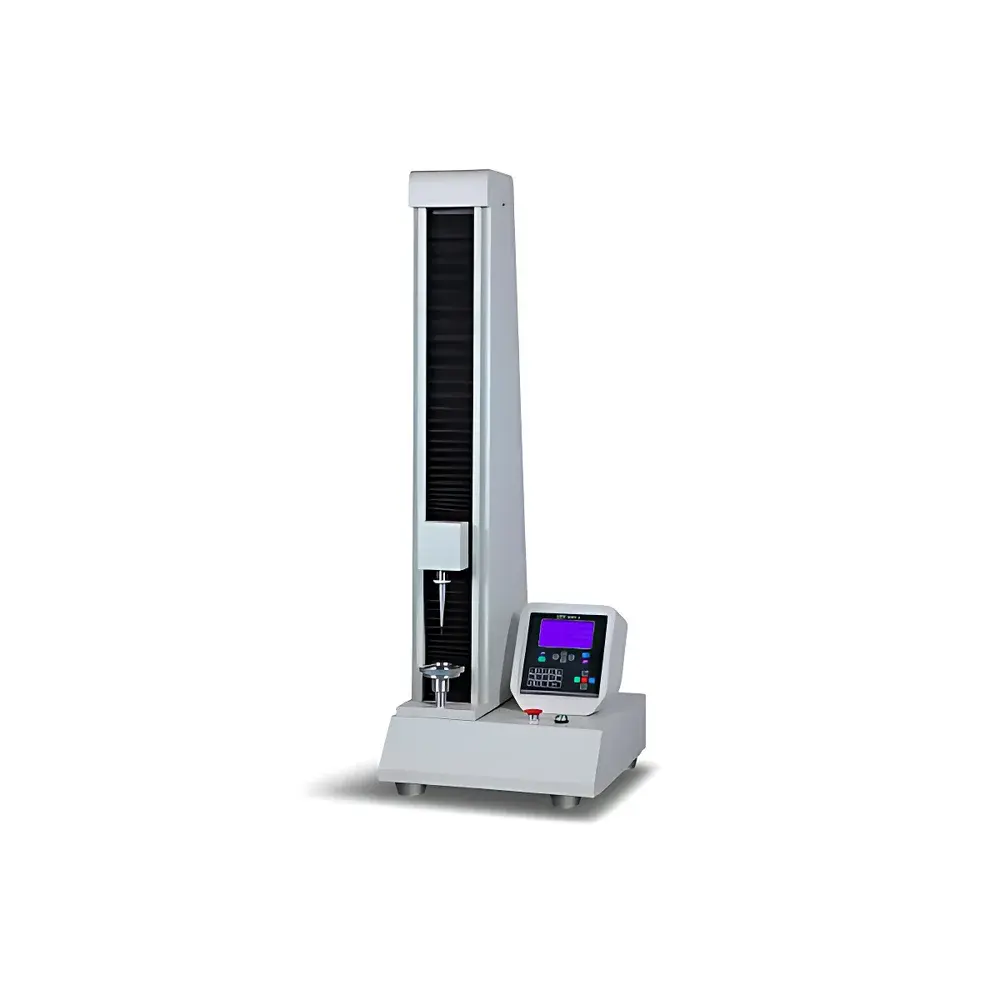
GBPI GBH-1L Single-Column Electronic Tensile Testing Machine
| Brand | GBPI |
|---|---|
| Origin | Guangdong, China |
| Manufacturer Type | Direct Manufacturer |
| Model | GBH-1L |
| Instrument Type | Electronic Tensile Testing Machine |
| Max Test Force | 1.5 kN |
| Force Range | 0–500 N (optional 0–1500 N) |
| Elongation Capacity | up to 1400% |
| Force Accuracy | ±0.5% of reading (Class 0.5) |
| Crosshead Travel | 750 mm |
| Displacement Resolution | ±0.5% of reading |
| Effective Sample Width | 30 mm (customizable to 50 mm) |
| Test Speed | 0–500 mm/min, infinitely variable |
| Power Supply | AC 220 V, 50 Hz |
| Power Consumption | 1000 W |
| Dimensions (W×D×H) | 600 × 600 × 1300 mm |
| Weight | 70 kg |
Overview
The GBPI GBH-1L Single-Column Electronic Tensile Testing Machine is a precision-engineered mechanical testing system designed for static tensile, peel, tear, puncture, compression, flexural, and shear property evaluation of thin, flexible materials. It operates on the fundamental principle of controlled uniaxial force application via a high-rigidity dual-column frame and servo-driven crosshead displacement, with real-time load and displacement acquisition using calibrated load cells and optical encoder feedback. The instrument complies with international mechanical testing standards—including ASTM E4 (load verification), ASTM D882 (tensile properties of thin plastic sheeting), ISO 37 (vulcanized rubber), and multiple Chinese national standards (e.g., GB/T 1040, GB/T 8808, GB/T 2792)—making it suitable for quality assurance laboratories in packaging, pharmaceuticals, food, and medical device manufacturing, as well as academic research and regulatory compliance testing.
Key Features
- Single-column, benchtop structural design with rigid aluminum alloy frame and precision-ground ball-screw drive—optimized for long-term dimensional stability and minimal thermal drift.
- Imported AC servo motor and digital motion controller enable smooth, low-noise operation across the full speed range (0–500 mm/min), supporting both quasi-static and rapid deformation protocols.
- Class 0.5 force measurement accuracy (±0.5% of reading) certified per JJG 139 and ISO 7500-1, with optional dual-range load cell configuration (0–500 N standard; 0–1500 N upgradeable).
- High-speed data acquisition at 100 Hz ensures precise capture of transient mechanical events such as yield onset, necking, or brittle fracture.
- Modular control architecture: supports both embedded controller mode (standalone operation) and PC-integrated mode (via RS232 interface) for maximum workflow flexibility.
- Comprehensive safety system including hardware-based upper/lower limit switches, overload cutoff, emergency stop button, and software-enforced test termination logic.
- Multi-functional gripping capability: accommodates manual wedge clamps (standard 30 mm width, optional 50 mm), pneumatic clamps (optional), and specialized fixtures for peel (ASTM F88), puncture (ASTM F1306), and tear (ASTM D1938) tests.
Sample Compatibility & Compliance
The GBH-1L is validated for use with polymeric films (BOPP, PET, PE, CPP), laminated flexible packaging (aluminum foil composites, paper-plastic structures), adhesive tapes, nonwovens, rubber sheets, coated papers, and biomedical membranes. Its 750 mm effective travel and 1400% elongation capacity allow full characterization of highly ductile materials without premature frame interference. All test methods align with GLP-compliant documentation requirements: audit trails, user access logs, electronic signatures, and raw data immutability are supported through optional software modules compliant with FDA 21 CFR Part 11. Calibration certificates traceable to NIM (National Institute of Metrology, China) or equivalent national metrology institutes can be provided upon request.
Software & Data Management
The included Windows-based testing software provides ISO/IEC 17025-aligned data handling: real-time stress–strain curve visualization, automatic calculation of tensile strength, elongation at break, Young’s modulus, peel adhesion (N/15 mm), seal strength (N/15 mm), and puncture force (N). Raw data export is native to CSV and Excel-compatible formats; curve overlay comparison across batches or material lots is supported. Users may define custom test templates—including preset gauge lengths, pre-load conditions, and pass/fail criteria—with version-controlled parameter libraries. Software architecture permits integration into LIMS environments via ODBC or API endpoints. Optional reporting modules generate PDF test reports with embedded metadata (operator ID, timestamp, environmental conditions, calibration status).
Applications
- Quality control of heat-seal integrity in sterile barrier packaging (per ASTM F88 and YBB00112003).
- Tensile performance validation of pharmaceutical blister lidding foils (YBB00202004) and pouch films (YBB00132002).
- Peel strength assessment of pressure-sensitive adhesives in medical tapes and transdermal patches.
- Mechanical screening of biodegradable films under accelerated aging protocols (ISO 14855).
- Teaching laboratories: hands-on instruction in polymer mechanics, Hookean vs. viscoelastic response, and standardization principles (GB/T 16578.1, ASTM D3330).
- Regulatory submission support: raw data archives meet ICH Q5C and USP requirements for material characterization dossiers.
FAQ
What standards does the GBH-1L comply with for pharmaceutical packaging testing?
It meets YBB series standards (YBB00112003, YBB00202004), ASTM F88 (seal strength), ASTM F904 (peel adhesion), and ISO 11607-2 for packaging validation.
Can the system perform simultaneous multi-channel measurements?
Yes—its modular analog input architecture supports up to four independent sensor channels (e.g., dual load cells + extensometer + environmental sensor) with synchronized sampling.
Is third-party calibration certification available?
Yes—GBPI offers NIST-traceable calibration services with documented uncertainty budgets and ISO/IEC 17025-accredited certificates.
What is the recommended maintenance interval?
Preventive maintenance is advised every 12 months or after 5,000 test cycles, including ball-screw lubrication, encoder alignment verification, and load cell zero-drift check.
Does the software support 21 CFR Part 11 compliance?
Full Part 11 functionality—including role-based access control, electronic signatures, and immutable audit trails—is available via the optional GxP Edition software module.



