
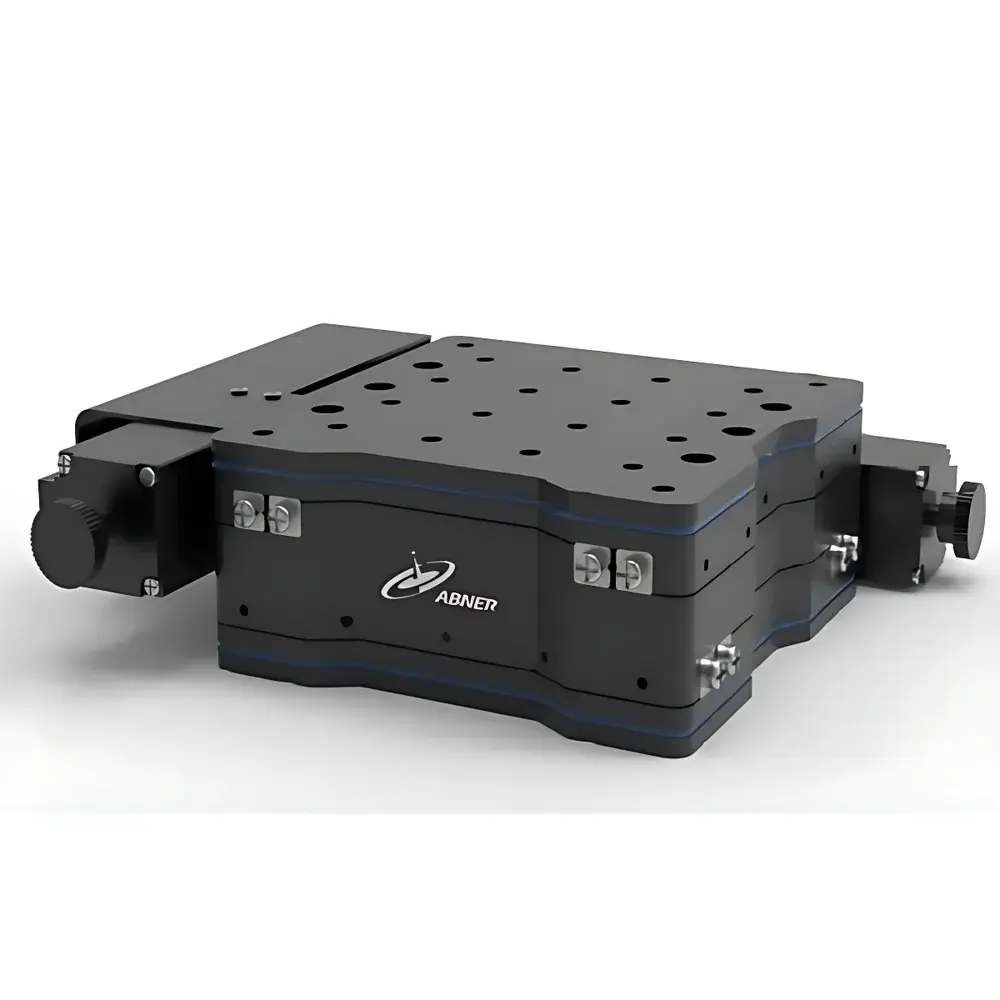
Abner XC20 120×120 mm XY Electric Translation Stage
| Brand | Abner |
|---|---|
| Origin | Jiangsu, China |
| Manufacturer Type | Authorized Distributor |
| Product Category | Domestic |
| Model | XC20 |
| Price | USD 645 (excl. tax & shipping) |
| Product Type | Motorized Translation Stage |
| Travel Range | X: 50 mm, Y: 50 mm |
| Repeatability | ≤ ±2 µm |
| Platform Size | 120 × 120 mm |
| Body Material | Anodized Aluminum (Black) |
| Lead Screw | MISUMI Precision Ball Screw |
| Linear Guide | MISUMI Crossed Roller Bearing |
| Motor | Shinano Kenshi Stepper Motor |
| Drive Type | Open-Loop Stepper Control (Optional Closed-Loop Upgrade Available) |
Overview
The Abner XC20 is a high-stiffness, motorized XY translation stage engineered for precision positioning in optical alignment, microfabrication, and nanoscale research environments. Based on a robust crossed roller bearing and precision ball screw drive architecture, it delivers deterministic motion control with sub-micron repeatability over its 50 mm × 50 mm bidirectional travel range. Unlike piezo-driven or flexure-based stages, the XC20 employs conventional mechanical actuation—optimized for long-term stability, load-bearing capacity (up to 5 kg centered), and compatibility with vacuum-compatible and non-magnetic configurations upon request. Its 120 mm × 120 mm black anodized aluminum platform provides ample mounting area for optical components, sample holders, or integrated vision systems, while maintaining low thermal expansion and high dimensional stability under ambient lab conditions (20–25 °C, <50% RH). The stage operates on standard 24 V DC power and interfaces via industry-standard 15-pin D-sub or USB-to-serial (TTL/RS-485) protocols, enabling seamless integration into automated optical benches, probe stations, and custom metrology rigs.
Key Features
- High-repeatability motion: ≤ ±2 µm bidirectional repeatability across full travel, verified per ISO 230-2 Annex B methodology using laser interferometry
- Rigid mechanical architecture: MISUMI crossed roller linear guides and preloaded ball screws ensure minimal hysteresis and angular deviation (<5 arcsec pitch/yaw)
- Modular drive compatibility: Standard open-loop stepper motor (Shinano Kenshi SK29J02) supports optional encoder feedback upgrade for closed-loop position verification
- Optimized platform geometry: 120 mm × 120 mm mounting surface with 25 mm grid of M4 threaded holes (depth 6 mm) for flexible fixture integration
- Surface finish and durability: Hard-anodized (Type II, 25 µm thickness) aluminum body meets MIL-A-8625F specifications for wear resistance and electrical insulation
- Thermal management: Low coefficient of thermal expansion (23.1 × 10⁻⁶ /°C) and symmetrical structural design minimize thermally induced drift during extended operation
Sample Compatibility & Compliance
The XC20 accommodates a wide range of substrates—from 10 mm × 10 mm MEMS chips to 150 mm (6-inch) wafers—when paired with optional vacuum chucks (−80 kPa minimum holding force) or kinematic clamping kits. It complies with ISO 7243 (hot surface safety), IEC 61000-6-2 (EMC immunity), and RoHS 2015/863/EU directives. While not certified for cleanroom Class 100 use out-of-box, its non-outgassing anodized surface and absence of lubricants make it suitable for Class 1000 environments when operated with filtered air. For regulated applications, the stage supports audit-ready operation logs when integrated with compliant motion controllers meeting FDA 21 CFR Part 11 requirements for electronic records and signatures.
Software & Data Management
Abner provides native drivers for LabVIEW (2020 SP1+), MATLAB (R2021a+), and Python (PySerial + NumPy). A vendor-neutral ASCII command set (e.g., “MOV X 25.34” followed by “POS?”) enables interoperability with third-party automation frameworks such as EPICS, TwinCAT, or HALcon-based vision alignment engines. Position data can be streamed at up to 100 Hz via buffered serial output, timestamped with microsecond resolution using internal hardware clocks. All firmware updates are signed and validated; configuration parameters—including acceleration profiles, current limits, and homing offsets—are stored in non-volatile memory with CRC-32 checksum protection.
Applications
- Semiconductor process development: Wafer-level alignment for maskless lithography, probe card calibration, and flip-chip bonder pre-alignment
- Optical assembly: Active alignment of fiber collimators, lens doublets, and free-space isolators under real-time interferometric feedback
- 2D materials research: Precise lateral registration of graphene/hBN heterostructures during dry-transfer processes
- Quantitative microscopy: Coordinated stage-scanner synchronization for large-area mosaic imaging and drift-compensated time-lapse acquisition
- Educational instrumentation: Modular platform for undergraduate labs in optomechanics, mechatronics, and precision engineering courses
FAQ
What is the maximum payload capacity of the XC20 stage?
The stage supports up to 5 kg when centrally loaded and operated within its specified acceleration limits (0.1 g max). Payload distribution must remain within ±15 mm of the platform center to maintain specified repeatability.
Can the XC20 be used in vacuum environments?
Yes—standard units operate at pressures down to 10⁻² mbar. For ultra-high vacuum (UHV) applications (<10⁻⁷ mbar), optional stainless-steel fasteners, ceramic-insulated motors, and dry-lubricated guides are available upon request.
Is encoder feedback included by default?
No—encoder integration is optional. The base model uses open-loop stepper control. Closed-loop variants (XC20-CL) include 1000-line quadrature encoders and real-time error correction firmware.
How is homing performed?
Mechanical limit switches (normally closed) are installed at both ends of each axis. Homing sequence follows ISO 10791-6: the stage moves toward the switch at reduced speed, detects closure, backs off by 0.1 mm, then re-engages at full resolution.
Does Abner provide application-specific mounting adapters?
Yes—custom kinematic mounts, vacuum chucks, and tilt-adjustable base plates are available under NRE-supported engineering services, with lead times of 4–6 weeks from drawing approval.




