
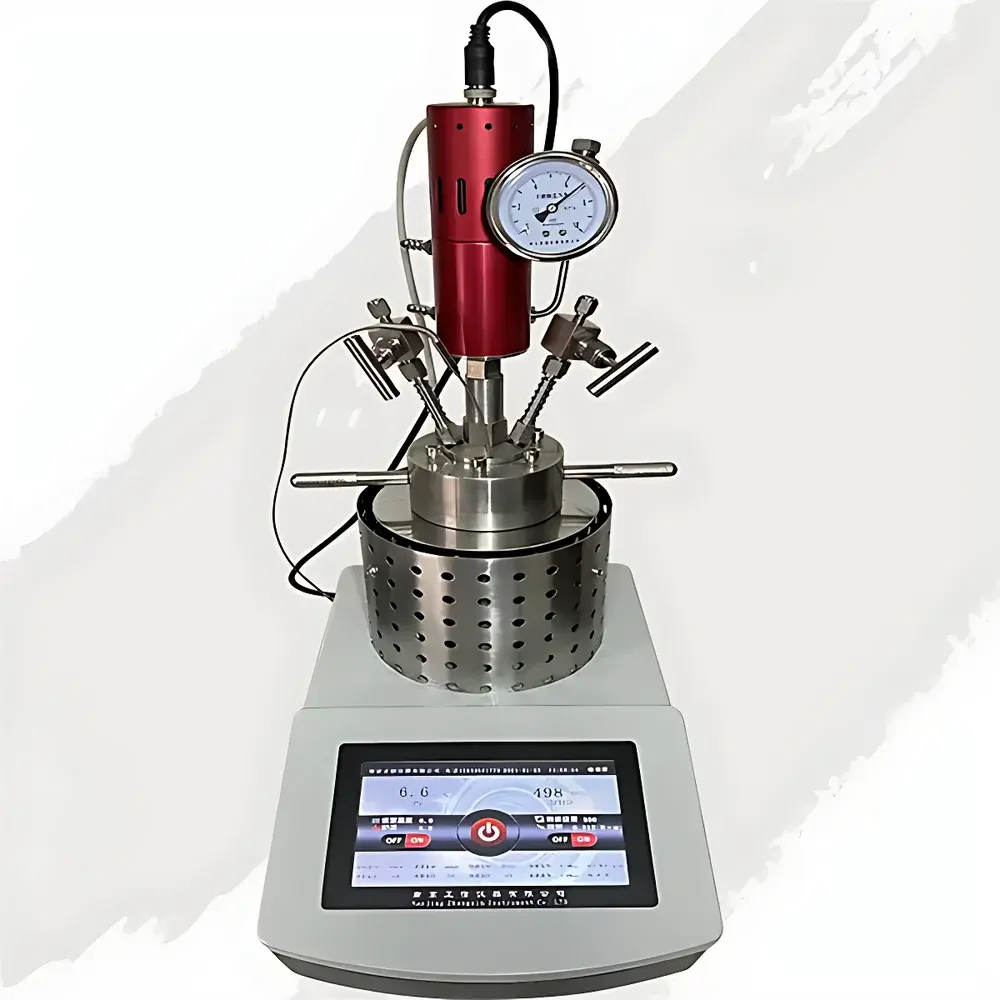
K-PFK-100ML Laboratory-Scale Hydrogenation High-Pressure Reactor with Corrosion-Resistant Construction
| Brand | ZXYIQI |
|---|---|
| Origin | Jiangsu, China |
| Manufacturer Type | Authorized Distributor |
| Origin Category | Domestic |
| Model | K-PFK-100ML |
| Price | USD 3,500 (FOB) |
| Usable Volume | 100 mL |
| Vessel Material | 316L Stainless Steel |
| Operating Pressure Range | 0–10 MPa |
| Vacuum Capability | Up to –0.1 MPa (absolute) |
| Sealing Type | Dual-option (Soft PTFE/Gasket or Hard Metal-to-Metal) |
| Temperature Range | Ambient to 300 °C (with optional upgrade to 450 °C) |
| Stirring Torque | Up to 20 N·m |
| Stirring Speed | 0–1000 rpm |
| Heating Power | 0–2500 W |
| Temperature Control | Dual-channel PID with programmable ramp/soak profiles |
| Temperature Accuracy | ±1 °C |
| Pressure Monitoring | Digital pressure transducer with 0.5% FS accuracy |
| Safety Systems | Overpressure rupture disc (Hastelloy C-276), overtemperature cutoff, audible/visual alarm, auto-shutdown interlock |
Overview
The K-PFK-100ML is a compact, benchtop hydrogenation high-pressure reactor engineered for safe, reproducible catalytic synthesis under elevated hydrogen partial pressures and controlled thermal conditions. Designed for laboratory-scale R&D in fine chemical, pharmaceutical, and materials science applications, it employs a robust 316L stainless steel pressure vessel with optional corrosion-resistant internal linings (PTFE, PPL, or quartz). Its core operating principle relies on sealed batch reaction kinetics—enabling precise control of H₂ partial pressure (up to 10 MPa), temperature (ambient to 300 °C standard), and mechanical agitation (0–1000 rpm) to facilitate heterogeneous catalysis, reductive amination, nitro-group reduction, and asymmetric hydrogenation. The reactor integrates ASME BPVC Section VIII Div. 1–compliant pressure boundary design principles, with full traceability of material certifications (EN 10204 3.1), weld procedure qualifications (WPQR), and non-destructive testing (100% dye penetrant inspection on critical joints).
Key Features
- Monolithic 316L stainless steel body forged from solid billet and machined in a single setup—eliminating weld seams in the pressure-retaining zone and enhancing fatigue resistance under cyclic pressurization.
- Dual sealing architecture: Standard soft-seal configuration uses reinforced PTFE gaskets with nickel alloy backing rings; optional hard-seal variant employs precision-lapped Hastelloy C-276 seat surfaces for ultra-high-purity or halogenated solvent applications.
- Intelligent dual-loop temperature control system with independent heating and cooling channel monitoring—prevents thermal overshoot during exothermic hydrogenation events via real-time cascade logic and dynamic power modulation.
- High-torque, brushless DC drive motor (SmCo permanent magnets) delivering up to 20 N·m at low speeds—capable of homogenizing viscous slurries, suspensions containing precipitated catalysts (e.g., Pd/C, Raney Ni), or magnetically responsive media without stalling.
- Modular heating module with embedded NiCr alloy resistive elements and aluminum nitride thermal interface—enables rapid thermal equilibration (<15 min from ambient to 200 °C) and seamless detachment for post-reaction quenching or inline sampling.
- Integrated safety architecture compliant with IEC 61508 SIL 2 functional safety requirements: pressure-triggered rupture disc (Hastelloy C-276, calibrated burst tolerance ±2%), redundant temperature sensors, and hardware-based emergency shutdown circuitry independent of controller firmware.
Sample Compatibility & Compliance
The K-PFK-100ML accommodates heterogeneous, homogeneous, and slurry-phase reactions involving corrosive reagents (e.g., HCl, HF, brominated solvents), air-sensitive catalysts, and thermally labile intermediates. Internal wetted surfaces support optional PTFE, PPL, or fused quartz linings—validated per ASTM D543 for chemical resistance across pH 0–14 and temperatures ≤260 °C. All pressure components conform to PED 2014/68/EU Annex I essential safety requirements. Documentation includes full Declaration of Conformity, material test reports (MTRs), and calibration certificates traceable to NIST standards. The system supports GLP-compliant operation with audit-trail-enabled data logging (time-stamped pressure/temperature/stir speed), meeting FDA 21 CFR Part 11 requirements when paired with validated software.
Software & Data Management
The reactor interfaces via RS485 Modbus RTU or optional Ethernet/IP with ZXYIQI’s ReactorControl Suite v3.2—a Windows-based application supporting ISO/IEC 17025-aligned data integrity protocols. Features include multi-step program scheduling (up to 20 segments), real-time trend visualization, automated CSV export with digital signature, and electronic signature workflows compliant with ALCOA+ principles. Raw sensor data (including thermocouple cold-junction compensation and pressure transducer linearity correction) is stored unaltered in encrypted SQLite databases with SHA-256 hash verification. Optional integration with LIMS platforms (e.g., LabWare, Thermo SampleManager) via HL7 or REST API ensures end-to-end sample traceability.
Applications
- Catalytic hydrogenation of unsaturated bonds (alkenes, alkynes, aromatics) using supported noble metal catalysts under controlled H₂ partial pressure.
- Hydrodeoxygenation (HDO) studies for bio-oil upgrading, requiring sulfur-resistant reactor internals and precise temperature ramping.
- High-pressure kinetic investigations of CO₂ hydrogenation to methanol or formic acid—leveraging accurate pressure decay analysis and isothermal hold stability.
- Screening of chiral catalysts in asymmetric synthesis where reproducibility of stirring hydrodynamics directly impacts enantioselectivity.
- Development of solid-state battery electrode precursors via solvothermal reduction under inert or reducing atmospheres.
- Method development for USP <1058> analytical instrument qualification (AIQ) of high-pressure reaction parameters in pharmaceutical process validation.
FAQ
What pressure and temperature ratings are certified for continuous operation?
Continuous rated operating conditions are 10 MPa at 300 °C. Short-term excursions to 12 MPa/350 °C are permitted for ≤30 minutes per cycle, provided all safety interlocks remain active.
Can the reactor be configured for corrosive halogenated solvents like chlorobenzene or HF?
Yes—specify the Hastelloy C-276 hard-seal option and PTFE-lined internal components. Valve stems and sampling ports should be upgraded to Alloy 825 for long-term HF exposure.
Is third-party calibration and IQ/OQ documentation available?
ZXYIQI provides factory IQ/OQ protocols (ASTM E2500-compliant) and offers on-site SAT by accredited metrology partners (ISO/IEC 17025 accredited). Calibration certificates include as-found/as-left data with uncertainty budgets.
How is gas introduction and venting managed for hydrogen service?
Standard configuration includes dual-stage stainless steel regulators (inlet/outlet), back-pressure regulator for H₂ partial pressure control, and catalytic recombiner-equipped vent line to eliminate explosive H₂/O₂ mixtures.
Does the system support automated sampling under pressure?
Yes—optional high-pressure liquid sampling valve (HP-LSV) with integrated septum-piercing needle and PTFE-coated plunger enables <1 mL representative sampling at full operating pressure without depressurization.



