
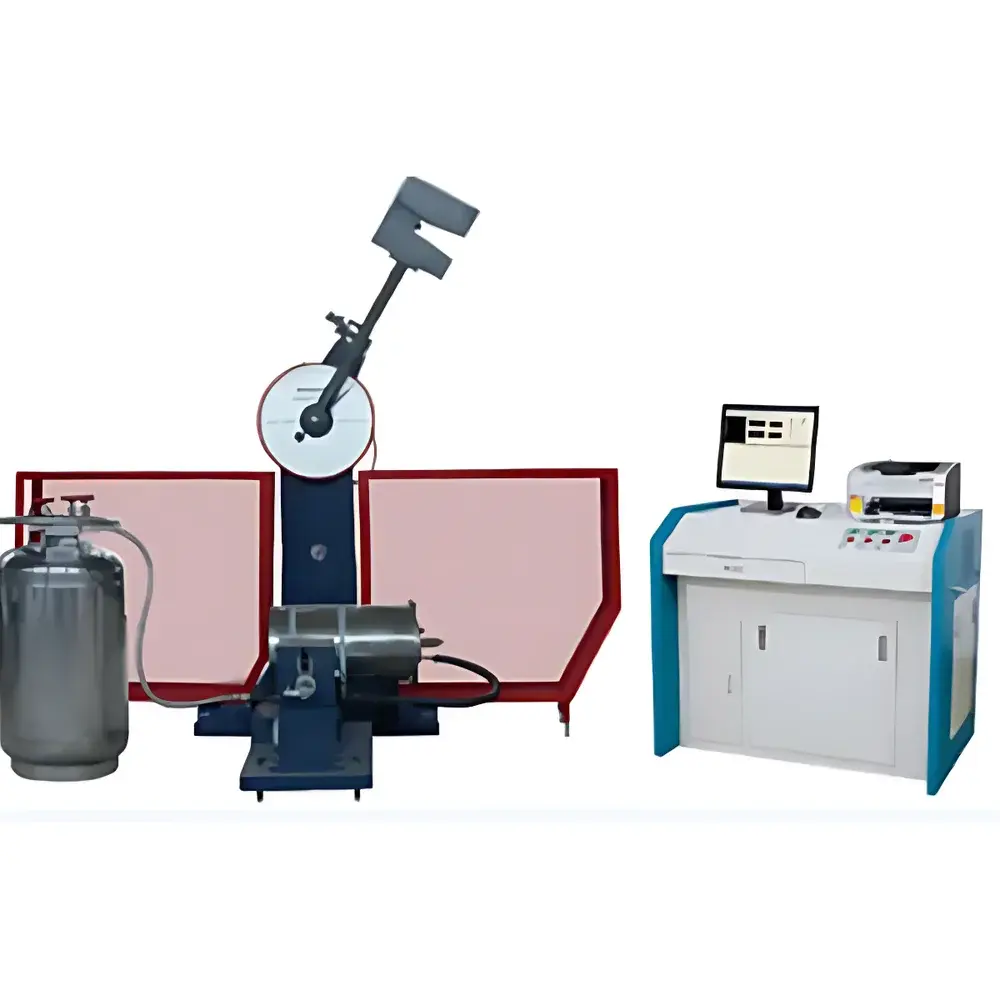
YANRUN JBDW-450C Computer-Controlled Cryogenic Charpy Impact Testing Machine
| Brand | YANRUN |
|---|---|
| Origin | Shanghai, China |
| Manufacturer Type | Direct Manufacturer |
| Country of Origin | China |
| Model | JBDW-450C |
| Instrument Type | Pendulum Impact Tester |
| Nominal Impact Energy | 450 J |
| Impact Velocity | 5.2 m/s |
| Temperature Range | –190 °C to +20 °C (–196 °C achievable with ≥99.99% liquid nitrogen) |
| Specimen Dimensions | 10 mm × 10 mm × 55 mm |
| Anvil Span | 40 mm |
| Hammer Blade Radius | R2–R2.5 mm |
| Hammer Thickness | 16 mm |
| Pendulum Arm Length | 800 mm |
| Pre-lift Angle | 150° |
| Temperature Stability | ±2 °C fluctuation, ≤3 °C gradient |
| Specimen Tray Capacity | 6 positions (4 uniformly cooled) |
| Refrigeration Method | Liquid Nitrogen Cooling |
| Net Weight | 880 kg |
| Power Supply | 3-phase AC 380 V ±10% |
| Overall Dimensions | 1600 mm × 850 mm × 1530 mm |
Overview
The YANRUN JBDW-450C is a fully computer-controlled cryogenic Charpy impact testing machine engineered for precise determination of metallic and polymeric material toughness across an extended low-temperature range—from ambient (+20 °C) down to –190 °C (extendable to –196 °C using high-purity liquid nitrogen). It operates on the classical pendulum impact principle defined in ISO 148-1, ASTM E23, and GB/T 229, where a calibrated pendulum strikes a notched specimen supported on standardized anvils, and the energy absorbed during fracture is calculated from the pendulum’s angular displacement. The system integrates real-time digital acquisition, automated specimen handling, and closed-loop liquid nitrogen temperature control—enabling repeatable, traceable, and GLP-compliant impact testing under stringent thermal conditions required for aerospace alloys, pipeline steels, cryogenic storage vessels, and nuclear-grade materials.
Key Features
- High-energy 450 J pendulum with precision-machined hammer (R2–R2.5 mm blade radius, 16 mm thickness) and verified kinetic energy calibration per ISO 148-2
- Integrated liquid nitrogen refrigeration system with dual-zone thermal chamber: six-position specimen tray (four actively uniform-cooled zones) and programmable ramp/soak profiles
- Automated specimen feeding and positioning mechanism with optical alignment sensors and mechanical centering fixtures
- Motor-driven pendulum lifting, automatic release, and safe return cycle—all synchronized with temperature stabilization status
- Rigid monolithic frame (880 kg net weight) with vibration-damped base and seismic-grade leveling hardware (adjustable shims and anchor bolts)
- Digital angular encoder and high-resolution光电 sensor for impact energy calculation with ≤0.5% relative error at full scale
- Comprehensive safety architecture: interlocked guarding, emergency stop circuitry, and fail-safe brake engagement upon abnormal motion detection
Sample Compatibility & Compliance
The JBDW-450C accommodates standard Charpy V-notch (CVN) and U-notch specimens measuring 10 mm × 10 mm × 55 mm, compliant with ISO 148-1, ASTM E23 Type A/B, and EN 10045-1 geometries. Optional adapters support subsize specimens (e.g., 7.5 mm or 5 mm square cross-sections) when referenced to validated correlation protocols. All thermal conditioning and impact procedures adhere to the environmental control requirements specified in ASTM E23 Annex A3 (low-temperature testing) and ISO 148-3 (temperature measurement uncertainty). The system supports audit-ready documentation for GMP/GLP environments, including electronic signatures, timestamped test logs, and raw encoder data export—fully compatible with FDA 21 CFR Part 11–compliant software validation frameworks.
Software & Data Management
Control and analysis are executed via dedicated Windows-based software running on an integrated Lenovo industrial PC. The application provides real-time temperature monitoring (with dual Pt100 sensors per zone), impact energy calculation, statistical reporting (mean, SD, CV%), and customizable certificate generation (PDF/CSV). Raw data—including pendulum angle vs. time, specimen temperature history, and trigger event timestamps—is stored in a structured SQLite database with immutable audit trails. Export formats include ASTM E23-compliant XML, ISO-standardized .IMP files, and Excel-compatible tables. Software updates and calibration certificates are version-controlled and digitally signed; remote diagnostics and firmware upgrades are supported via secure HTTPS channel.
Applications
This instrument serves critical quality assurance and R&D functions in sectors requiring low-temperature ductile-to-brittle transition temperature (DBTT) characterization: structural steel certification for Arctic offshore platforms; qualification of austenitic stainless steels and nickel-based superalloys in LNG infrastructure; validation of weld metal toughness in ASME Section IX welding procedure specifications; and material screening for spaceflight components exposed to cryogenic propellant environments. Its reproducibility (≤2% coefficient of variation across ten replicate tests at –100 °C) meets the repeatability criteria stipulated in ISO 5725-2 for certified reference material verification.
FAQ
What standards does the JBDW-450C comply with for low-temperature impact testing?
It conforms to ISO 148-1/-2/-3, ASTM E23, EN 10045-1, and GB/T 229, including Annexes covering specimen cooling, temperature measurement, and energy calibration.
Is liquid nitrogen consumption monitored or optimized during testing?
Yes—the system features mass-flow estimation via pressure decay modeling and includes configurable LN₂ refill alerts based on cumulative usage and ambient dew point.
Can the machine be integrated into a laboratory LIMS or MES environment?
Fully supported via OPC UA server interface and RESTful API endpoints for bidirectional data exchange, including test initiation, status polling, and result ingestion.
What maintenance intervals are recommended for the refrigeration subsystem?
Liquid nitrogen delivery lines require quarterly visual inspection; cold-stage O-rings should be replaced annually or after 500 thermal cycles below –150 °C.
Does the system provide traceability for calibration certificates?
All pendulum calibrations are performed using NIST-traceable reference hammers; temperature sensors are calibrated against accredited dry-block standards with documented uncertainty budgets.



