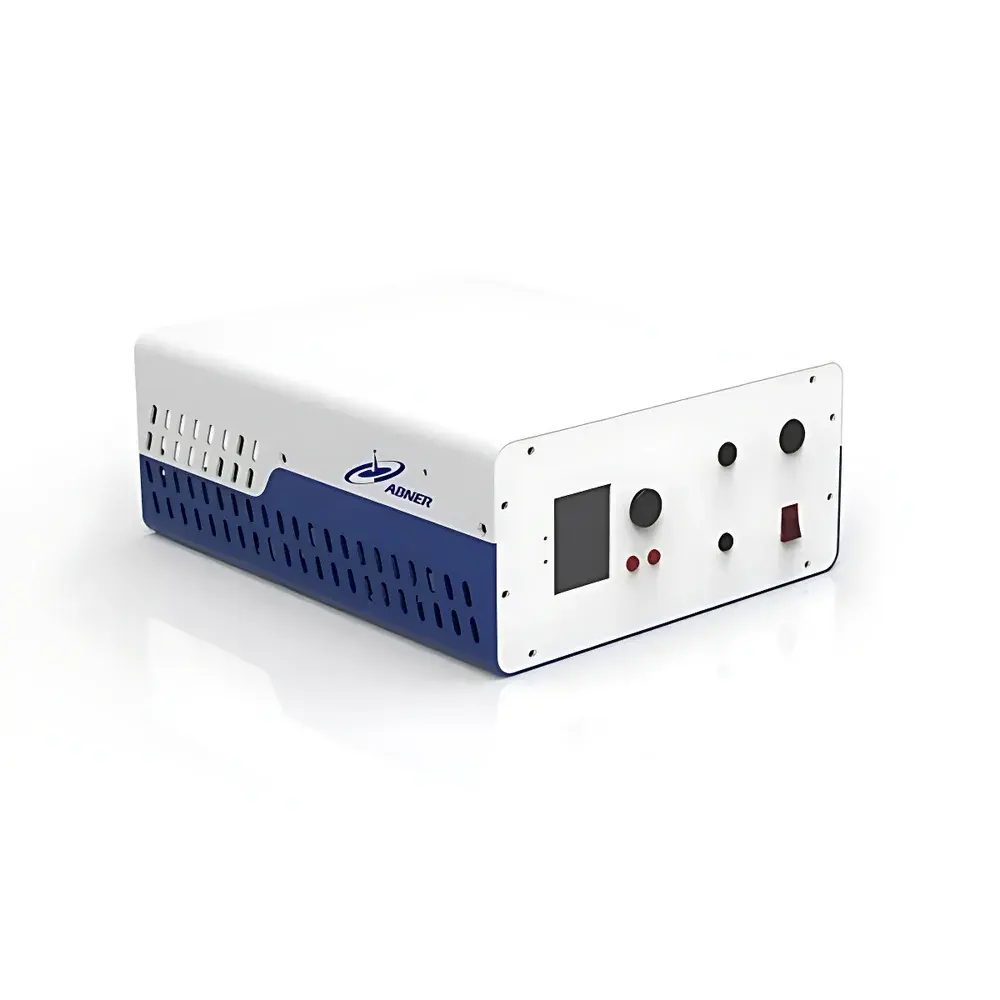
Abner ABN-MCE-001 Motion Control Chassis
| Key | Brand: Abner |
|---|---|
| Origin | Jiangsu, China |
| Model | ABN-MCE-001 |
| Enclosure Type | 19-inch Rack-Mountable / Desktop-Deployable Chassis |
| Axis Support | 2–16 axes (configurable) |
| Communication Interfaces | Ethernet, USB 2.0, RS-232/485, CAN 2.0B, EtherCAT (IEC 61158 Type 12), CANopen |
| Power Supply | Industrial-grade multi-output DC power module (±12 V, +5 V, +24 V) |
| Cooling | Forced-air or passive thermal management with optimized airflow path |
| IP Rating | IP20 (customizable to IP54/IP65 upon request) |
| Compliance | CE-marked, RoHS-compliant, EMC tested per EN 61000-6-2/6-4 |
Overview
The Abner ABN-MCE-001 Motion Control Chassis is an engineered hardware platform designed for deterministic, low-latency motion coordination in industrial automation, precision instrumentation, and research-grade mechatronic systems. Unlike generic enclosures, it functions as a purpose-built mechanical and electrical integration backbone—housing motion control cards, servo drives, I/O modules, and power distribution units within a thermally managed, EMI-controlled structural frame. Its architecture supports real-time deterministic communication protocols—including EtherCAT (with sub-microsecond jitter synchronization), CANopen, and RS-485-based fieldbus topologies—enabling precise trajectory planning, closed-loop position/velocity/torque control, and multi-axis coordination across diverse actuation modalities (stepper, brushed/brushless DC, and linear servo motors). The chassis serves not as a standalone controller, but as the physical substrate for deploying PC-based, embedded Linux, or FPGA-accelerated motion control architectures compliant with IEC 61131-3 programming environments.
Key Features
- Modular 19-inch rack-mount or desktop-integrated form factor, supporting DIN-rail mounting, front-accessible cable management, and rear-panel breakout for system-level integration.
- Configurable axis capacity from 2 to 16 axes, scalable via plug-in motion control modules compatible with third-party vendor cards (e.g., NI, Beckhoff, Delta Tau, or custom FPGA-based controllers).
- Multi-protocol connectivity: native support for EtherCAT (IEC 61158-12), CAN 2.0B, RS-232/485 serial, USB 2.0 host/device, and Gigabit Ethernet—enabling interoperability with PLCs, HMIs, vision systems, and host PCs running LabVIEW, MATLAB/Simulink, or Python-based control frameworks.
- Industrial-grade power architecture featuring redundant overvoltage/overcurrent protection, ripple-suppressed DC outputs (+24 V, ±12 V, +5 V), and thermal foldback circuitry to sustain continuous operation under variable load conditions.
- EMC-optimized mechanical design: galvanized steel enclosure with conductive gasketing, internal grounding busbar, shielded cable entry points, and compartmentalized module zones to minimize cross-talk between analog feedback lines and high-current motor drive paths.
- Thermal management system with intelligent fan control (PWM-driven), optional heat-sink integration, and passive convection pathways—validated for ambient operating temperatures ranging from 0 °C to 50 °C (IEC 60068-2-1/2).
Sample Compatibility & Compliance
The ABN-MCE-001 accommodates a broad spectrum of motion components and environmental configurations. It interfaces directly with incremental/absolute optical encoders (TTL, HTL, EnDat 2.2), resolvers, Hall-effect sensors, and SSI-based feedback devices. Mechanical compatibility extends to NEMA 17–34 stepper motors, BLDC servos with integrated drivers, and linear stage actuators requiring ±10 V analog command inputs or digital pulse/direction signals. From a regulatory standpoint, the chassis meets CE conformity requirements under the Low Voltage Directive (2014/35/EU) and Electromagnetic Compatibility Directive (2014/30/EU). It is RoHS 3 (2015/863/EU) compliant and undergoes conducted/radiated emissions testing per EN 55011 Class A and immunity validation per EN 61000-4-2/3/4/6. While not certified for hazardous locations, optional conformal coating and IP54-rated front panels are available for cleanroom or semi-industrial lab environments.
Software & Data Management
The chassis itself is firmware-agnostic; however, its hardware abstraction layer enables seamless integration with industry-standard motion software ecosystems. Users deploy control logic using IEC 61131-3-compliant IDEs (e.g., TwinCAT, CODESYS, or ISaGRAF), MATLAB Real-Time Workshop, or open-source frameworks such as ROS 2 (via EtherCAT master nodes like SOEM or IgH). All communication interfaces support standard data logging protocols—including OPC UA (IEC 62541) for time-stamped axis status, encoder counts, error flags, and thermal sensor readings—enabling traceable audit trails required under GLP and GMP-aligned workflows. Optional firmware extensions provide built-in data buffering, non-volatile fault logging, and secure boot verification to meet baseline cybersecurity expectations outlined in IEC 62443-3-3.
Applications
- Automated semiconductor handling: wafer probers, mask aligners, and pick-and-place platforms requiring sub-micron repeatability and synchronized multi-axis interpolation.
- Precision optical instrumentation: motorized filter wheels, automated focus stages in confocal microscopes, and beam steering mirrors in adaptive optics testbeds.
- Academic and R&D motion labs: modular experimental rigs for kinematic modeling, haptic interface development, and real-time control algorithm validation.
- Medical device manufacturing: vision-guided dispensing systems, syringe pump controllers, and robotic end-effector positioning in diagnostic analyzers.
- Microfabrication infrastructure: laser direct-write systems, nanoimprint lithography stages, and AFM/STM scanner controllers where mechanical rigidity and thermal stability are critical.
FAQ
Is the ABN-MCE-001 certified for use in FDA-regulated medical device production?
The chassis itself is not FDA-cleared; however, it is routinely deployed in Class II medical equipment as a subsystem component. Customers integrating it into final devices must perform full system-level verification per ISO 13485 and IEC 62304, including risk analysis for motion-related hazards.
Can I install third-party motion control cards without modification?
Yes—standard variants accept half-length PCIe, PCI, or PMC form-factor cards. Custom backplane layouts are available for proprietary card geometries or high-density I/O expansion.
Does Abner provide technical documentation for system-level EMC validation?
Full EMC test reports (per EN 55011 and EN 61000-4 series), mechanical drawings (STEP/IGES), and pinout schematics for all interface connectors are supplied under NDA upon order confirmation.
What is the mean time between failures (MTBF) under continuous operation?
Based on accelerated life testing and component derating analysis, the chassis achieves ≥100,000 hours MTBF at 40 °C ambient, assuming proper ventilation and nominal load conditions.
Is vacuum-compatible or cryogenic variant available?
Yes—Abner offers MC-Custom derivatives with non-outgassing materials (e.g., stainless steel fasteners, silicone-free gaskets), low-temperature-rated capacitors, and feedthrough connectors rated for UHV (<1×10⁻⁹ mbar) and operation down to –40 °C.
Related Products