
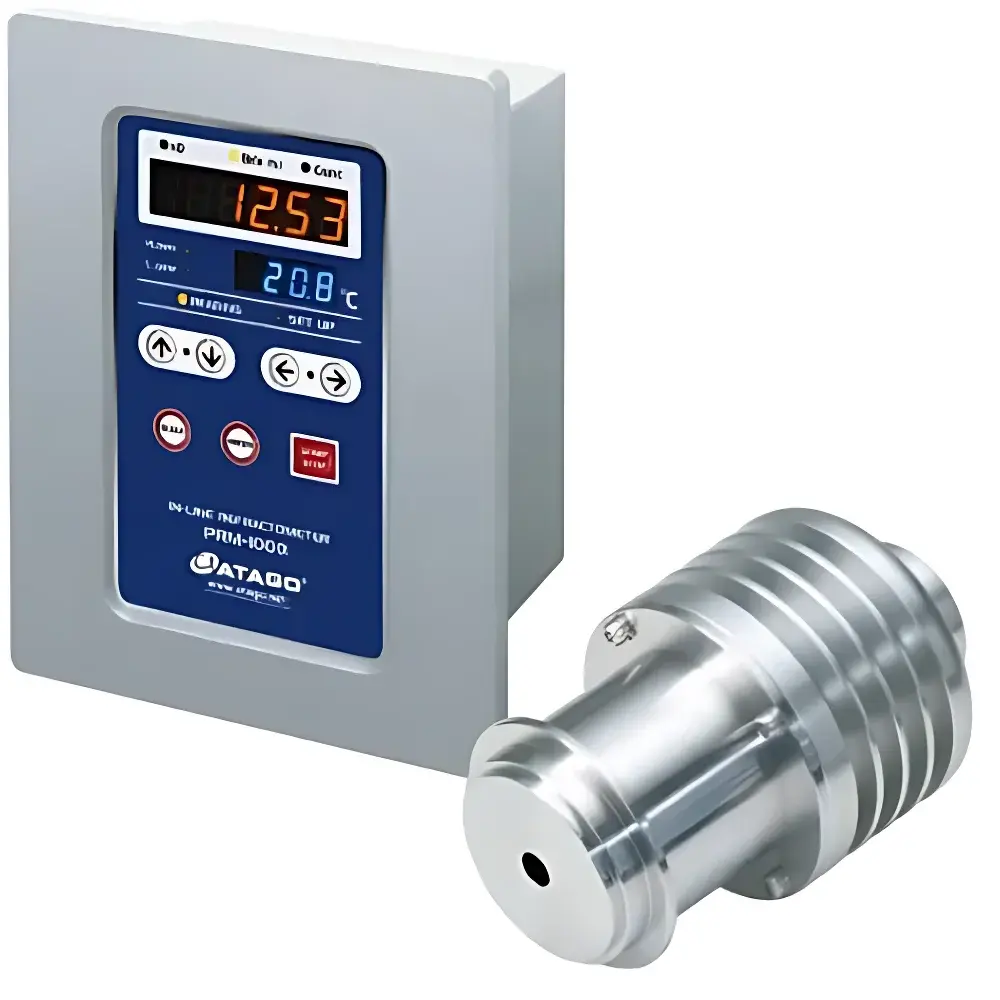
ATAGO PRM-100α DX High-Precision In-Line Refractometer
| Brand | ATAGO |
|---|---|
| Origin | Japan |
| Model | PRM-100α DX |
| Measurement Range | Refractive Index (nD): 1.32000–1.55700 |
| Brix | 0.00–100.00% |
| Accuracy | Refractive Index: ±0.00010 |
| Brix | ±0.05% |
| Temperature Range | −5.0 to 160.0 °C |
| Auto-Temperature Compensation (ATC) | 5–100 °C |
| Output | DC 4–20 mA, RS-232C |
| Display | 7-segment LED |
| IP Rating | IP67 |
| Pressure Rating | 0.98 MPa (10 kgf/cm²) |
| Wetted Materials | SUS316L sample chamber, Sapphire prism |
| Power | AC 100–240 V, 50–60 Hz |
| Dimensions (Sensor) | 10.8 × 17.26 × 10.8 cm, 2.6 kg |
| Dimensions (Display Unit) | 19.2 × 10 × 24 cm, 3.3 kg |
| Cable Length | Standard 15 m (extendable to 200 m) |
Overview
The ATAGO PRM-100α DX is a high-precision in-line refractometer engineered for continuous, real-time measurement of refractive index (nD) and concentration (expressed as Brix %) in liquid process streams. It operates on the principle of total internal reflection at the interface between a sapphire prism and the flowing sample—where changes in refractive index directly correlate with solute concentration under controlled thermal conditions. Unlike benchtop or handheld units, the PRM-100α DX integrates directly into production pipelines without flow interruption, enabling non-invasive, maintenance-free monitoring across demanding industrial environments. Its optical architecture is calibrated to ISO 21542-compliant reference standards and traceable to NIST-traceable sucrose solutions, ensuring metrological integrity across its full Brix range (0.00–100.00%). Designed for integration into validated manufacturing systems, it supports critical quality attributes (CQAs) defined in ICH Q5, Q7, and USP , particularly where concentration consistency governs product stability, viscosity, osmolality, or reaction stoichiometry.
Key Features
- High-resolution optical detection with sapphire prism (Vickers hardness ≥2000 HV) and SUS316L wetted surfaces—resistant to corrosion, abrasion, and high-pressure cleaning cycles.
- Real-time measurement interval of approximately 1 second, synchronized with analog (4–20 mA) and digital (RS-232C) outputs for PLC/SCADA integration.
- Automatic temperature compensation (ATC) across 5–100 °C, minimizing thermal drift using integrated Pt100 sensor and proprietary algorithm per ISO 21542 Annex C.
- IP67-rated sensor housing and 0.98 MPa pressure rating—certified for direct mounting on sanitary (3A), DIN 11851, or ASME BPE-compliant piping systems.
- Dual-resolution display mode: default resolution (nD: 0.00001; Brix: 0.01%) or user-selectable coarse mode (nD: 0.0001; Brix: 0.1%) via front-panel configuration.
- No moving parts, no consumables, and no reagent requirements—designed for >10-year operational life in continuous 24/7 operation.
Sample Compatibility & Compliance
The PRM-100α DX is compatible with aqueous and polar organic solutions—including DMSO, ethanol/water mixtures, glycerol, surfactant formulations, and acidic or alkaline process streams (pH 1–13). It excludes opaque, highly viscous (>10,000 cP), or particulate-laden fluids unless pre-filtered to ≤5 µm. Regulatory alignment includes compliance with FDA 21 CFR Part 11 (when paired with compliant data acquisition software), EU GMP Annex 11 (data integrity controls), and ISO/IEC 17025 calibration traceability. Its ATC function satisfies ASTM D1218 and ISO 21542 requirements for temperature-corrected refractive index reporting. Validation documentation (IQ/OQ/PQ protocols) and factory calibration certificates (including uncertainty budgets per GUM) are available upon request.
Software & Data Management
While the PRM-100α DX operates autonomously via its embedded microcontroller, its RS-232C interface enables bidirectional communication with third-party SCADA, MES, or LIMS platforms. ASCII-based command protocol supports real-time polling, configuration updates, and alarm threshold setting. When integrated with ATAGO’s optional PC software (RefractoLink™), users gain audit-trail-enabled data logging, trend visualization, statistical process control (SPC) charting (X̄-R, Cpk), and export to CSV/PDF formats compliant with 21 CFR Part 11 electronic record requirements. All timestamps are synchronized to NTP servers; data retention intervals are configurable from 1 second to 24 hours.
Applications
- Pharmaceutical manufacturing: Real-time monitoring of API crystallization mother liquors, buffer dilution accuracy, and excipient solution concentration (e.g., PEG, mannitol) during lyophilization cycle development.
- Food & beverage processing: Continuous control of sugar content in fruit juice blending, syrup concentration in soft drink formulation, and alcohol-by-volume estimation in fermented beverages via empirical Brix–ethanol correlation models.
- Chemical synthesis: In-situ tracking of reaction progress in condensation polymerizations (e.g., polyurethane prepolymer concentration), solvent recovery efficiency, and emulsion stability indices.
- Clean-in-place (CIP) validation: Quantitative verification of caustic/acid rinse concentrations and final water rinse purity (conductivity + refractive index dual-parameter confirmation).
- Biotechnology: Monitoring of cell culture media osmolality proxies, harvest clarification endpoint detection, and chromatography buffer composition verification pre-load.
FAQ
Does the PRM-100α DX require periodic recalibration?
Yes—annual calibration against certified reference materials (CRM) is recommended per ISO/IEC 17025 and internal quality system requirements. Factory calibration includes uncertainty analysis per GUM (Guide to the Expression of Uncertainty in Measurement).
Can it measure non-aqueous solvents like DMSO or acetone?
Yes—provided the solvent is optically transparent and falls within the nD range (1.32000–1.55700). For DMSO specifically, a custom Brix-to-concentration conversion table can be loaded via RS-232C.
Is the sensor suitable for sterile applications?
The SUS316L/sapphire construction meets ASME BPE surface finish (Ra ≤ 0.4 µm) and supports SIP (steam-in-place) up to 135 °C when installed with appropriate gasketing and thermal expansion allowance.
How is temperature uniformity ensured across the prism-sample interface?
The integrated Pt100 sensor is positioned within 0.5 mm of the prism surface, and thermal mass optimization ensures ΔT < 0.1 °C between sensor and optical interface during dynamic flow conditions.
What cybersecurity safeguards apply to the RS-232C interface?
The interface is electrically isolated (2.5 kV RMS), lacks network stack or web server functionality, and requires physical serial connection—rendering it inherently resistant to remote cyber intrusion per IEC 62443-3-3 Level 1 requirements.




