
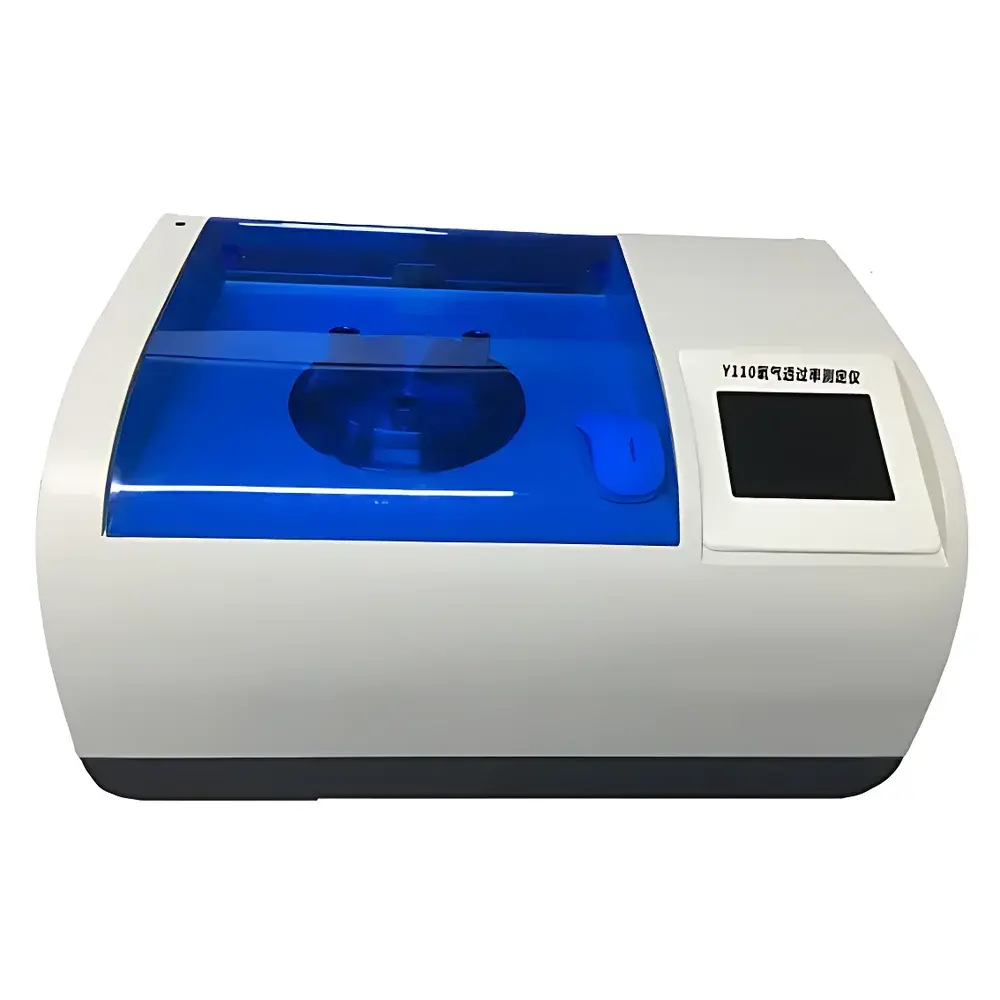
GBPI Y110 Oxygen Transmission Rate (OTR) Analyzer
| Brand | GBPI |
|---|---|
| Origin | Guangdong, China |
| Manufacturer Type | OEM/ODM Manufacturer |
| Regional Category | Domestic (China) |
| Model | Y110-aa |
| Price Range | USD 14,000 – 70,000 |
Overview
The GBPI Y110 Oxygen Transmission Rate (OTR) Analyzer is a precision laboratory instrument engineered for quantitative determination of oxygen permeation through polymeric films, laminates, foils, rigid containers, and functional barrier materials. It operates on the coulometric sensor principle — a gravimetrically traceable, electrochemical detection method widely accepted in global regulatory and industrial standards. In this configuration, a test specimen is clamped between two isolated chambers: the upstream side is purged with high-purity oxygen (≥99.999%), while the downstream side is continuously swept with ultra-high-purity nitrogen (≤1 ppm O₂). Oxygen molecules permeating across the sample are carried by the nitrogen carrier gas to a solid-state coulometric oxygen sensor, where oxygen concentration is measured amperometrically. The instrument calculates OTR in real time using Fick’s first law of diffusion, normalized to standard conditions (23 °C, 0% RH unless otherwise specified), delivering results in cm³/m²·24 h and ppm — fully compliant with ISO 15105-2, ASTM D3985, ASTM F1307, ASTM F1927, GB/T 19789–2005, and YBB00082003–2015.
Key Features
- High-resolution OTR measurement range: 0.02–16,500 cm³/m²·24 h (extendable to 260,000 cm³/m²·24 h via optional large-area mask kit)
- Measurement resolution: 0.001 cm³/m²·24 h — enabling reliable quantification of ultra-high-barrier materials including aluminum foil and SiOₓ-coated PET
- Precise environmental control: temperature regulated from 15–45 °C (±0.1 °C stability); relative humidity from 0–90% RH (±1% RH accuracy) using dual-stream dry/wet gas mixing
- Dedicated container testing mode: supports bottles, pouches, trays, and cups via integrated flow-path adapters and internal N₂ circulation
- ARM-based embedded control architecture: enables standalone operation without PC dependency; full test execution, data logging, and real-time curve visualization on built-in LCD interface
- GMP-aligned software architecture: user role management (Administrator, Operator, Viewer), audit trail (system, method, run-level), electronic signatures, and 21 CFR Part 11–compatible data integrity controls
- Modular hardware design: field-replaceable coulometric sensor with over-range protection; quick-swap sample holders; standardized 1/8″ VCR fittings and Φ3 mm pneumatic tubing interfaces
Sample Compatibility & Compliance
The Y110 accommodates flat specimens up to Φ100 mm and ≤3 mm thickness, with standard test area of 50.24 cm² (adjustable down to 0.785 cm² using mini-test fixtures). It validates OTR performance across diverse material classes: flexible packaging (BOPP, PE, EVOH laminates), metallized films (AlOx, SiOx), pharmaceutical blister foils, medical device pouches, solar backsheet substrates, OLED encapsulation films, and hydrogel-based transdermal patches. All measurements adhere to internationally recognized test protocols — including ISO 15105-2 (differential pressure method), ASTM D3985 (coulometric sensor), ASTM F1307 (container testing), and Chinese pharmacopoeial standard YBB00082003–2015. GBPI holds CNAS-accredited calibration capability and supplies certified reference materials (CRM) traceable to NIM (National Institute of Metrology, China), with GBW(E)130497/8 national standard substance certification for OTR instrumentation.
Software & Data Management
The GBPI OTR Control Suite is a Windows-native application designed for GLP/GMP environments. It supports customizable test methods, multi-step environmental ramping (T/RH profiles), automatic endpoint detection, and real-time overlay of OTR, O₂ concentration, temperature, and humidity curves. All data are stored in an encrypted local SQLite database with immutable timestamps and user attribution. Reports are auto-generated in PDF and Office-compatible formats (XLSX, DOCX), including metadata such as instrument ID, operator, calibration status, environmental logs, and uncertainty estimates per GUM (Guide to the Expression of Uncertainty in Measurement). Audit trails record every action — method edits, result overrides, calibration events, and user logins — ensuring full compliance with FDA 21 CFR Part 11 and EU Annex 11 requirements.
Applications
The Y110 serves critical quality assurance functions across regulated and industrial sectors: shelf-life prediction modeling for food and pharmaceutical packaging; validation of cold-chain barrier integrity in biologics vials; qualification of moisture/oxygen dual-barrier films for flexible electronics; R&D screening of novel nanocomposite coatings; stability testing of ophthalmic lenses and wound dressings; and regulatory submission support for USP , EP 3.2.1, and ICH Q5C. Its adaptability to both flat and 3D geometries makes it indispensable for packaging engineers evaluating seal integrity, thermoforming effects, and post-fill aging behavior under accelerated conditions.
FAQ
What calibration standards are supported?
The Y110 accepts both certified reference films (e.g., GBPI CRM-OTR-01, traceable to NIM) and certified reference gases (O₂-in-N₂ blends at known concentrations) for dual-mode verification.
Can the instrument perform simultaneous T/RH ramping during a test?
Yes — the embedded ARM controller supports programmable multi-segment environmental profiles, allowing dynamic adjustment of temperature and humidity during OTR acquisition.
Is container testing performed under vacuum or positive pressure?
Container mode uses positive-pressure nitrogen purge inside the vessel, with ambient or controlled O₂ environment externally — consistent with ASTM F1307 and ISO 15105-2 Annex C.
Does the software support LIMS integration?
Yes — the OTR Control Suite provides configurable ODBC and REST API endpoints for bidirectional data exchange with major LIMS platforms (e.g., LabWare, Thermo Fisher SampleManager, STARLIMS).
What is the recommended maintenance interval for the coulometric sensor?
Under typical usage (≤8 hrs/day), sensor recalibration is advised every 90 days; full replacement is recommended after 18 months or 5,000 test cycles — documented in the instrument’s service log.





