
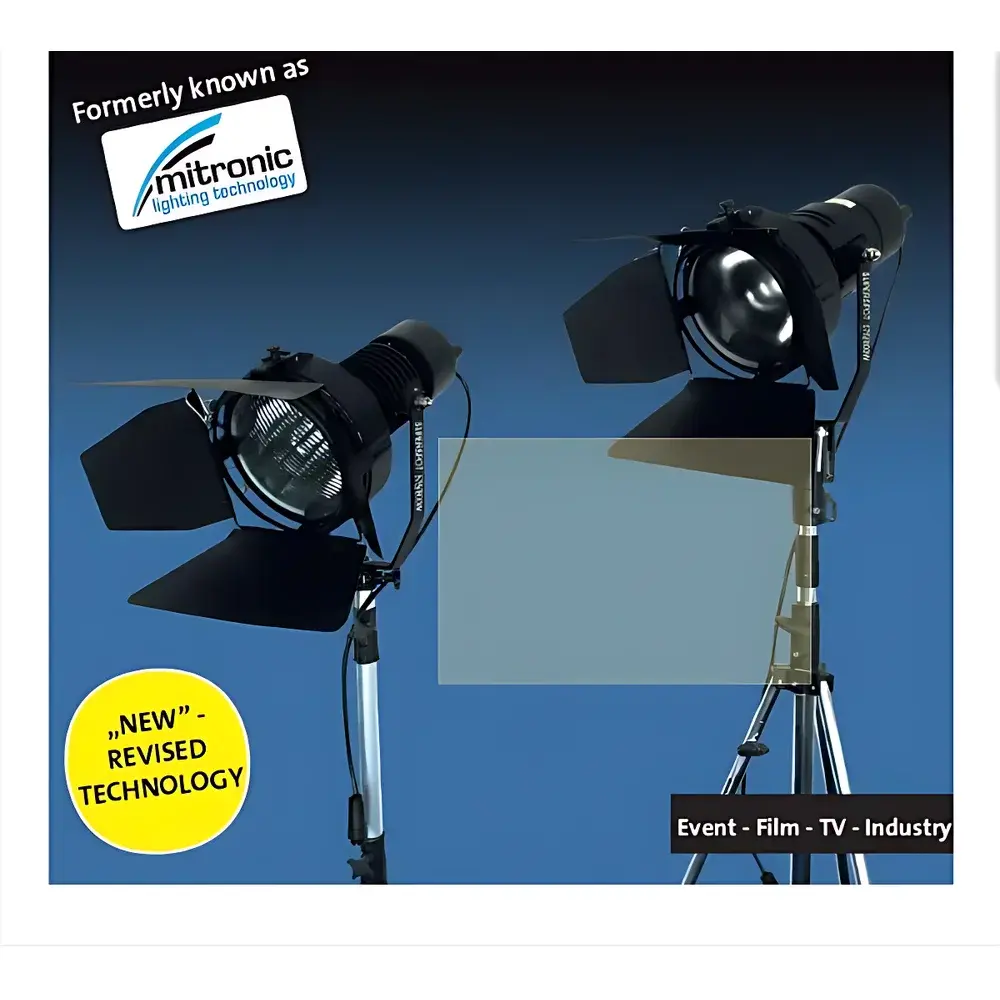
Superspot 575/800 W High-Intensity HMI Spotlight System by Hönle
| Brand | Hönle |
|---|---|
| Origin | Germany |
| Model | Superspot 575/800 W |
| Lamp Types | HMI 575 W / HR and HMI 800 W / HR |
| Reflector | Precision Parabolic Aluminum |
| Cooling | Patented Lector Active Cooling System |
| Housing | Three-Part Cast Aluminum with Thermal Decoupling Ignition |
| Socket | G22 |
| Beam Shaping | 8 Interchangeable Light Spread Filters |
| Surface Finish | Heat-Resistant Black or Anodized Aluminum Powder Coating |
| Dimensions | 320 × 230 mm (L × W), Lens Diameter: 205 mm |
| Weight | Approx. 6.5 kg |
Overview
The Superspot 575/800 W is a high-intensity, continuous-spectrum HMI (Hydrargyrum Medium-Arc Iodide) spotlight system engineered by Hönle—a German manufacturer with decades of expertise in UV and visible-light irradiation technology. Designed for demanding industrial, scientific, and calibration applications requiring stable, high-luminance illumination, the system operates on the principle of arc discharge within a quartz envelope filled with mercury and metal halide additives. Its optical architecture centers on a precision-machined parabolic reflector that delivers collimated, high-radiance output with minimal divergence—critical for photometric standardization, accelerated aging tests, solar simulation pre-screening, and optical sensor characterization. Unlike conventional halogen or LED spotlights, the Superspot leverages the broad spectral continuity of HMI sources (350–800 nm), enabling spectrally uniform irradiance across UV-A, visible, and near-IR bands without discrete peaks or gaps. The unit is not a standalone lamp but a fully integrated optical engine—comprising ignition circuitry, thermal management, mechanical beam control, and robust mechanical housing—optimized for long-term radiometric stability under continuous duty cycles.
Key Features
- Three-part cast aluminum housing with thermally decoupled ignition module, minimizing heat transfer to sensitive electronics and ensuring consistent cold-start performance.
- G22 base socket compliant with international lamp standards, supporting both HMI 575 W/HR and HMI 800 W/HR lamps interchangeably without hardware modification.
- Patented Lector active cooling system: a closed-loop, low-noise air circulation path integrated into the rear chassis, maintaining junction temperatures below critical thresholds during extended operation.
- Eight precision-machined light spread filters—each calibrated for defined beam angles (10°, 15°, 25°, 35°, 50°, 70°, 90°, and flood)—enabling reproducible irradiance profiles across target surfaces up to 2 m distance.
- Front-access lens assembly with 205 mm aperture diameter and anti-reflective coated borosilicate glass, optimized for >92% transmittance in the 320–780 nm range.
- Double-pole safety disconnect activated automatically upon lamp access panel opening—meeting EN 60598-1 and IEC 61000-6-3 requirements for operator protection and EMC immunity.
- Low-socket-temperature design (<45 °C at ambient 25 °C), facilitating integration into enclosed test chambers or robotic staging platforms without auxiliary ventilation.
Sample Compatibility & Compliance
The Superspot 575/800 W is compatible with standard HMI lamps conforming to IEC 62471 (Photobiological Safety) and ANSI C78.1001 (HMI Lamp Specifications). Its spectral output has been validated per CIE S 023/E:2013 for use in non-imaging optical testing environments. The system supports ISO 4892-2 (Plastics — Exposure to laboratory light sources) and ASTM G155 (Xenon-Arc Exposure Apparatus) as a high-fidelity alternative for preliminary spectral matching and irradiance mapping. All electrical components meet CE marking requirements under the Low Voltage Directive (2014/35/EU) and RoHS 3 (2015/863/EU). Mechanical construction adheres to IP20 ingress protection and meets vibration resistance Class M2 per IEC 60068-2-6 for stationary lab and factory-floor deployment.
Software & Data Management
While the Superspot 575/800 W operates as a standalone analog-controlled illuminator, it is fully compatible with third-party radiometric monitoring systems via its 0–10 V analog dimming interface and TTL-compatible status output. When integrated with calibrated spectroradiometers (e.g., Instrument Systems CAS 140D or Gamma Scientific GS-1220), users can log time-resolved irradiance (W/m²/nm), chromaticity coordinates (CIE 1931), and CCT drift over lamp lifetime. Audit trails—including lamp runtime hours, ignition count, and thermal event logs—can be captured through optional RS-485 Modbus RTU modules (available as field-upgrade kits). Data export complies with ASTM E2912-22 for irradiance reporting and supports GLP-compliant metadata tagging when used with validated LIMS platforms.
Applications
- Radiometric calibration of imaging sensors, photodiodes, and spectrometers in metrology labs.
- Pre-screening and spectral validation of solar simulators prior to Class AAA certification (IEC 60904-9).
- Accelerated photochemical degradation studies of polymers, coatings, and OLED encapsulants under controlled UV-vis stress.
- Optical alignment and focus verification in precision optics assembly lines.
- Reference illumination source for ISO/IEC 17025-accredited photometric laboratories performing luminous intensity and illuminance intercomparisons.
- UV-curable adhesive and ink process development where broadband visible activation complements primary UV curing stages.
FAQ
What lamp types are supported?
HMI 575 W/HR and HMI 800 W/HR lamps with G22 base, meeting IEC 62471 Risk Group 2 (RG2) classification.
Is remote dimming available?
Yes—via 0–10 V analog input; full power range is linearly controllable from 10% to 100% without spectral shift.
How often does the lamp require replacement?
Rated average life is 750 hours at nominal power; lumen maintenance remains ≥85% at 500 hours per IEC 61195.
Can the unit be mounted vertically or inverted?
Yes—mechanical design supports all orientations; however, horizontal mounting is recommended for optimal thermal dissipation and lamp arc stability.
Does the system include a power supply?
No—the Superspot requires an external, stabilized HMI ballast (e.g., Hönle PowerBox series) rated for 575 W or 800 W, supplied separately per application voltage and regulatory region.






