
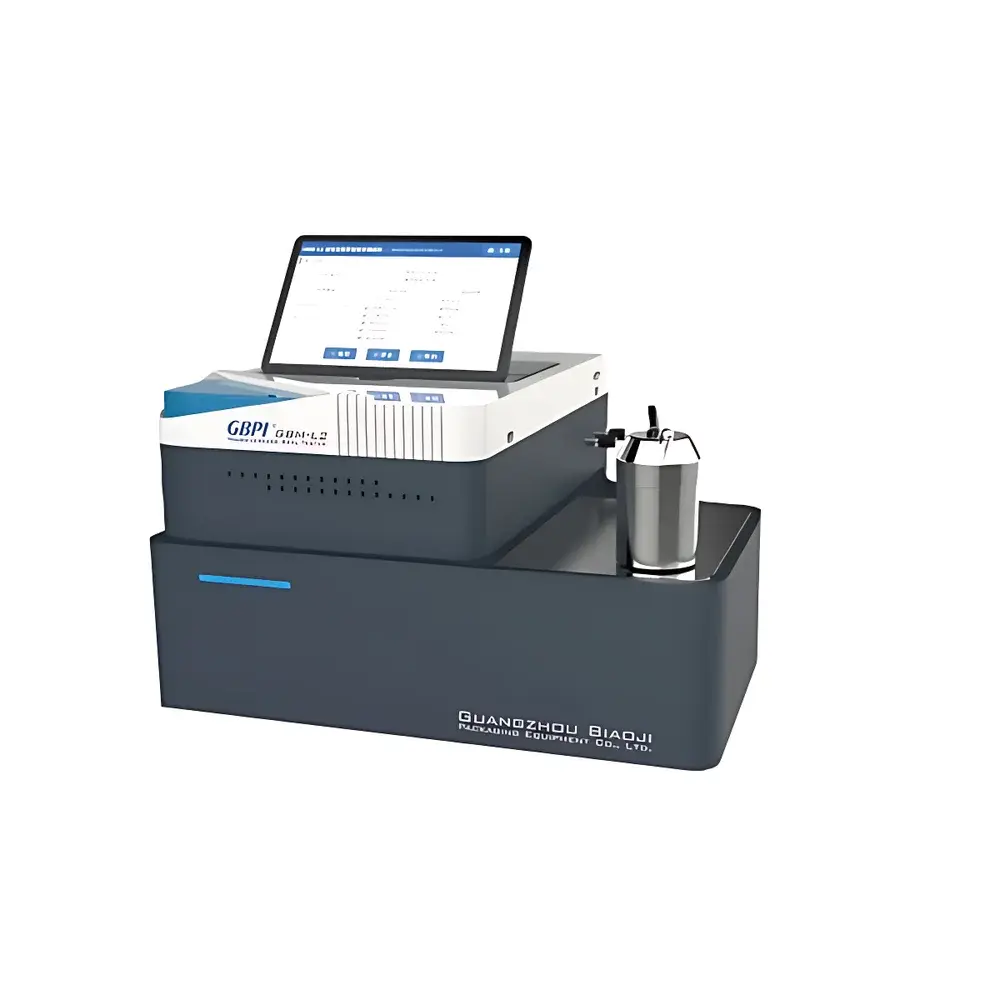
GBPI GBM-L2M Dual-Pressure Micro-Leak Integrity Tester for Pre-Filled Syringes and Ophthalmic Bottles
| Brand | GBPI |
|---|---|
| Origin | Guangdong, China |
| Manufacturer Type | Direct Manufacturer |
| Country of Origin | China |
| Model | GBM-L2M |
| Price | USD 42,000 (FOB Guangzhou) |
| Absolute Pressure Range | 0–300 kPa |
| Differential Pressure Range | −2 to +2 kPa |
| Detection Sensitivity | 1–3 µm |
| Equilibration/Test Time | 1–3600 s |
| Vacuum Purge Time | 1–3600 s |
| Set Flow Rate | 0–3 mL/min |
| Sensor Configuration | Dual-sensor (absolute + differential pressure) / Dual-loop testing system |
| Chamber | Custom-engineered per sample geometry |
| Test Principles | Vacuum Decay Method & Pressure Decay Method |
| Compliance Standards | ASTM F2338-2009(2013), YY/T 0681.18-2020, USP <1207.2>, ASTM F2095 |
| Dimensions (W×D×H) | 495 × 455 × 280 mm |
| Ambient Temp | 20–30 °C |
| Relative Humidity | ≤80% RH (non-condensing) |
| Power Supply | AC 220 V, 50 Hz |
Overview
The GBPI GBM-L2M Dual-Pressure Micro-Leak Integrity Tester is an engineered solution for deterministic, non-destructive container closure integrity testing (CCIT) of sterile pharmaceutical packaging. It operates on two complementary physical principles—vacuum decay and pressure decay—enabling reliable detection of micro-leaks across a broad spectrum of rigid and semi-rigid primary containers, including pre-filled syringes, ophthalmic bottles, lyophilized vials, ampoules, HDPE bottles, IV bags, and flexible pouches. Unlike single-mode systems, the GBM-L2M employs synchronized dual-sensor architecture: a high-stability absolute pressure transducer (0–300 kPa, ±0.1% FS) and a high-resolution differential pressure sensor (±2 kPa, ±0.1% FS), enabling simultaneous monitoring of chamber baseline drift and transient leak-induced pressure differentials. This dual-path measurement strategy eliminates ambiguity in vacuum-sensitive configurations—such as freeze-dried products under headspace vacuum—where conventional vacuum decay methods risk false-negative outcomes due to internal pressure equilibration masking leakage signals.
Key Features
- Dual-pressure methodology with automatic mode selection: instrument autonomously switches between vacuum decay and pressure decay protocols based on package headspace condition and regulatory validation requirements.
- High-fidelity sensing architecture: dual-loop pneumatic circuitry isolates reference and test paths, minimizing cross-talk and thermal drift; calibrated against NIST-traceable standards.
- Sub-micron sensitivity: validated detection capability down to 1 µm equivalent leak orifice diameter under ISO 15142-1 conditions, with repeatability ≤0.8% RSD across 30 consecutive trials on standardized stainless-steel leak standards.
- Industrial-grade vacuum subsystem: imported dry scroll vacuum pump (3 L/s free-air displacement, ultimate vacuum ≤5 Pa, acoustic noise ≤50 dB(A)), integrated oil-level monitoring and quick-change maintenance interface.
- Precision gas flow control: UK-sourced mass flow controller (range 0–3 mL/min, resolution 0.001 mL/min) enables traceable method qualification via calibrated leak standard simulation.
- GMP-compliant human-machine interface: 11-inch capacitive touchscreen with role-based access control (administrator, operator, reviewer), full audit trail per 21 CFR Part 11 Annex 11 requirements, electronic signature support, and encrypted local data storage.
Sample Compatibility & Compliance
The GBM-L2M accommodates diverse pharmaceutical packaging formats through fully customizable test chambers—designed per ISO 11607-1 mechanical interface specifications and sterilization compatibility (gamma/E-beam/ETO). Chamber inserts are CNC-machined from 316L stainless steel or PTFE-coated aluminum, supporting batch testing of heterogeneous container sizes (e.g., 1 mL and 3 mL pre-filled syringes in one cycle via nested fixture design). All hardware and firmware comply with IEC 62304 (Class B medical device software), ISO 13485:2016, and EU MDR Annex I essential requirements. Test protocols align with USP “Package Integrity Evaluation – Sterile Products”, ASTM F2338-2009(2013) “Standard Test Method for Nondestructive Detection of Leaks in Packages by Vacuum Decay Method”, and YY/T 0681.18-2020 “Test Methods for Package Integrity of Sterile Medical Devices — Part 18: Pressure Decay Method”.
Software & Data Management
Embedded GBPI IntegritySuite™ v3.2 firmware provides automated method development, real-time curve visualization (pressure vs. time, dP/dt derivative plots), and statistical process control (SPC) charting. Raw sensor data—including timestamped absolute pressure, differential pressure, temperature, and flow rate—is stored in vendor-neutral CSV and PDF report formats. Audit trails record all user actions (login/logout, parameter edits, test start/stop, result overrides) with immutable timestamps and operator IDs. Data export supports LIMS integration via HL7 or ASTM E1384-compliant interfaces. System validation documentation includes IQ/OQ/PQ templates aligned with FDA guidance on computerized systems (2003) and EU GMP Annex 11.
Applications
- Final container release testing for pre-filled syringes (glass/polymeric) per ICH Q5C stability requirements.
- Post-sterilization CCIT of lyophilized vials sealed under nitrogen/vacuum headspace.
- Stability-indicating leak verification during accelerated aging studies (ASTM F1980).
- Comparative evaluation of stopper-crimp combinations across multiple suppliers.
- Root cause analysis of seal failure in ophthalmic multidose bottles subjected to drop impact or thermal cycling.
- Method transfer support for QC labs transitioning from dye ingress or microbial challenge to deterministic physical methods.
FAQ
Does the GBM-L2M require helium or tracer gases for operation?
No. It is a gas-agnostic, pressure-based system requiring only compressed air or nitrogen (oil-free, ≤0.01 µm particulate filtered) as the test medium.
Can the system validate leak size quantitatively—not just pass/fail?
Yes. Using calibrated flow models derived from ASTM F2095, it calculates equivalent leak orifice diameter (ELOD) in micrometers with uncertainty ≤±15% at 1–10 µm range.
Is chamber customization included in the base price?
Chamber design and fabrication are performed per customer’s dimensional drawings and material specifications; engineering consultation is included, while machining costs are quoted separately.
How is sensor calibration maintained over time?
The system supports on-site zero/span verification using certified reference pressure modules; full recalibration is recommended annually by GBPI-certified service engineers with ISO/IEC 17025-accredited traceability.
Does the software support 21 CFR Part 11 compliance out-of-the-box?
Yes. Role-based permissions, electronic signatures, audit trail export, and data immutability are enabled by default and verified during factory acceptance testing (FAT).




