
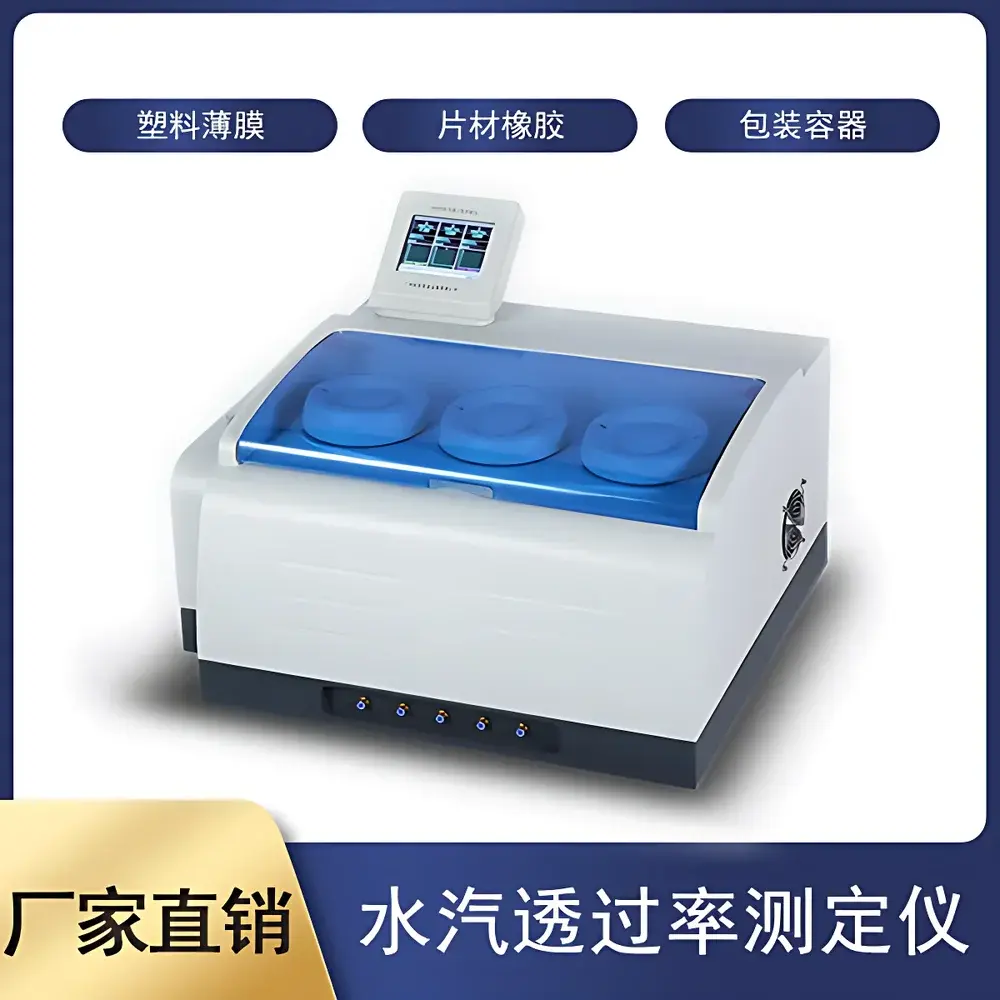
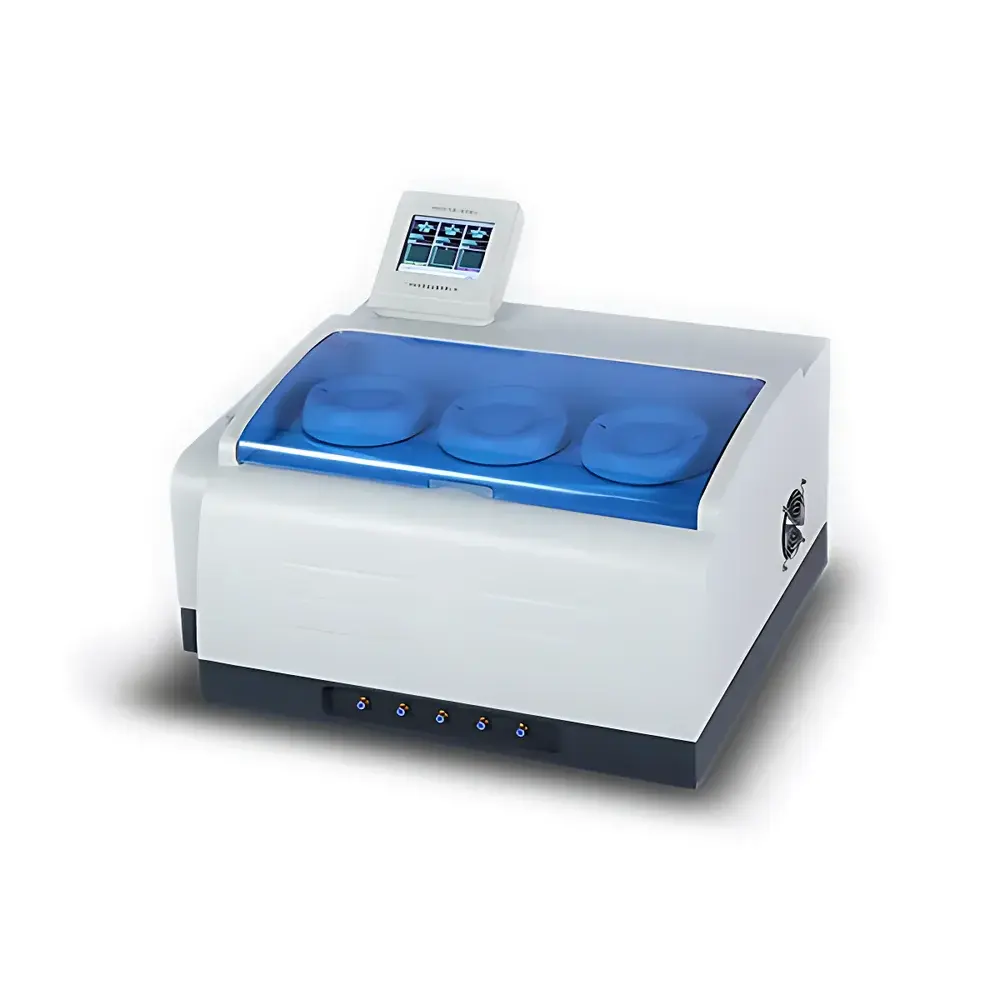
GBPI W413D Water Vapor Transmission Rate (WVTR) Tester
| Brand | GBPI |
|---|---|
| Origin | Guangdong, China |
| Manufacturer Type | Direct Manufacturer |
| Country of Origin | China |
| Model | W413D |
| Pricing | Upon Request |
| Test Range | 0.002–1000 g/(m²·24h) |
| Accuracy | 0.001 g/(m²·24h) |
| Temperature Control | 15–45°C (optional up to 60°C), ±0.1°C |
| Humidity Control | 0%, 30–90%, or 100% RH, ±1% RH |
| Permeation Area | 50.24 cm² (down to 0.785 cm² with optional fixtures) |
| Sample Diameter | Φ100 mm |
| Max Sample Thickness | ≤3 mm |
| Sample Capacity | 1–3 specimens per test cycle |
| Carrier Gas | ≥99.999% N₂, pressure ≥0.1 MPa, flow rate 5–120 mL/min |
| Power Supply | AC 220 V, 50 Hz (110 V optional) |
| Dimensions | 610 × 550 × 300 mm |
| Weight | 57.1 kg |
| Power Consumption | 1000 W |
Overview
The GBPI W413D Water Vapor Transmission Rate (WVTR) Tester is a gravimetric-coupled, dual-chamber dynamic sensor-based instrument engineered for precise and reproducible measurement of water vapor permeation through packaging and functional barrier materials. It operates on the principle of controlled humidity gradient diffusion: a conditioned humid gas stream flows over the upper surface of a clamped specimen, while dry carrier gas (ultra-high-purity nitrogen) sweeps the lower surface. Water molecules permeating across the sample are transported by the dry gas stream to a highly stable electrolytic moisture sensor, where real-time water vapor concentration is quantified. The system calculates WVTR (g/m²·24h) based on sensor response, flow rate, temperature, humidity differential, and effective permeation area—fully compliant with fundamental mass transport theory under steady-state Fickian diffusion assumptions.
Key Features
- Triple-Independent Test Chambers: Three fully isolated test stations with independent temperature/humidity control, individual sensor arrays, and autonomous start/stop functionality—enabling concurrent testing of heterogeneous samples and generation of three discrete, audit-ready reports per cycle.
- High-Fidelity Environmental Control: Electromagnetic stepwise temperature regulation (±0.1°C stability) and dual-stream humidity generation (dry + saturated gas mixing) ensure ±1% RH accuracy across 0%, 30–90%, and 100% RH setpoints—critical for low-permeability validation and accelerated aging studies.
- Modular Permeation Area Configuration: Standard 50.24 cm² test area (Φ100 mm aperture); optional mini-fixtures support down to 0.785 cm² (Φ10 mm) for high-barrier films (e.g., Al foil laminates, SiOx-coated PET) and micro-scale medical device components.
- ARM-Based Embedded Architecture: Standalone operation via 7-inch color touchscreen interface; no external PC required for routine testing, calibration, or report generation—reducing IT infrastructure dependencies and cybersecurity exposure.
- GMP-Compliant Software Framework: Role-based user access (Administrator, Operator, Reviewer), full audit trail (system-level, method-level, run-level), electronic signatures, and 21 CFR Part 11–ready data integrity controls—including immutable record retention and change history logging.
- NIST-Traceable Calibration Support: Designed for direct verification using GBW(E)130543/4 certified reference standards issued by China’s National Institute of Metrology; enables in-house recalibration without third-party intervention.
Sample Compatibility & Compliance
The W413D accommodates flat and three-dimensional specimens across diverse material classes: flexible films (e.g., BOPP, PVDC, EVOH coextrusions), rigid sheets (PP, PVC, PC), paperboard (including metallized cigarette packaging), blister foils, pouches, bottles (PET, HDPE), thermoformed cups, pharmaceutical blister cards, solar backsheet laminates, lithium-ion battery enclosures, and wound care dressings. Its container-testing module supports headspace analysis of sealed packages per ASTM F1249 Annex A2 and ISO 15106-2 Annex B. Regulatory alignment includes GB/T 26253–2010 (Chinese national standard), YBB 00092003–2015 (Chinese pharmaceutical packaging), BS EN ISO 15106-2:2005, ASTM F1249–2013, and JIS K7129–2008—ensuring global test equivalence for regulatory submissions and supplier qualification.
Software & Data Management
GBPI’s proprietary WinWVTR software provides intuitive workflow configuration—from method creation (temperature ramping profiles, humidity dwell times, sensor stabilization thresholds) to automated baseline correction and endpoint determination. Real-time plotting displays four synchronized curves: chamber temperature, relative humidity, sensor output (ppm H2O), and calculated cumulative WVTR. All raw sensor data, metadata, and intermediate calculations are stored in an encrypted local SQLite database with configurable backup intervals. Reports comply with GLP/GMP documentation requirements: each includes instrument ID, operator ID, calibration certificate numbers, environmental logs, statistical summaries (mean, SD, RSD), and digital signature fields. Export formats include PDF (ISO-compliant), XLSX, and CSV for LIMS integration.
Applications
- Pharmaceutical packaging validation: moisture barrier assessment of PTP blisters, HDPE bottles, and desiccant-containing sachets per USP & Ph. Eur. monographs.
- Food packaging development: shelf-life modeling of snack bags, dairy cartons, and frozen meal trays under accelerated RH/temperature conditions.
- Medical device sterility assurance: WVTR verification of Tyvek® pouches, breathable films for wound dressings, and peelable lidding foils.
- Renewable energy materials: quantitative evaluation of moisture ingress resistance in PV backsheet multilayers (e.g., PET/EVA/Al/PE).
- Automotive fuel system compliance: permeation testing of polyethylene fuel tanks per SAE J1703 and ISO 11614.
- Battery safety engineering: long-term electrolyte containment validation for Li-ion cell housings exposed to cyclic humidity environments.
FAQ
Does the W413D support testing of non-planar containers such as bottles or pouches?
Yes—via optional container test fixtures that seal against the specimen’s opening, enabling headspace moisture accumulation measurement under controlled humidity gradients.
What carrier gas specifications are mandatory for valid ASTM F1249 compliance?
Ultra-high-purity nitrogen (≥99.999%) at regulated flow (5–120 mL/min) and pressure (≥0.1 MPa) is required; trace oxygen or moisture impurities will compromise sensor linearity and baseline stability.
How does the system handle high-barrier materials like aluminum foil or SiOx-coated films?
The triple-chamber architecture, sub-mg-level electrolytic sensor resolution (0.001 g/m²·24h), and miniaturized 0.785 cm² fixture collectively enable statistically robust measurements of ultra-low-permeability substrates without signal-to-noise degradation.
Is remote monitoring or networked data export supported?
While the embedded ARM platform operates autonomously, WinWVTR software supports LAN-connected PCs for centralized data aggregation; however, cloud upload or IoT telemetry is intentionally excluded to maintain data sovereignty and audit readiness per GxP requirements.
Can the instrument be verified using internationally recognized reference standards?
Yes—the GBW(E)130543/4 certified reference materials are accredited by China’s National Institute of Metrology and functionally equivalent to NIST SRM 2810 for permeation rate traceability; full validation protocols are documented in the instrument’s IQ/OQ manual.
Related Products





