
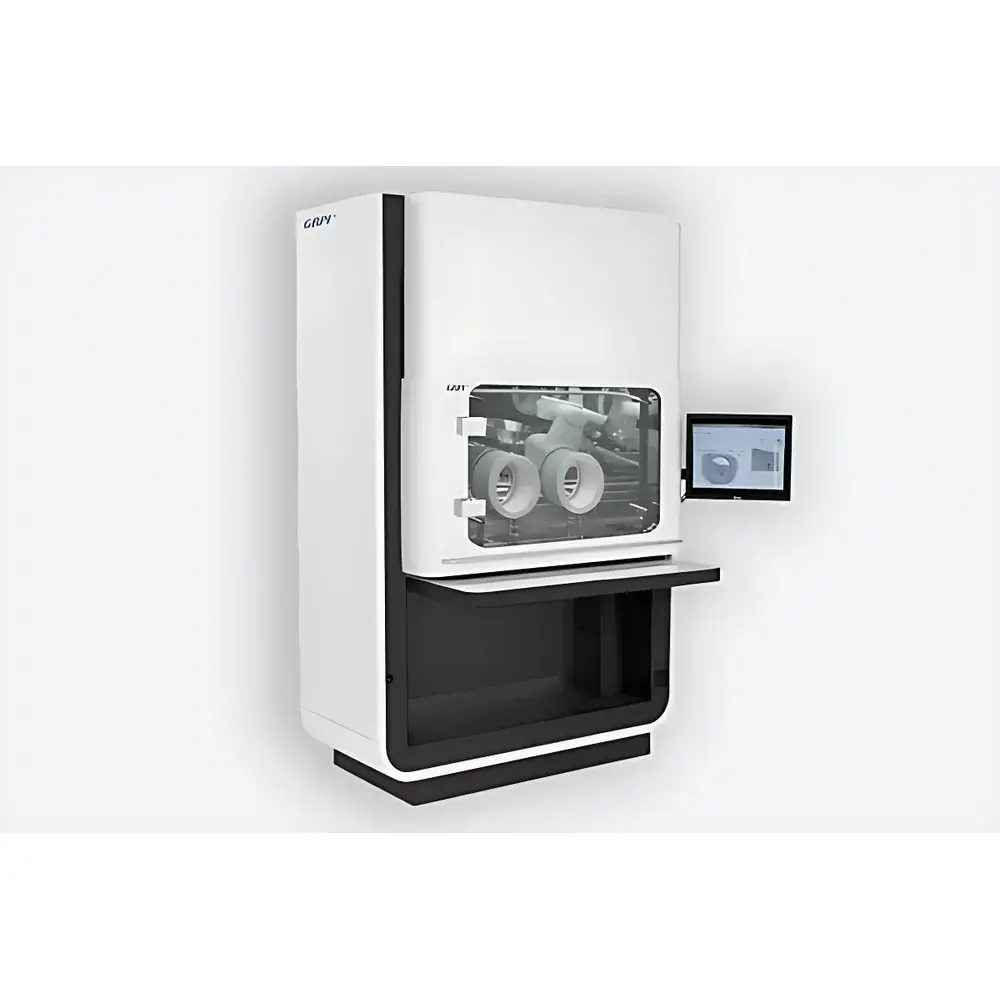
GBPI GB-KF30010R Bacterial Filtration Efficiency (BFE) Tester for Medical Masks
| Brand | GBPI |
|---|---|
| Origin | Guangdong, China |
| Manufacturer Type | Manufacturer |
| Product Category | Domestic |
| Model | GB-KF30010R |
| Instrument Type | Aerosol Detector |
| A-Path Sampling Flow Rate | 28.3 L/min ±2.5% (Resolution: 0.1 L/min) |
| B-Path Sampling Flow Rate | 28.3 L/min ±2.5% (Resolution: 0.1 L/min) |
| Nebulizer Flow Rate | 8–10 L/min ±2.5% (Resolution: 0.1 L/min) |
| Peristaltic Pump Flow Rate | 0.006–3.0 mL/min ±2.5% (Resolution: 0.001 mL/min) |
| Pre-Flowmeter Pressure (A/B Path) | −20 to 0 kPa ±2.5% (Resolution: 0.01 kPa) |
| Pre-Nebulizer Pressure | 0–300 kPa ±2.5% (Resolution: 0.1 kPa) |
| Ambient Temperature Range | −40 to 99 °C ±2.5% (Resolution: 0.1 °C) |
| Aerosol Chamber Negative Pressure | −90 to −120 Pa ±2.0% (Resolution: 0.1 Pa) |
| Cabinet Negative Pressure Range | −50 to −200 Pa |
| Data Storage Capacity | >100,000 test records |
| Vortex Mixer | 8 × Φ16×150 mm tubes |
| HEPA Filter Efficiency | ≥99.99% for particles ≥0.3 µm |
| Aerosol Generator Output | Mass Median Diameter (MMD) = 3.0 ± 0.3 µm, Geometric Standard Deviation (GSD) ≤1.5 |
| Andersen Six-Stage Sampler Cut-Points | Stage I >7 µm, II: 4.7–7 µm, III: 3.3–4.7 µm, IV: 2.1–3.3 µm, V: 1.1–2.1 µm, VI: 0.6–1.1 µm |
| Aerosol Chamber Dimensions | 600 × 85 × 30 mm (L×D×H) |
| Positive Control Target | 2200 ± 500 CFU |
| Cabinet Ventilation Flow Rate | ≥5 m³/min |
| Cabinet Door Size | 1000 × 730 mm (W×D) |
| Main Unit Dimensions | 1180 × 650 × 1300 mm (W×D×H) |
| Adjustable Stand Dimensions | 1180 × 650 × 600 mm (H adjustable within ±10 cm) |
| Acoustic Noise Level | <65 dB(A) |
| Net Weight | ~150 kg |
| Power Supply | AC 220 V ±10%, 50 Hz |
| Power Consumption | <1500 W |
Overview
The GBPI GB-KF30010R Bacterial Filtration Efficiency (BFE) Tester is a fully integrated, dual-channel aerosol-based testing system engineered for quantitative assessment of bacterial particle retention performance in medical face masks and respirator materials. It operates on the principle of controlled bioaerosol generation, simultaneous parallel sampling, and viable colony enumeration—aligning with the fundamental methodology defined in YY 0469–2004, YY/T 0969–2013, ASTM F2101, ASTM F2100, and EN 14683. The instrument generates a standardized, monodisperse microbial aerosol using a precision nebulizer calibrated to deliver Staphylococcus aureus (ATCC 6538) or equivalent challenge organisms at a mass median aerodynamic diameter (MMAD) of 3.0 ± 0.3 µm and geometric standard deviation (GSD) ≤1.5. Dual independent sampling trains—each equipped with a six-stage Andersen cascade impactor—enable concurrent collection and size-resolved deposition of viable bacteria across six discrete aerodynamic cut-points (0.6–7+ µm), permitting rigorous evaluation of filtration efficiency as a function of particle size distribution.
Key Features
- Negative-pressure containment cabinet (−50 to −200 Pa) with laminar airflow design and ≥5 m³/min ventilation, certified for operator biosafety during aerosol handling;
- Dual-path sampling architecture with synchronized 28.3 L/min flow control per channel (±2.5% accuracy), eliminating inter-path bias and enabling statistical validation via paired-sample t-testing;
- Integrated peristaltic pump (0.006–3.0 mL/min, ±2.5%) for precise collection medium delivery to Andersen stages, programmable via embedded industrial HMI;
- High-fidelity microbial aerosol generator with real-time pressure monitoring (0–300 kPa, ±2.5%) and adjustable nebulization flow (8–10 L/min), optimized for stable output and minimal droplet coalescence;
- 10.4-inch industrial-grade capacitive touchscreen interface with localized English firmware, supporting multi-user access control and audit-ready operation logs;
- Onboard data storage (>100,000 test records) with USB export capability, timestamped and compliant with basic ALCOA+ data integrity principles;
- HEPA filtration system (≥99.99% @ 0.3 µm) integrated into exhaust path, meeting ISO 14644-1 Class 5 requirements for post-test decontamination;
- Modular stainless-steel aerosol chamber (600 × 85 × 30 mm) with calibrated negative pressure control (−90 to −120 Pa, ±2.0%), ensuring consistent aerosol residence time and uniform particle challenge;
- Adjustable-height support stand with locking casters, enabling ergonomic positioning and facility integration without structural modification;
- Comprehensive electrical safety architecture including RCD protection, flame-retardant insulation, and front-access tempered glass viewing window with positive-seal gasket.
Sample Compatibility & Compliance
The GB-KF30010R accommodates flat mask material specimens (up to 100 mm × 100 mm) mounted in standardized holders compatible with ISO/IEC 17025-accredited calibration fixtures. It supports both qualitative (pass/fail) and quantitative (efficiency % vs. particle size) reporting per regulatory thresholds: ≥95% BFE at ≥2200 CFU challenge for surgical masks (YY 0469, EN 14683 Type II), and ≥98% for high-barrier variants. All fluidic and pneumatic subsystems are traceably calibrated against NIST-traceable flow meters and pressure transducers. The system satisfies essential requirements for GLP-compliant laboratories, including secure user authentication, electronic signature support (via optional software module), and full audit trail generation for instrument parameters, environmental conditions, and operator actions—laying groundwork for FDA 21 CFR Part 11 readiness when deployed with validated third-party LIMS integration.
Software & Data Management
Embedded firmware provides real-time visualization of all critical process variables: dual-path flow stability, nebulizer pressure, chamber vacuum, ambient temperature, and peristaltic pump RPM. Test sequences are preconfigured per standard protocols (e.g., “YY0469_BFE_Surgical”), with editable parameters for challenge concentration, exposure duration, and stage-specific collection volume. Raw data—including flow-corrected colony counts per Andersen stage, calculated log reduction values, and efficiency curves—is exported in CSV format with metadata headers compliant with ISO/IEC 17025 clause 7.7. Optional PC-based analysis software (sold separately) adds statistical process control charts, ANOVA-enabled inter-lot comparison, and automated report generation conforming to CNAS-CL01:2018 Annex A25 documentation requirements.
Applications
- Regulatory conformance testing of surgical masks, procedure masks, and barrier face coverings per YY 0469–2004 and YY/T 0969–2013;
- Quality control release testing in ISO 13485-certified manufacturing facilities;
- Comparative filtration benchmarking of novel filter media (electret, nanofiber, melt-blown composites);
- Accelerated aging studies assessing BFE retention after simulated shelf-life exposure (humidity, UV, thermal cycling);
- Method validation and uncertainty budgeting per ISO/IEC 17025:2017 clauses 7.2.2 and 7.6;
- Reference laboratory participation in proficiency testing schemes administered by NIM, CNAS, or international PT providers.
FAQ
What microorganism is recommended for BFE testing according to YY 0469–2004?
Staphylococcus aureus ATCC 6538 is specified as the challenge organism; alternative strains require method equivalence validation per YY/T 0969–2013 Annex C.
Can the GB-KF30010R be used for viral filtration efficiency (VFE) testing?
No—the system is designed and validated exclusively for bacterial aerosols. VFE requires distinct bioaerosol generation, detection (e.g., qPCR), and containment protocols beyond its scope.
Is external calibration certification included with purchase?
Factory calibration certificates (traceable to national standards) are supplied. On-site ISO/IEC 17025 calibration services are available upon request through GBPI’s authorized metrology partners.
How is aerosol uniformity verified during routine operation?
Users perform daily challenge verification using the built-in positive control target (2200 ± 500 CFU) and confirm stage-wise deposition profiles against historical baselines stored in the device database.
Does the system support automated pass/fail decision logic based on regulatory thresholds?
Yes—threshold-based pass/fail flags are configurable per test protocol and logged alongside raw data; final determination remains subject to authorized reviewer sign-off per internal SOPs.
Related Products







