
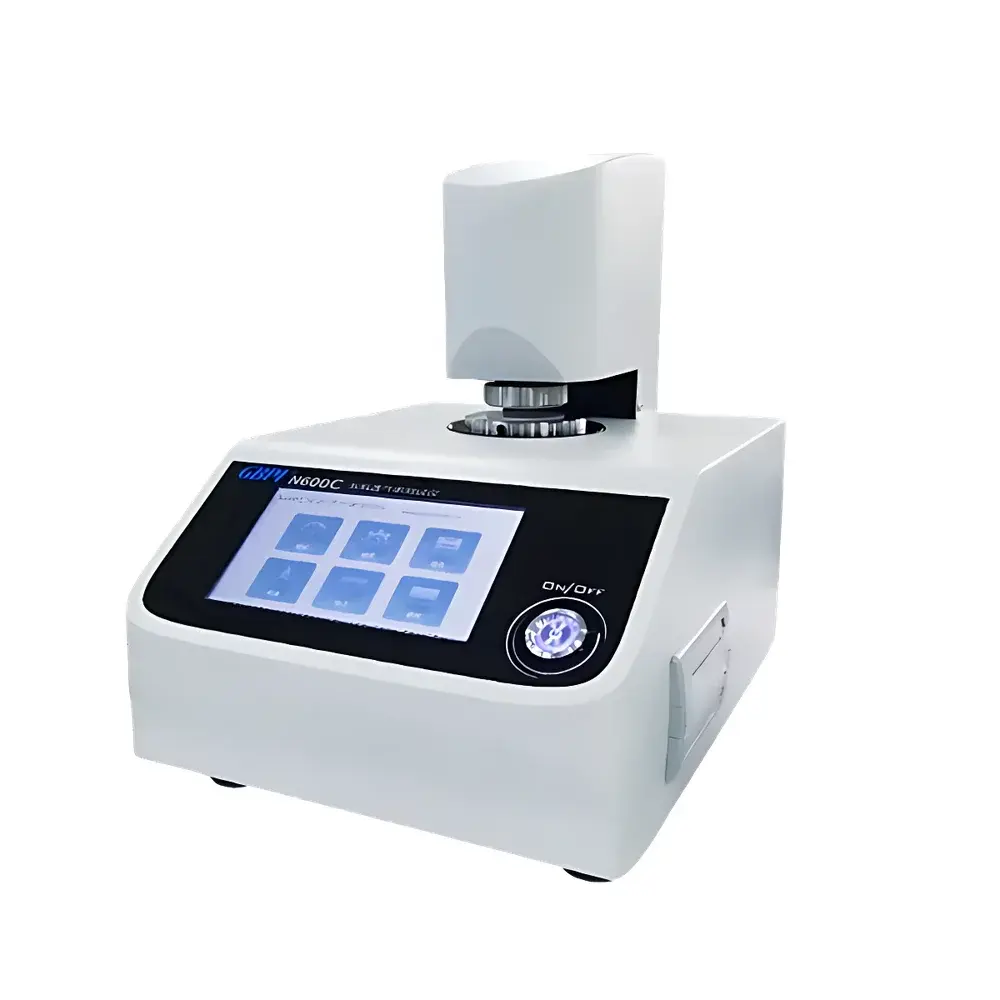
GBPI N600C Gas Permeability Tester for Carbon Paper
| Brand | GBPI |
|---|---|
| Origin | Guangdong, China |
| Manufacturer Type | Direct Manufacturer |
| Country of Origin | China |
| Model | N600C |
| Pricing | Upon Request |
| Test Principle | Differential Pressure (Manometric) Method |
| Compliant Standard | GB/T 20042.7–2014 |
| Measurement Range | 0–200,000 mL·mm/(cm²·h·mmHg) |
| Resolution | 0.1 mL·mm/(cm²·h·mmHg) |
| Pressure Range | 0–500 Pa (customizable) |
| Pressure Resolution | 0.1 Pa |
| Pressure Accuracy | ±0.1% FS |
| Flow Range | 0–50 L/min (customizable) |
| Flow Resolution | 1 mL/min |
| Flow Accuracy | ±1% FS |
| Test Area | 16 cm² |
| Dimensions | 410 × 295 × 365 mm |
| Power Consumption | 100 W |
| Input Voltage | 110–250 VAC, 50–60 Hz |
Overview
The GBPI N600C Gas Permeability Tester is a precision-engineered instrument designed specifically for the quantitative evaluation of gas permeability in carbon paper substrates used in proton exchange membrane fuel cells (PEMFCs). It operates on the differential pressure (manometric) principle defined in GB/T 20042.7–2014 — a national standard aligned with ISO 4022 and ASTM D726 test methodologies for porous sheet materials. During measurement, a conditioned carbon paper specimen is clamped between two sealed chambers, establishing a controlled pressure gradient across the sample. A regulated low-pressure differential (0–500 Pa) drives gas flow from the high-pressure side to the low-pressure side. The instrument precisely measures volumetric gas flow rate, pressure differential, sample thickness, and effective test area to compute permeability in standardized units: mL·mm/(cm²·h·mmHg). This physics-based calculation ensures traceable, reproducible results essential for R&D validation, incoming material inspection, and production process control in PEMFC component manufacturing.
Key Features
- High-accuracy differential pressure control system with 0.1 Pa resolution and ±0.1% full-scale accuracy — enabling stable, low-gradient testing critical for low-permeability carbon papers.
- Wide dynamic flow measurement range (0–50 L/min), extendable via calibration customization to accommodate ultra-low or high-flow carbon fiber substrates.
- Integrated 7-inch color capacitive touchscreen interface with embedded real-time data visualization, eliminating dependency on external PCs for routine operation.
- Onboard thermal line printer supporting immediate hardcopy output of test reports — including date/time stamp, operator ID, sample ID, measured values, and pass/fail status against user-defined limits.
- Modular clamp design with standardized 16 cm² test area fixture; optional fixtures available for 5 cm² and 25 cm² configurations to support ASTM D726-compliant comparative studies.
- Self-contained pneumatic architecture — no external air compressor required for baseline operation (optional external compressed air supply supports accelerated throughput in high-volume QA labs).
Sample Compatibility & Compliance
The N600C is validated for use with all commercially relevant carbon paper grades employed in PEMFC gas diffusion layers (GDLs), including Toray TGP-H series, SGL SIGRACET® GDLs, and custom nonwoven carbon fiber mats. Its mechanical clamping force and sealing geometry minimize edge leakage and ensure uniform compression without fiber distortion. The instrument complies with GB/T 20042.7–2014, which references ISO 9277 (gas adsorption surface area) and IEC 62282-3-100 (fuel cell stack qualification). When configured with optional computerized system software, it supports 21 CFR Part 11 compliance through role-based access control, electronic signatures, and immutable audit trails — fulfilling GLP and GMP documentation requirements for certified quality laboratories.
Software & Data Management
An optional PC-based upper-level software package is available for advanced data governance. Built in accordance with Annex 11 (Computerized Systems) of the EU GMP Guidelines and FDA’s Data Integrity Guidance, it provides multi-tier user permissions (Administrator, Supervisor, Analyst), time-stamped audit logs for all parameter changes and result exports, and digital signature capability for report finalization. Raw data files are stored in encrypted SQLite format with SHA-256 hash verification. Export options include CSV, PDF/A-2, and XML formats compatible with LIMS integration. Calibration records, maintenance logs, and instrument qualification (IQ/OQ) templates are preloaded for accelerated regulatory readiness.
Applications
- Quality assurance of carbon paper batches prior to GDL fabrication — verifying consistency in pore structure and interfacial gas transport resistance.
- R&D screening of hydrophobic/hydrophilic treatments (e.g., PTFE loading variations) and their impact on through-plane permeability.
- Correlation studies between permeability, electrical conductivity, and mechanical compressibility under simulated stack compression loads.
- Supporting DOE-defined durability protocols requiring periodic permeability trending over accelerated stress tests (e.g., humidity cycling, freeze-thaw).
- Third-party certification testing for ISO/IEC 17025-accredited laboratories serving PEMFC OEMs and Tier-1 suppliers.
FAQ
What standards does the N600C comply with?
It is fully compliant with GB/T 20042.7–2014 and technically aligned with ISO 4022, ASTM D726, and IEC 62282-3-100 for gas permeability testing of porous planar materials.
Can the instrument test materials other than carbon paper?
Yes — with appropriate fixture adaptation and method validation, it supports microporous membranes, catalyst-coated membranes (CCMs), gas diffusion media (GDM), and thin polymer films where low-pressure differential flow characterization is required.
Is calibration traceable to national standards?
All pressure and flow sensors are factory-calibrated using NIST-traceable reference instruments; optional UKAS or CNAS-certified calibration certificates are available upon request.
How is data integrity ensured during automated reporting?
With the optional software module, every test event generates an immutable audit trail, including operator identity, timestamp, environmental conditions, raw sensor outputs, and final calculated permeability — all digitally signed and export-locked per ALCOA+ principles.
What maintenance is required for long-term stability?
Routine maintenance includes quarterly verification of seal integrity, annual sensor recalibration, and biannual cleaning of flow path components using isopropyl alcohol — documented in the included maintenance logbook template.






