
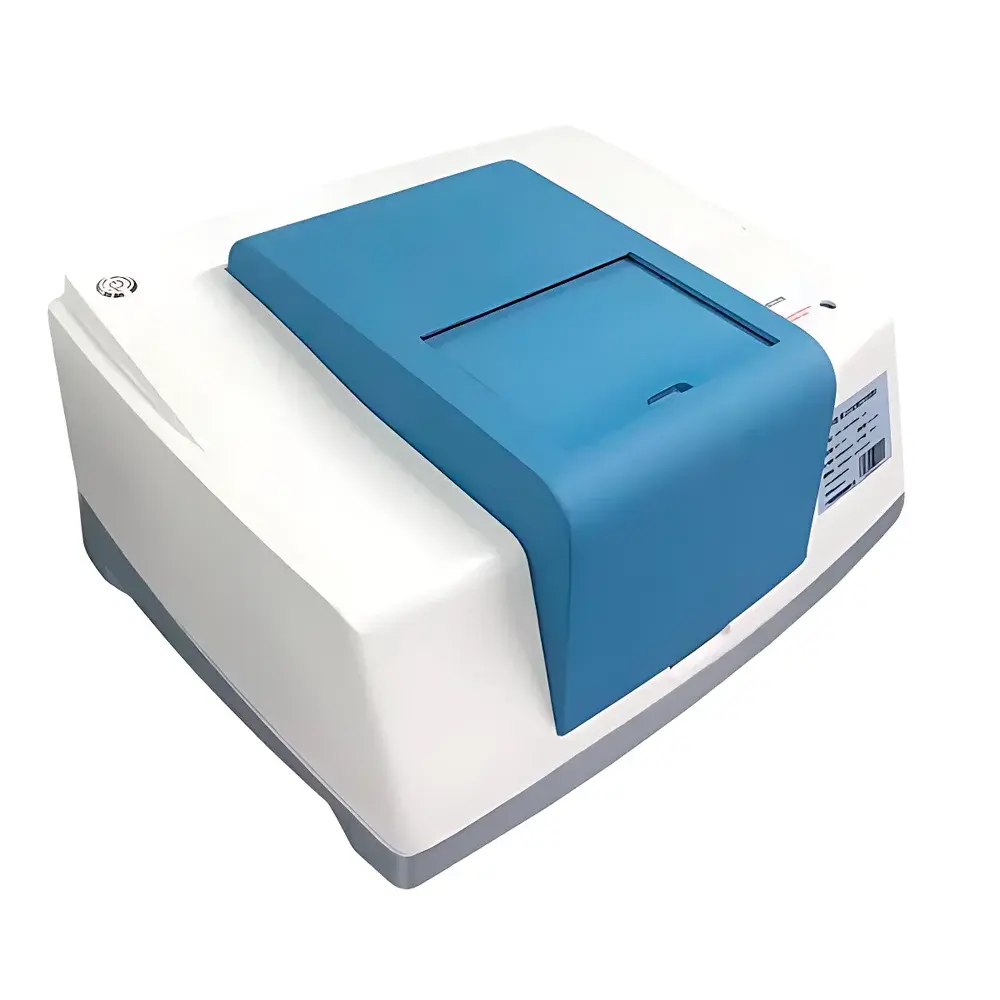
GBPI BFH-960-2 Fourier Transform Infrared (FTIR) Spectrometer
| Brand | GBPI |
|---|---|
| Origin | Guangdong, China |
| Manufacturer Type | Direct Manufacturer |
| Instrument Type | Laboratory FTIR Spectrometer |
| Wavenumber Range | 7800–350 cm⁻¹ |
| Spectral Resolution | <1.0 cm⁻¹ |
| Scan Speed | 4 cm⁻¹ (optical path difference rate) |
| Signal-to-Noise Ratio | 15,000:1 (at 4 cm⁻¹, 1 min scan) / 30,000:1 (at 4 cm⁻¹, 1 min scan, DLaTGS detector) |
| Beamsplitter | KBr substrate with Ge coating |
| Detector | Imported high-sensitivity deuterated triglycine sulfate (DLaTGS) |
| Source | Imported long-life, air-cooled high-intensity IR source |
| Interferometer | Sealed 30°-incidence Michelson interferometer with integrated auto-alignment optics |
| A/D Conversion | 24-bit, 500 kHz |
| Communication Interface | USB 2.0 (backward compatible with USB 3.0) |
| Dimensions | 450 × 350 × 235 mm (L×W×H) |
| Weight | 14 kg |
| Operating Temperature | 15–35 °C |
| Power Consumption | <30 W |
Overview
The GBPI BFH-960-2 Fourier Transform Infrared (FTIR) Spectrometer is a precision laboratory-grade instrument engineered for high-fidelity molecular identification and quantitative analysis across pharmaceutical, environmental, polymer, forensic, and academic research applications. It operates on the fundamental principle of interferometric spectroscopy: infrared radiation from a broadband thermal source is split, recombined after differential path-length modulation in a sealed Michelson interferometer, and detected as an interferogram. A real-time He–Ne laser reference ensures optical path stability and sub-wavenumber accuracy. The acquired interferogram undergoes fast Fourier transformation (FFT) to yield a high-resolution absorbance or transmittance spectrum across the full mid-IR range (7800–350 cm⁻¹). Its design emphasizes metrological robustness—achieving spectral resolution better than 1.0 cm⁻¹, wavenumber accuracy traceable to NIST-standard references, and exceptional signal fidelity via optimized optical throughput and low-noise detection architecture.
Key Features
- Sealed, purged-free interferometer housing with 30°-incidence geometry and built-in active optical alignment—eliminates manual collimation and enhances long-term stability.
- Gold-coated corner-cube retroreflectors delivering >98% reflectivity and angular tolerance <0.5 arcsec, ensuring phase consistency over thousands of scans.
- KBr-based beamsplitter with durable germanium anti-reflection coating, optimized for broad spectral transmission and humidity resistance.
- Imported high-sensitivity DLaTGS detector with thermoelectric cooling, enabling stable baseline performance without liquid nitrogen dependency.
- Long-life ceramic IR source (>10,000 h operational life) with 80% radiant efficiency and air-cooled thermal management.
- Front-tilted (7°) humidity indicator window and oversized desiccant chamber—provides fivefold moisture retention capacity versus standard FTIR systems, reducing maintenance frequency.
- Push-pull sample compartment door minimizes ambient CO₂ and H₂O intrusion during measurement, critical for high-accuracy atmospheric compensation.
- Ultra-low power consumption (<30 W total system draw) achieved through intelligent thermal regulation and energy-efficient drive electronics.
- Tool-free, pin-aligned optical module installation—ensures repeatable mechanical registration without iterative alignment procedures.
Sample Compatibility & Compliance
The BFH-960-2 supports universal sampling modalities including transmission (KBr pellets, solution cells), attenuated total reflectance (ATR), diffuse reflectance (DRIFTS), and specular reflectance. Its large sample compartment accommodates commercial accessories such as diamond ATR stages, gas cells (up to 10 cm pathlength), and temperature-controlled holders (−10 to 250 °C). All hardware and firmware comply with ISO/IEC 17025:2017 requirements for analytical instrument validation. Software includes audit trail functionality compliant with FDA 21 CFR Part 11 for electronic records and signatures. Wavenumber calibration follows ASTM E1421–22 and USP , supporting GLP/GMP-regulated workflows in QC laboratories.
Software & Data Management
The included GBPI IRPro software suite provides full spectral acquisition, processing, and reporting capabilities. Key modules include real-time interferogram preview, automatic baseline correction (Rubberband, Concave Rubberband), derivative spectroscopy (1st–3rd order), peak integration (area, height, centroid), functional group assignment using rule-based logic, and advanced ATR correction algorithms. Multi-sample batch processing enables automated pass/fail QC comparisons against reference spectra. The system ships with 12 domain-specific spectral libraries—including Chinese Pharmacopoeia, Veterinary Pharmacopoeia, Polymer, Solvent, Food Additive, and Forensic databases—and supports user-defined library creation, spectral annotation, and hierarchical taxonomy tagging. Data export formats include JCAMP-DX (.dx), CSV, PNG, and PDF reports with embedded metadata (instrument ID, operator, date/time, acquisition parameters).
Applications
The BFH-960-2 delivers reliable performance in regulated and exploratory settings: identification of active pharmaceutical ingredients (APIs) and excipients per ICH Q5A; quantification of residual solvents in drug substances (ICH Q3C); characterization of polymer degradation products and crosslinking density; detection of adulterants in food matrices (e.g., melamine in dairy, synthetic dyes in spices); microplastic identification in environmental water/sediment samples; verification of raw material authenticity in chemical manufacturing; and structural elucidation of unknown organics in forensic casework. Its high SNR and reproducibility support method transfer between R&D and QC labs under ISO 17025 accreditation.
FAQ
What is the recommended calibration frequency for routine operation?
Annual wavelength calibration using polystyrene film (ASTM E1421) is advised; daily verification with built-in laser reference ensures drift remains within ±0.02 cm⁻¹.
Does the system support external accessories like purge gas lines or temperature controllers?
Yes—standardized vacuum/purge ports (¼” Swagelok) and analog I/O connectors enable integration with environmental chambers, reaction cells, and gas-handling systems.
Is spectral data compatible with third-party chemometric platforms?
All exported spectra adhere to JCAMP-DX v5.01 format and are fully importable into Unscrambler, MATLAB, Python (SciPy/NumPy), and OpenMEE.
How is humidity managed without continuous dry-air purging?
The dual-layer desiccant system—comprising hygroscopic molecular sieve and hydrophobic membrane—maintains internal dew point below −40 °C for >6 months under typical lab conditions (RH ≤ 60%).
Can the instrument be validated for GMP environments?
Yes—full IQ/OQ/PQ documentation templates, electronic signature support, and 21 CFR Part 11-compliant audit trails are provided as part of the validation package.
Related Products






