
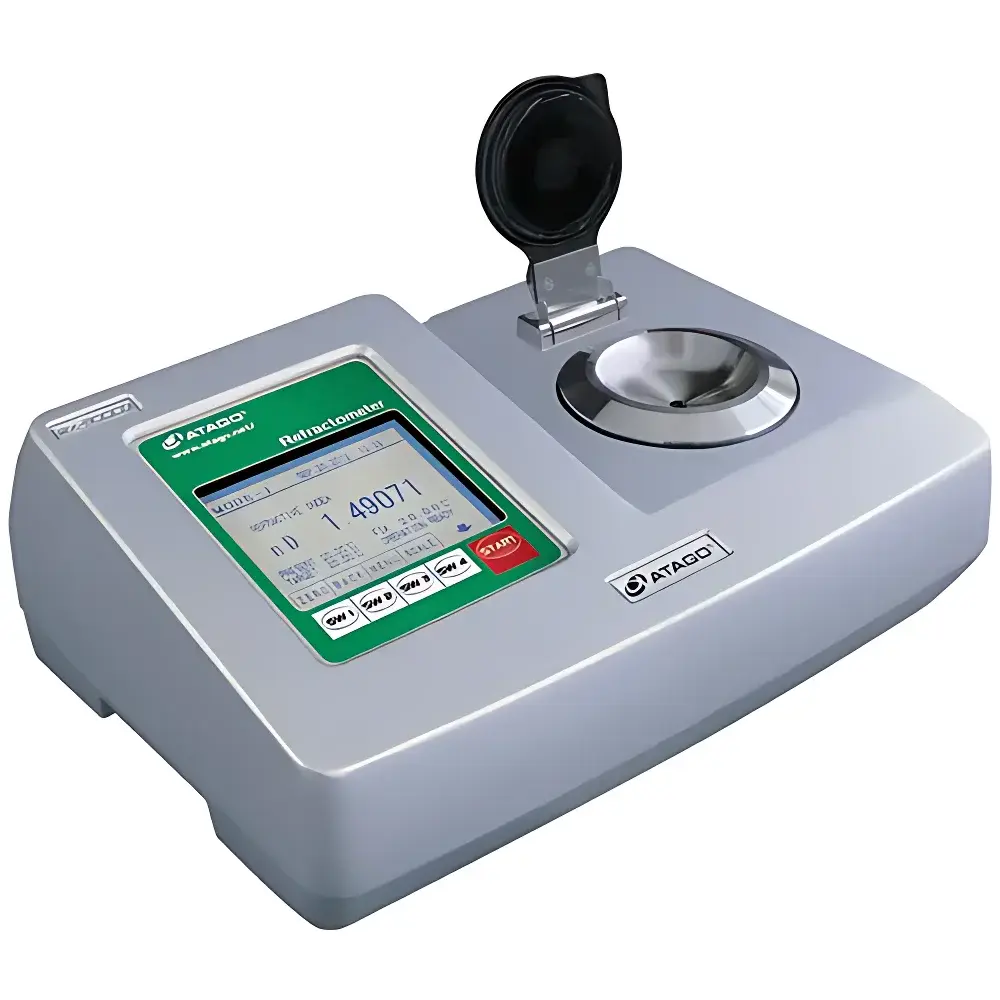
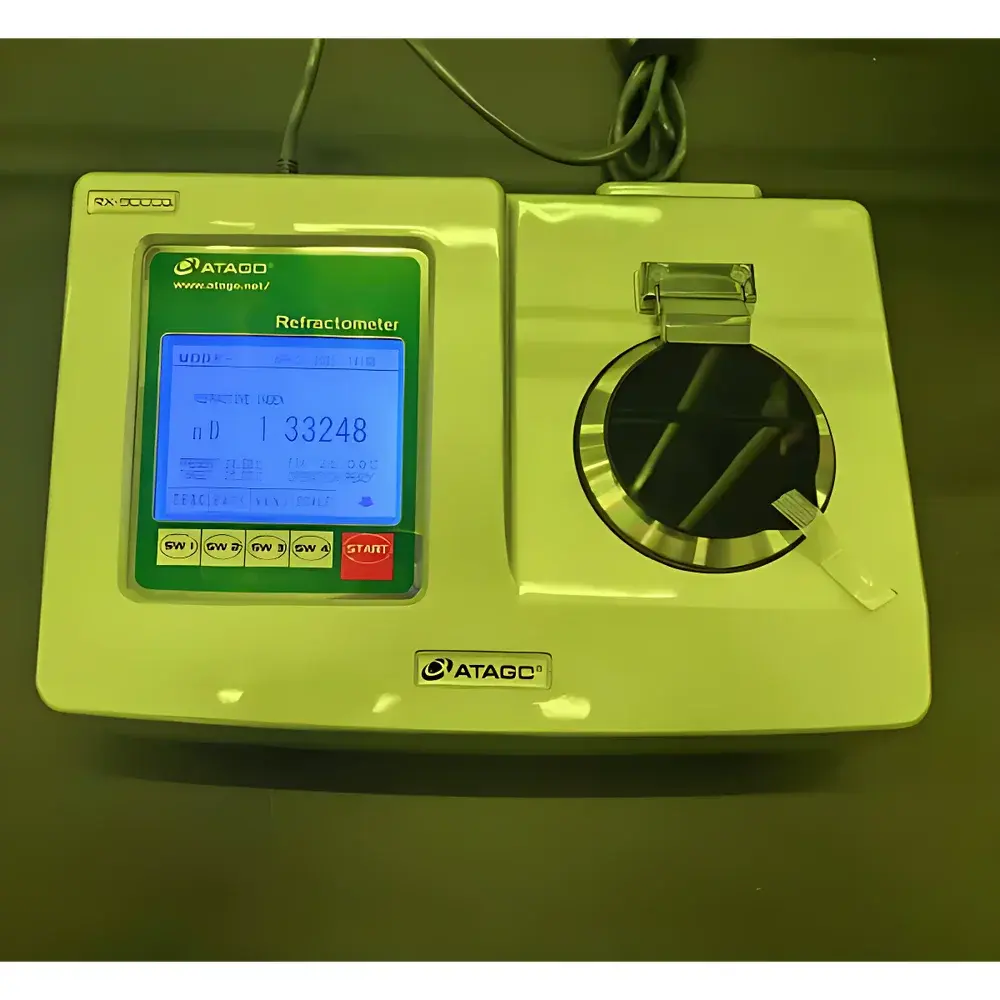
ATAGO RX-9000α High-Precision Desktop Refractometer
| Brand | ATAGO |
|---|---|
| Origin | Japan |
| Model | RX-9000α |
| Product Type | Desktop Refractometer |
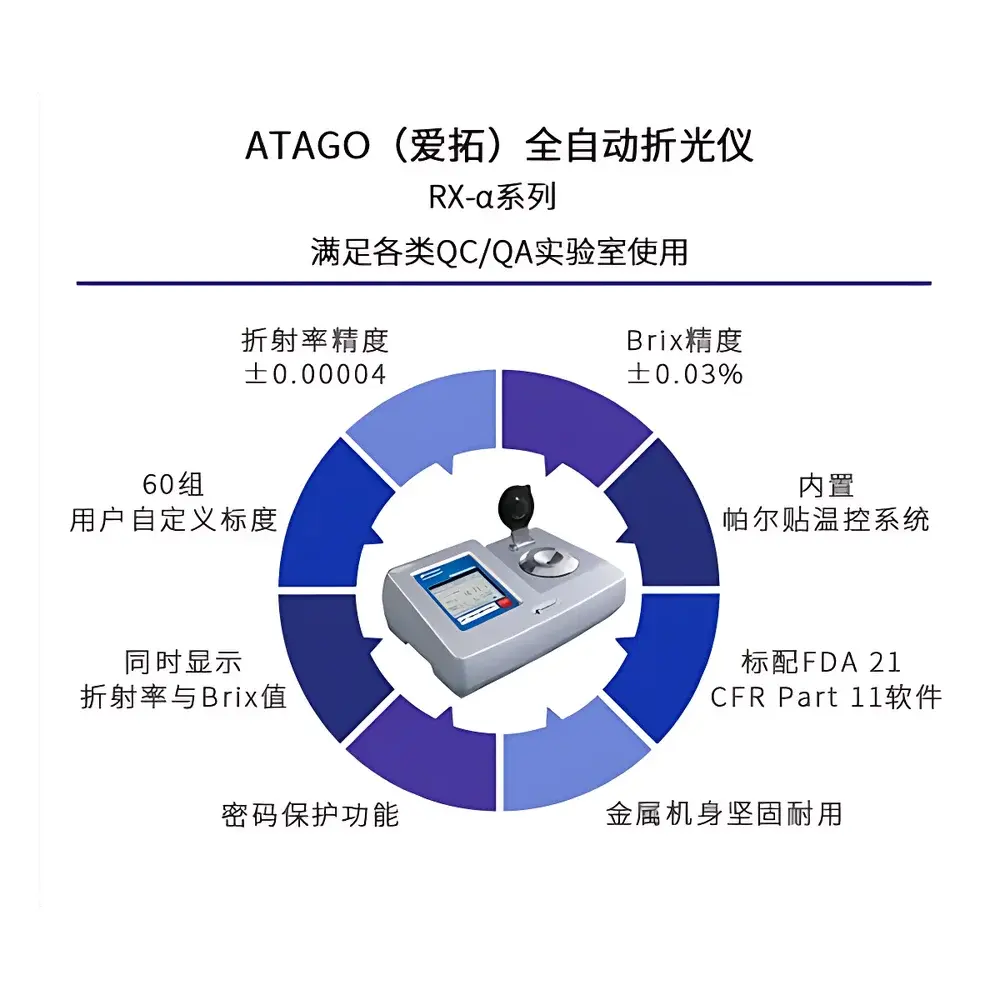
| Temperature Control | Peltier-based, 5.00–70.00 °C |
| Display | Digital LCD |
| Refractive Index Range | 1.29980–1.71500 |
| Brix Range | 0.00–100.00% |
| RI Resolution | 0.00001 |
| Brix Resolution | 0.01% |
| Temperature Resolution | 0.01 °C |
| RI Accuracy | ±0.00004 (±0.00010 for RI ≥1.42009) |
| Brix Accuracy | ±0.03% (±0.05% for 50.01–95.00%) |
| Temp Accuracy | ±0.05 °C (10.00–30.00 °C) |
| Interface | RS-232C |
| Power | AC 100–240 V, 50/60 Hz, 65 VA |
| Dimensions | 370 × 260 × 140 mm |
| Weight | 6.8 kg |
Overview
The ATAGO RX-9000α High-Precision Desktop Refractometer is a laboratory-grade optical instrument engineered for absolute metrological integrity in refractive index (RI) and Brix measurements. It operates on the principle of critical angle measurement using a high-stability LED light source and a precision sapphire prism assembly. Unlike handheld or analog refractometers, the RX-9000α integrates a closed-loop Peltier thermoelectric temperature control system—ensuring sample thermal equilibration within ±0.05 °C across its full 5.00–70.00 °C operating range. This capability is essential for measuring high-melting-point samples such as hydrogenated oils, aromatic solvents (e.g., benzyl alcohol, ethyl salicylate), and concentrated flavor/fragrance formulations where viscosity and thermal stability significantly impact optical path consistency. Its extended RI range (1.29980–1.71500) exceeds standard Abbe refractometers, enabling direct quantification of dense organic media without dilution—a critical advantage in QC workflows governed by ISO 21542 (optical characterization of transparent materials) and ASTM D1218 (refractive index of hydrocarbons).
Key Features
- Peltier-controlled sample stage with real-time temperature feedback and programmable ramping profiles
- Manual calibration offset function for traceable alignment against NIST-traceable reference standards (e.g., certified sucrose solutions or synthetic oils)
- High-resolution digital display showing simultaneous RI, Brix, and temperature values at 0.00001 RI / 0.01% Brix / 0.01 °C resolution
- Sapphire prism surface with enhanced chemical resistance and long-term optical stability—critical for repeated exposure to aggressive solvents
- Compliance-ready architecture supporting audit trails: all calibration events, temperature setpoints, and measurement timestamps are logged internally and exportable via RS-232C
- Robust mechanical design (6.8 kg mass, rigid aluminum housing) minimizes vibration-induced drift during extended measurement sessions
Sample Compatibility & Compliance
The RX-9000α accommodates viscous, volatile, and thermally sensitive samples—including molten waxes (mp > 60 °C), anhydrous glycerol, propylene glycol-based formulations, and high-boiling-point aromatics. Its sealed optical chamber prevents solvent vapor ingress, preserving detector sensitivity over time. The instrument conforms to key regulatory frameworks for analytical instrumentation: data integrity features align with FDA 21 CFR Part 11 requirements when paired with compliant LIMS software; temperature control performance satisfies ISO 17025 clause 5.4.2 for environmental condition monitoring; and Brix measurement uncertainty budgets meet USP criteria for pharmaceutical excipient characterization. Optional printer output supports GLP-compliant hard-copy record retention.
Software & Data Management
While the RX-9000α operates autonomously via front-panel interface, its RS-232C port enables bidirectional communication with external PCs running custom or third-party data acquisition platforms (e.g., LabVIEW, MATLAB, or validated enterprise QC systems). All measurements include embedded metadata: operator ID (manually entered), sample ID, timestamp, ambient temperature/humidity (if external sensors are integrated), and calibration status flag. Internal memory retains up to 1,000 measurement records with full traceability—each entry includes checksum-verified raw photodiode signal data, not just final calculated values—facilitating root-cause analysis during method validation or deviation investigations.
Applications
- Quality control of edible oils and fats: determination of iodine value proxies via RI correlation per AOCS Cd 3c-94
- Concentration monitoring in fragrance compounding: direct Brix-to-density conversion for ethanol-free perfume bases
- Process validation in semiconductor cleaning chemistry: real-time verification of isopropyl alcohol/water blend ratios
- R&D of polymerizable monomers: tracking RI shifts during UV-cure kinetics without sample extraction
- Raw material screening in biopharma: rapid assessment of polysaccharide purity in heparin sodium batches
- Academic research in colloid science: correlating RI with nanoparticle volume fraction in non-aqueous dispersions
FAQ
Does the RX-9000α support automatic temperature compensation (ATC) for non-aqueous samples?
Yes—the built-in Peltier system maintains constant prism temperature regardless of sample thermal properties, eliminating reliance on empirical ATC algorithms that assume aqueous matrix behavior.
Can calibration be performed using non-sucrose standards?
Absolutely: the manual offset function accepts any certified reference material with known RI at the target temperature (e.g., bromonaphthalene, n-butyl phthalate), enabling method-specific traceability.
Is the instrument suitable for GMP-regulated environments?
Yes—when deployed with documented SOPs, periodic verification using NIST-traceable standards, and electronic record controls, it meets Annex 11 and ICH Q7 requirements for analytical equipment qualification.
What maintenance is required beyond routine prism cleaning?
Annual verification of Peltier thermal response time and photodiode linearity is recommended; no optical realignment or lamp replacement is necessary due to solid-state LED illumination and fixed-path optics.
How does the RX-9000α differ from the RX-5000α in metrological capability?
The RX-9000α offers double the RI resolution (0.00001 vs. 0.00002), tighter temperature stability (±0.05 °C vs. ±0.1 °C), and extended upper RI limit (1.71500 vs. 1.55000), making it uniquely suited for specialty chemical and advanced materials applications.




