
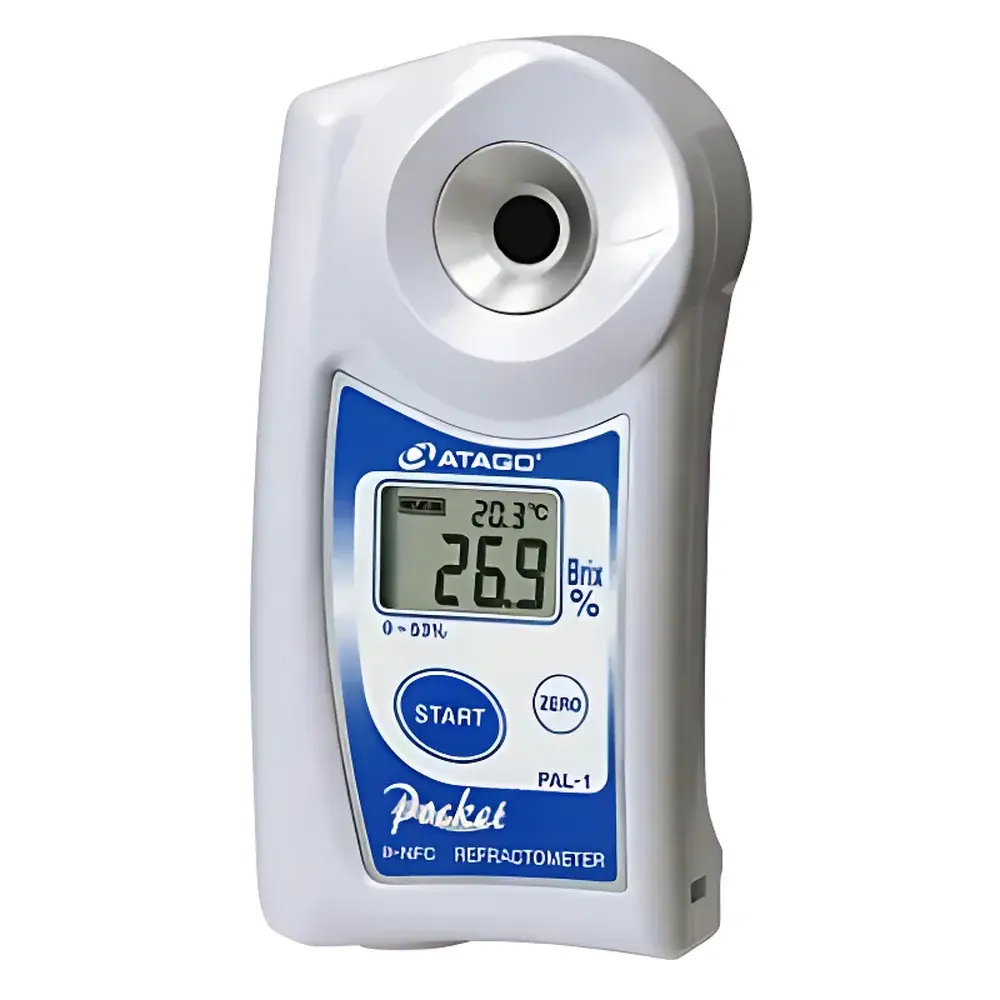
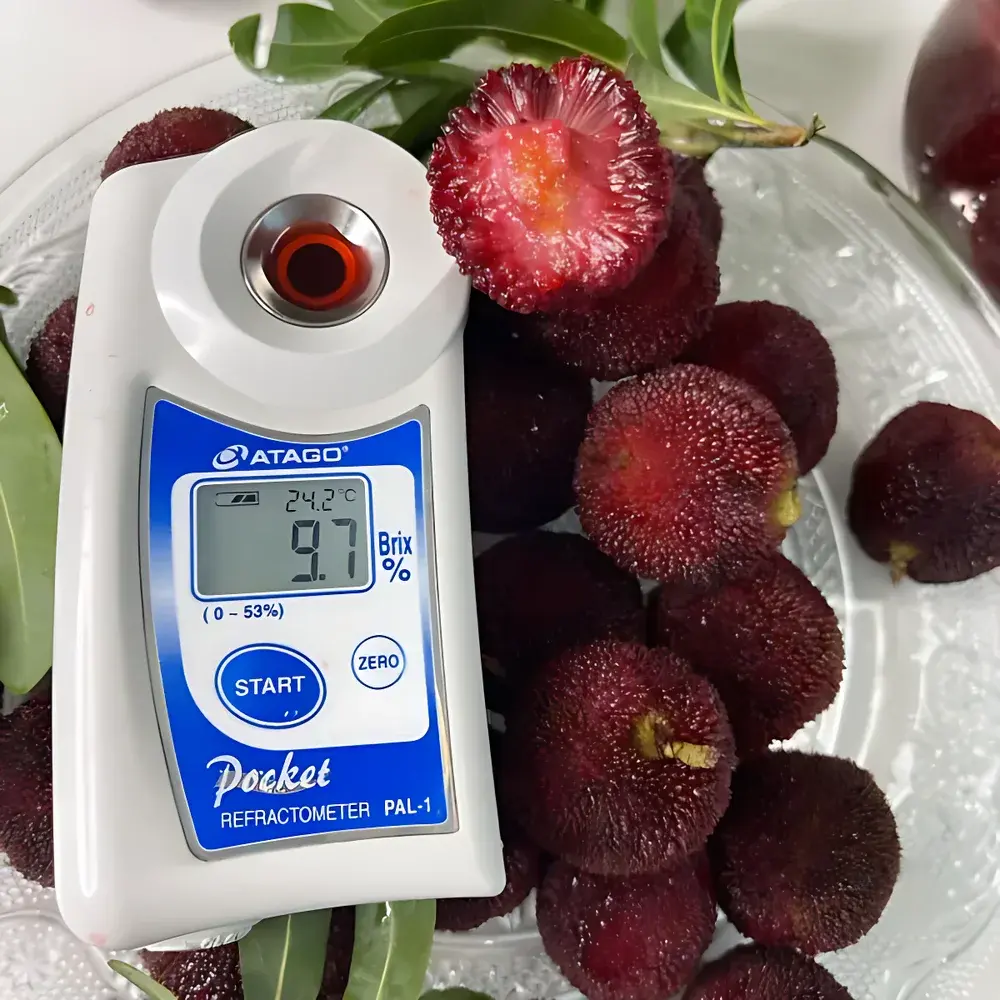
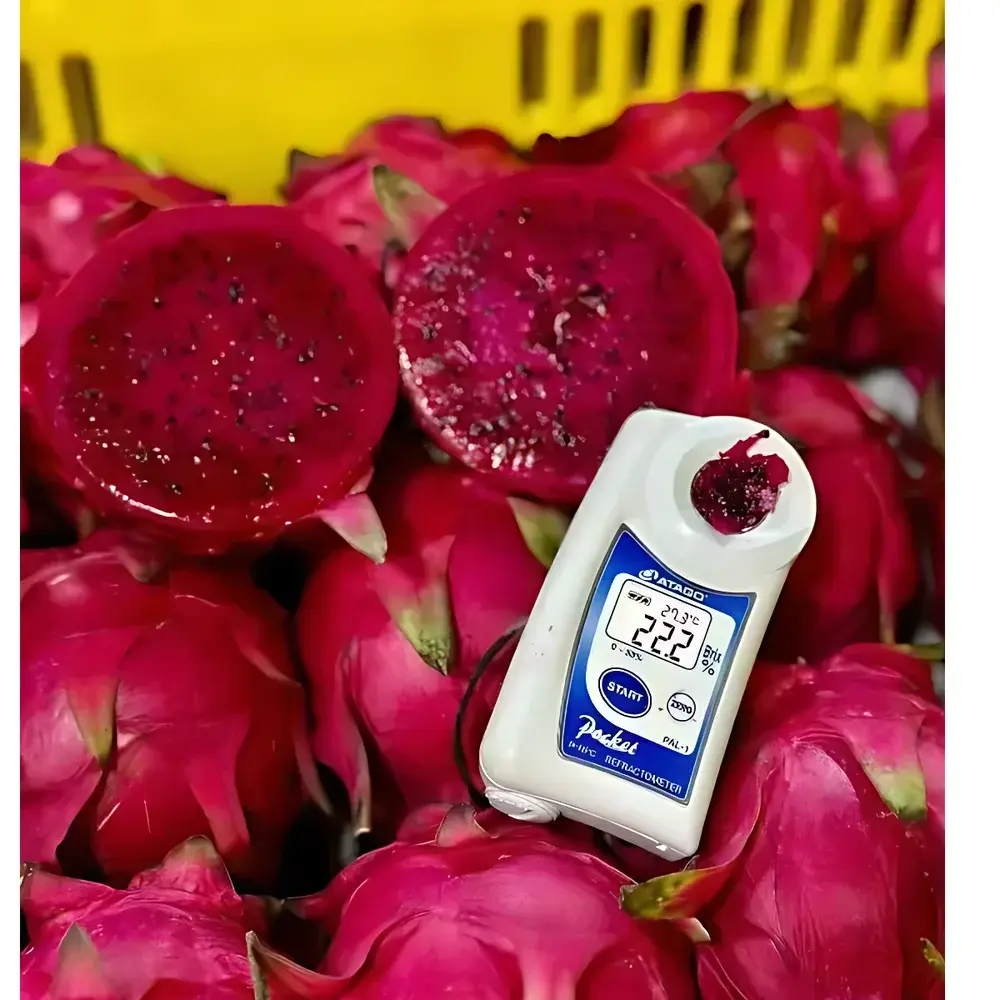
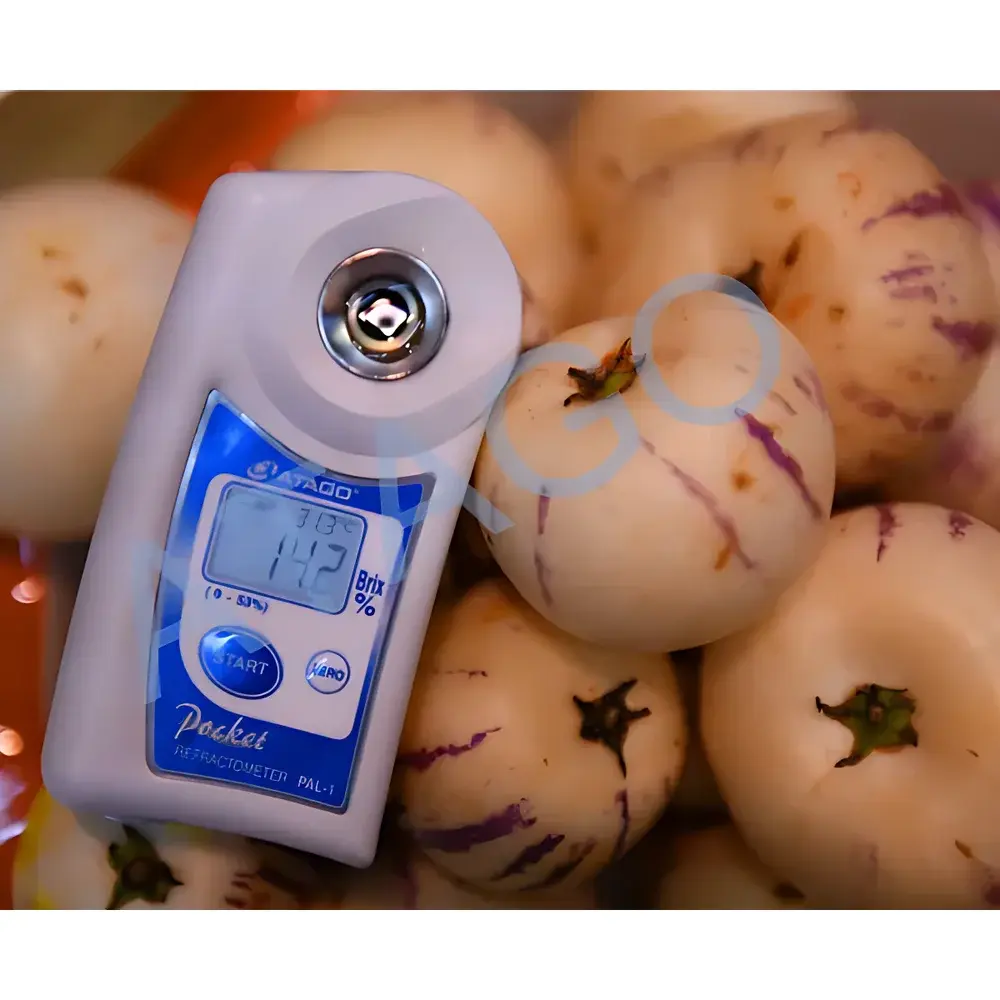
ATAGO PAL-1 Digital Refractometer for Fruit Brix Measurement
| Brand | ATAGO |
|---|---|
| Origin | Japan |
| Model | PAL-1 |
| Measurement Range | 0.0–53.0% Brix |
| Accuracy | ±0.2% Brix |
| Automatic Temperature Compensation (ATC) | Yes (10–100°C) |
| Resolution | 0.1% Brix |
| Operating Ambient Temperature | 10–40°C |
| Power Supply | Two AAA batteries |
| IP Rating | IP65 |
| Dimensions | 55 × 31 × 109 mm |
| Weight | 100 g (instrument only) |
| Type | Destructive Sampling Refractometer |
Overview
The ATAGO PAL-1 Digital Refractometer is a handheld, portable optical instrument engineered for rapid, field-deployable measurement of soluble solids concentration—expressed as Brix (% w/w)—in liquid and semi-liquid samples. It operates on the principle of critical-angle refractometry: incident light passes through a prism-sample interface, and the resulting refraction angle is precisely detected by an internal linear image sensor array. This optical signal is converted into a digital Brix value using factory-calibrated algorithms traceable to NIST-standard sucrose solutions. Designed specifically for agricultural, food processing, and industrial quality control environments, the PAL-1 delivers repeatable results without requiring laboratory infrastructure or operator training beyond basic sample handling. Its compact form factor, rugged housing, and IP65-rated enclosure enable reliable operation in orchards, production lines, and maintenance workshops where dust, moisture, and mechanical shock are common.
Key Features
- High-precision optical system with temperature-compensated sapphire prism and CMOS linear image sensor
- Automatic Temperature Compensation (ATC) across 10–100°C sample temperature range, eliminating manual correction tables
- Digital display with 0.1% Brix resolution and ±0.2% Brix accuracy at 20°C (calibrated with 30% sucrose standard)
- IP65 ingress protection rating ensures resistance to dust and low-pressure water jets—suitable for outdoor and wet-process environments
- Two AAA battery power supply supports >10,000 measurements per set under typical usage conditions
- No warm-up time required; ready for measurement within 2 seconds of activation
- Non-invasive prism cleaning design with integrated microfiber wipe slot and removable protective cover
Sample Compatibility & Compliance
The PAL-1 is validated for use with aqueous solutions containing dissolved sugars (e.g., fructose, glucose, sucrose), organic acids, salts, glycols, and other non-volatile solutes whose refractive index correlates linearly with concentration. Typical compatible matrices include fruit juices (apple, orange, grape), vegetable extracts, soft drinks, syrups, antifreeze (ethylene/propylene glycol blends), cutting fluids, and alkaline cleaning agents. It is not suitable for highly viscous, turbid, or volatile samples (e.g., essential oils, ethanol-rich distillates) without prior dilution or filtration. While the instrument itself does not carry CE, UKCA, or FDA device registration, its measurement methodology aligns with ASTM D115–22 (Standard Test Methods for Rubber—Refractive Index) and ISO 2173:2003 (Fruit and vegetable products — Determination of soluble solids content — Refractometric method). For GLP/GMP-regulated environments, users may implement documented calibration procedures per ISO/IEC 17025 requirements using certified sucrose reference standards.
Software & Data Management
The PAL-1 is a standalone, embedded-system instrument with no Bluetooth, USB, or data logging capability. All measurements are displayed locally and not stored internally. However, its consistent output format and stable calibration allow seamless integration into paper-based or LIMS-linked workflows: operators can manually record readings alongside batch IDs, timestamps, and environmental notes. For automated data capture, third-party barcode scanners or mobile apps (e.g., custom iOS/Android applications via camera-based OCR) may be deployed in conjunction with printed log sheets. ATAGO provides downloadable calibration verification protocols and traceable certificate templates compliant with ISO/IEC 17025 Annex A.2 for metrological validation.
Applications
- Agricultural harvest management: Real-time Brix assessment of apples, pears, grapes, mangoes, and citrus to determine optimal picking windows and post-harvest ripening staging
- Food & beverage QC: In-line verification of juice concentrate dilution ratios, syrup blending consistency, and finished-product sweetness compliance per brand specifications
- Industrial fluid monitoring: Verification of coolant concentration in CNC machining systems, freeze-point validation of automotive antifreeze, and detergent strength in CIP rinse cycles
- Educational laboratories: Teaching core principles of optical density, solution thermodynamics, and empirical calibration modeling in undergraduate chemistry and food science curricula
- Contract testing services: Rapid pre-screening of client-submitted samples prior to full-spectrum HPLC or enzymatic analysis
FAQ
Is the PAL-1 suitable for measuring honey or maple syrup?
No—these materials exceed the instrument’s viscosity and refractive index range. Dilution with distilled water (1:10) followed by multiplication of the reading is possible but introduces uncertainty; dedicated high-Brix refractometers (e.g., PAL-HIKARI series) are recommended.
Does the PAL-1 require periodic recalibration?
Yes—ATAGO recommends daily verification with a 0% and 30% sucrose standard before first use and after any temperature shift exceeding 5°C. Full recalibration by authorized service centers is advised every 12 months or after 5,000 measurements.
Can the PAL-1 measure alcohol content?
No—alcohol lowers refractive index non-linearly and volatilizes rapidly on the prism surface. Ethanol concentration must be determined via densitometry, gas chromatography, or dedicated alcohol refractometers with ethanol-specific scales.
What is the minimum sample volume required?
Approximately 0.3 mL is sufficient to fully cover the prism surface. Excess sample may be wiped away with the included microfiber cloth without affecting measurement integrity.
Is the PAL-1 compliant with FDA 21 CFR Part 11 for electronic records?
No—the device lacks audit trail, electronic signature, or secure data storage capabilities. It functions as an analog-to-digital transducer only; compliance must be achieved at the procedural level (e.g., handwritten logs with witness signatures, timestamped photos).




