
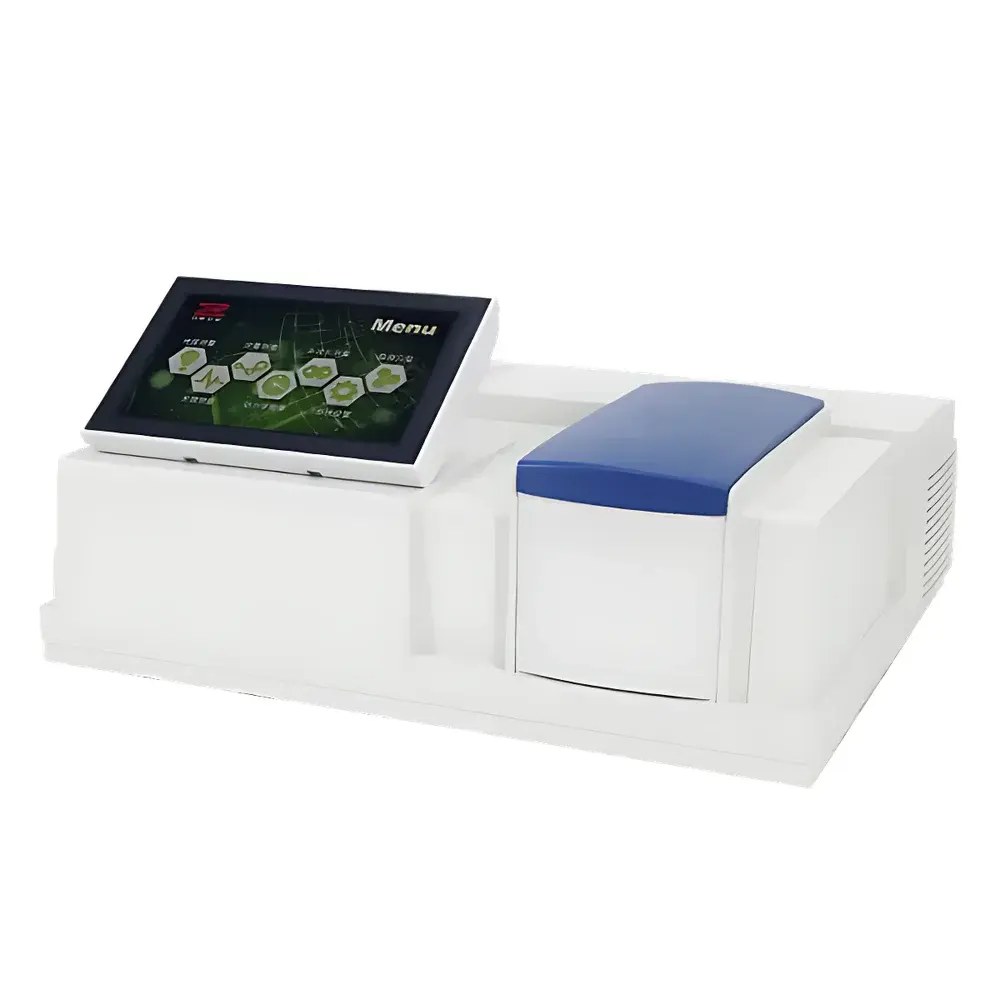
GBPI L9 Dual-Beam UV-Vis Spectrophotometer
| Brand | GBPI |
|---|---|
| Origin | Guangdong, China |
| Manufacturer Type | Original Equipment Manufacturer (OEM) |
| Model | L9 |
| Wavelength Range | 190–1100 nm |
| Optical Design | Czerny-Turner Monochromator |
| Focal Length | 200 mm |
| Grating Density | 1600 lines/mm |
| Spectral Bandwidth | 0.5 / 1 / 2 / 4 / 5 nm (standard at 2 nm) |
| Wavelength Accuracy | ±0.3 nm (typical ≤±0.2 nm) |
| Wavelength Repeatability | ≤0.1 nm |
| Stray Light | ≤0.02% T (at 220 nm, NaI |
| Photometric Range | 0.0–200.0% T, –0.301–4.000 A, 0.000–9999 C |
| Photometric Accuracy | ±0.2% T, ±0.0009 A (0–0.5 A), ±0.002 A (0.5–1 A) |
| Photometric Repeatability | ≤0.08% T, ≤0.0004 A (0–0.5 A), ≤0.008 A (0.5–1 A) |
| Baseline Flatness | ±0.0006 A |
| Noise | 0.03% T / 0.00015 A |
| Baseline Drift | 0.0003 A/h (after 2 h warm-up at 250 nm & 500 nm) |
| Light Source | Imported deuterium lamp + tungsten-halogen lamp, auto-switching at 340 nm (adjustable) |
| Detector | Imported photodiode array or silicon photodetector |
| Display | 10.1″ capacitive touch screen, Android 10 OS, 262k-color, 178° viewing angle |
| Data Storage | 8 GB internal memory |
| Connectivity | USB port, Wi-Fi, Bluetooth |
| Software Options | UVWin8 PC software (optional), GLP-compliant data logging and audit trail support |
Overview
The GBPI L9 Dual-Beam UV-Vis Spectrophotometer is a high-performance analytical instrument engineered for precision absorbance, transmittance, and concentration measurements across the ultraviolet, visible, and near-infrared spectral regions (190–1100 nm). Based on the Czerny-Turner optical architecture with a 200 mm focal length and 1600 lines/mm holographic grating, the system delivers exceptional wavelength fidelity, low stray light (<0.02% T), and high photometric stability—critical for quantitative analysis in regulated environments. Its dual-beam design continuously compensates for source drift and solvent background fluctuations, ensuring reproducible results during kinetic studies, multi-wavelength assays, and long-duration scanning protocols. The instrument is designed to meet fundamental requirements of ISO/IEC 17025-accredited laboratories and supports traceable calibration per ASTM E275 and USP , making it suitable for QC/QA workflows in pharmaceuticals, environmental testing, food safety, and academic research.
Key Features
- Aberration-corrected Czerny-Turner monochromator delivering high resolution and minimal optical distortion across the full spectral range.
- 10.1-inch capacitive touchscreen running Android 10 OS, enabling intuitive operation without external PCs—ideal for glove-box or cleanroom deployment.
- Auto-switching dual-source illumination (deuterium + tungsten-halogen lamps) with dynamic optimization of lamp position and intensity; switching point adjustable between 320–360 nm.
- Five selectable spectral bandwidths (0.5, 1, 2, 4, and 5 nm) to balance resolution and signal-to-noise ratio for diverse sample types.
- Integrated 8 GB flash memory supporting storage of >100,000 spectra, method files, calibration logs, and embedded instructional videos compliant with GxP training documentation standards.
- Wireless connectivity via Wi-Fi and Bluetooth enables secure export of spectra, screenshots, or screen recordings directly to mobile devices or network printers—fully auditable under FDA 21 CFR Part 11 when paired with UVWin8 software.
- USB host port allows direct data transfer to USB drives in CSV, TXT, or JCAMP-DX formats; compatible with third-party LIMS and ELN systems.
Sample Compatibility & Compliance
The L9 accommodates standard 1 cm quartz or glass cuvettes as standard, with optional accessories including 5 cm and 10 cm pathlength holders, solid-sample reflectance stages, gas cells, and thermostatted flow cells (Peltier or water-jacketed). All optical components are certified for UV-grade transmission down to 190 nm. Instrument validation follows IQ/OQ protocols aligned with ISO 9001 and ISO/IEC 17025. Built-in self-diagnostics monitor lamp energy, detector linearity, and baseline stability in real time. Stray light performance complies with ISO 10810 and JIS K 0115 specifications. When operated with UVWin8 software, the system supports electronic signatures, user access levels, and full audit trails required for GLP and GMP compliance.
Software & Data Management
Onboard Android firmware provides native execution of common analytical routines: full-spectrum scanning, fixed-wavelength quantitation (up to 3 λ), time-resolved kinetics, multi-point calibration curves (1st–3rd order), derivative spectroscopy (1st–4th order), and baseline correction algorithms. Data files include metadata such as date/time stamp, operator ID, instrument serial number, and measurement parameters—enabling full traceability. UVWin8 PC software (optional) extends functionality with advanced peak integration, spectral library matching, batch processing, and automated report generation compliant with FDA 21 CFR Part 11 Annex 11 requirements. All exported data retain embedded timestamps and checksums to prevent tampering.
Applications
- Pharmaceutical: Assay of active pharmaceutical ingredients (APIs), dissolution testing, excipient compatibility studies, and stability-indicating methods per ICH Q2(R2).
- Environmental: Quantification of nitrate, phosphate, heavy metals (via colorimetric complexes), and organic pollutants (e.g., phenols, PAHs) in water and soil extracts.
- Food & Beverage: Determination of antioxidants (e.g., ascorbic acid), colorants (E-numbers), protein content (Lowry/BCA), and enzymatic activity (NADH/NADPH kinetics).
- Academic Research: Teaching spectroscopic principles, enzyme kinetics modeling, ligand-binding studies, and nanoparticle characterization (surface plasmon resonance estimation).
- Quality Control Labs: Routine verification of raw material purity, cleaning validation swab analysis, and incoming inspection of dyes and pigments.
FAQ
Does the L9 support regulatory-compliant data integrity?
Yes—when used with UVWin8 software, the system implements role-based user authentication, electronic signatures, immutable audit trails, and encrypted data storage meeting FDA 21 CFR Part 11 and EU Annex 11 requirements.
Can the instrument perform kinetic measurements over extended time periods?
Yes—its dual-beam architecture and thermally stabilized optics enable stable monitoring for up to 24 hours, with configurable sampling intervals from 0.1 s to 60 min.
Is calibration traceable to NIST or other national standards?
All factory calibrations are performed using NIST-traceable holmium oxide and didymium filters; users may perform routine verification using certified reference materials per ASTM E275.
What maintenance is required for the light sources?
Deuterium and tungsten lamps are rated for ≥2,000 hours; automatic lamp diagnostics alert operators prior to end-of-life, and replacement requires no optical realignment due to precision mechanical fixtures.
Can custom application methods be deployed across multiple instruments?
Yes—methods created on one L9 can be exported as encrypted .uvw files and imported onto other units, ensuring method uniformity across distributed lab networks.




