
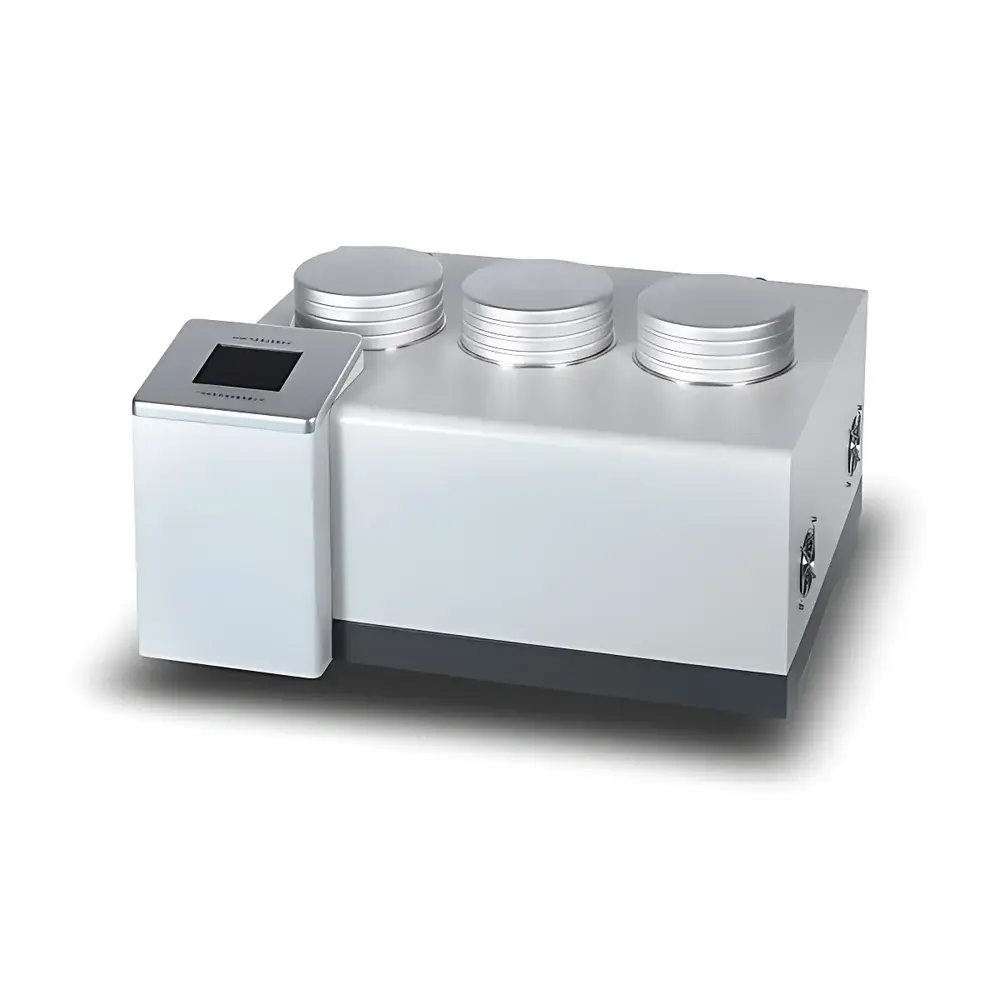
GBPI N530G Differential-Pressure Gas Permeability Analyzer
| Brand | GBPI |
|---|---|
| Origin | Guangdong, China |
| Manufacturer | GBPI Packaging Equipment Co., Ltd. |
| Model | N530G-aa |
| Test Gases | O₂, CO₂, N₂ |
| Measurement Range | 0.02–50,000 cm³/(m²·24h·0.1 MPa), extendable to 600,000 cm³/(m²·24h·0.1 MPa) |
| Accuracy | 0.001 cm³/(m²·24h·0.1 MPa) |
| Temperature Control | 15–60 °C ±0.1 °C |
| Vacuum Level | <20 Pa (resolution: 0.01 Pa) |
| Test Pressure Range | −0.1 to +0.1 MPa |
| Gas Supply Pressure | 0.2–0.8 MPa |
| Specimen Area | 50.24 cm² |
| Specimen Diameter | Φ110 mm |
| Max Thickness | ≤2 mm |
| Chamber Configuration | Triple independent test chambers |
| Power | AC 220 V, 50 Hz, 1000 W |
| Dimensions | 800 × 620 × 480 mm |
| Weight | 77 kg |
Overview
The GBPI N530G Differential-Pressure Gas Permeability Analyzer is an engineered solution for precise, standardized determination of gas transmission rates (GTR) through polymeric films, laminates, foils, and rigid packaging structures. It operates on the differential-pressure (manometric) principle per ASTM D1434, ISO 15105-1:2007, ISO 2556:1974, GB/T 1038-2000, JIS K7126-1:2006, and YBB 00082003-2015. In this method, a conditioned specimen separates two sealed chambers: the upstream (high-pressure) side is pressurized with a pure test gas (e.g., O₂, CO₂, or N₂), while the downstream (low-pressure) side is evacuated to sub-20 Pa vacuum. The resulting pressure gradient drives gas diffusion across the membrane; real-time monitoring of downstream pressure rise—coupled with known chamber volume, temperature, and permeation area—enables calculation of gas permeability in standard units (cm³/(m²·24h·0.1 MPa)). This gravimetrically traceable, physically grounded approach ensures metrological integrity without reliance on carrier gases or detectors requiring frequent calibration.
Key Features
- Triple Independent Test Chambers: Three thermally isolated, pneumatically decoupled test stations enable concurrent evaluation of identical or dissimilar specimens under identical or varied conditions—including different gases (e.g., O₂ in Chamber 1, CO₂ in Chamber 2, N₂ in Chamber 3)—yielding three fully independent, audit-ready reports per cycle.
- High-Fidelity Environmental Control: Electromagnetic stepwise temperature regulation maintains ±0.1 °C stability across 15–60 °C, eliminating bulky external baths and minimizing thermal lag. Each chamber integrates its own calibrated PT100 sensor and PID-controlled heating/cooling loop.
- Extended Dynamic Range Architecture: Standard range spans 0.02–50,000 cm³/(m²·24h·0.1 MPa); optional volumetric expansion module extends upper limit to 600,000 cm³/(m²·24h·0.1 MPa), supporting low-barrier films (e.g., PET, PP) and ultra-high-barrier substrates (e.g., Al foil, SiOₓ-coated PET) within a single platform.
- ARM-Based Embedded Control System: Standalone operation via 7-inch color capacitive touchscreen eliminates dependency on external PCs. All control logic—including vacuum sequencing, gas dosing, pressure ramping, and auto-hold differential maintenance—is executed locally with deterministic timing and firmware-level fault recovery.
- GMP-Compliant Data Governance: Role-based access control (Administrator, Operator, Viewer) enforces procedural discipline. Full audit trail captures user login/logout, method modification, result export, and manual data entry events—fully compliant with FDA 21 CFR Part 11 and EU Annex 11 requirements for computerized systems in regulated environments.
Sample Compatibility & Compliance
The N530G accommodates flat sheet materials up to 2 mm thickness and 110 mm diameter—including monolayer plastics (LDPE, BOPP), coextrusions, metallized films (Al-coated PET), ceramic-coated substrates, rubber sheets, and rigid plates. With optional container adapters, it quantifies gas ingress through formed packages: pouches, blister cavities, injection-molded trays, and pharmaceutical bottles (per ASTM F2638 for container testing). All measurements adhere to internationally harmonized standards referenced in quality agreements across pharma (ICH Q5C), medical device (ISO 11607-1), food packaging (EU 10/2011), and electronics (IPC-CC-830B for moisture-sensitive components). Certified reference materials (GBW(E)130541/2) are supplied for routine verification per ISO/IEC 17025 calibration protocols.
Software & Data Management
GBPI PermeaSoft™ v4.2 provides intuitive workflow navigation, customizable test templates, and real-time multi-parameter visualization (pressure, ΔP, temperature, cumulative permeation). Raw data is stored in encrypted SQLite databases with immutable timestamps and SHA-256 hash integrity checks. Reports generate automatically in PDF (with digital signature field) and editable Office formats (DOCX, XLSX), embedding instrument ID, calibration certificate numbers, environmental logs, and raw curve exports. Export functions include CSV-compatible time-series datasets for statistical process control (SPC) integration and LIMS interfacing via configurable RESTful API endpoints. All software modules undergo annual penetration testing and are validated per GAMP5 Category 3 criteria.
Applications
- Pharmaceutical primary packaging qualification (blister foil, sachet laminates, vial stoppers)
- Food shelf-life modeling via O₂ transmission rate (OTR) and CO₂ transmission rate (CTR) correlation
- Barrier layer development for flexible OLED encapsulation and perovskite solar cell backsheets
- Regulatory submission support for USP , EP 3.2.1, and JP 17 compliance dossiers
- QC release testing of medical adhesives, transdermal patches, and contact lens packaging
- Material comparison studies for sustainable mono-material alternatives to multilayer laminates
FAQ
What standards does the N530G comply with for regulatory submissions?
The instrument meets all technical and reporting requirements of ASTM D1434, ISO 15105-1, GB/T 1038, and YBB 00082003-2015. Its validation package supports ICH Q5C, USP , and EU Annex 15 protocols.
Can the system validate ultra-high-barrier materials like aluminum foil or SiOx-coated films?
Yes—the base configuration achieves 0.001 cm³/(m²·24h·0.1 MPa) resolution, and the extended-range option enables accurate measurement down to <0.0001 cm³/(m²·24h·0.1 MPa) when paired with certified low-permeability reference standards.
Is remote monitoring or LIMS integration supported?
PermeaSoft™ includes built-in Ethernet and RS-232 ports, plus optional OPC UA and HL7-compliant interfaces for seamless integration into enterprise laboratory informatics systems.
How is calibration traceability maintained?
Each unit ships with NIST-traceable GBW(E)130541/2 certified permeability standards. On-site calibration verification follows ISO/IEC 17025 procedures using dual-pressure sensor cross-checking and thermal drift compensation algorithms.
Does the triple-chamber design require separate validation for each station?
No—chambers share a common vacuum manifold and temperature control architecture. IQ/OQ documentation covers all three stations simultaneously under a single validation protocol, reducing qualification effort by >60% versus single-chamber equivalents.






