
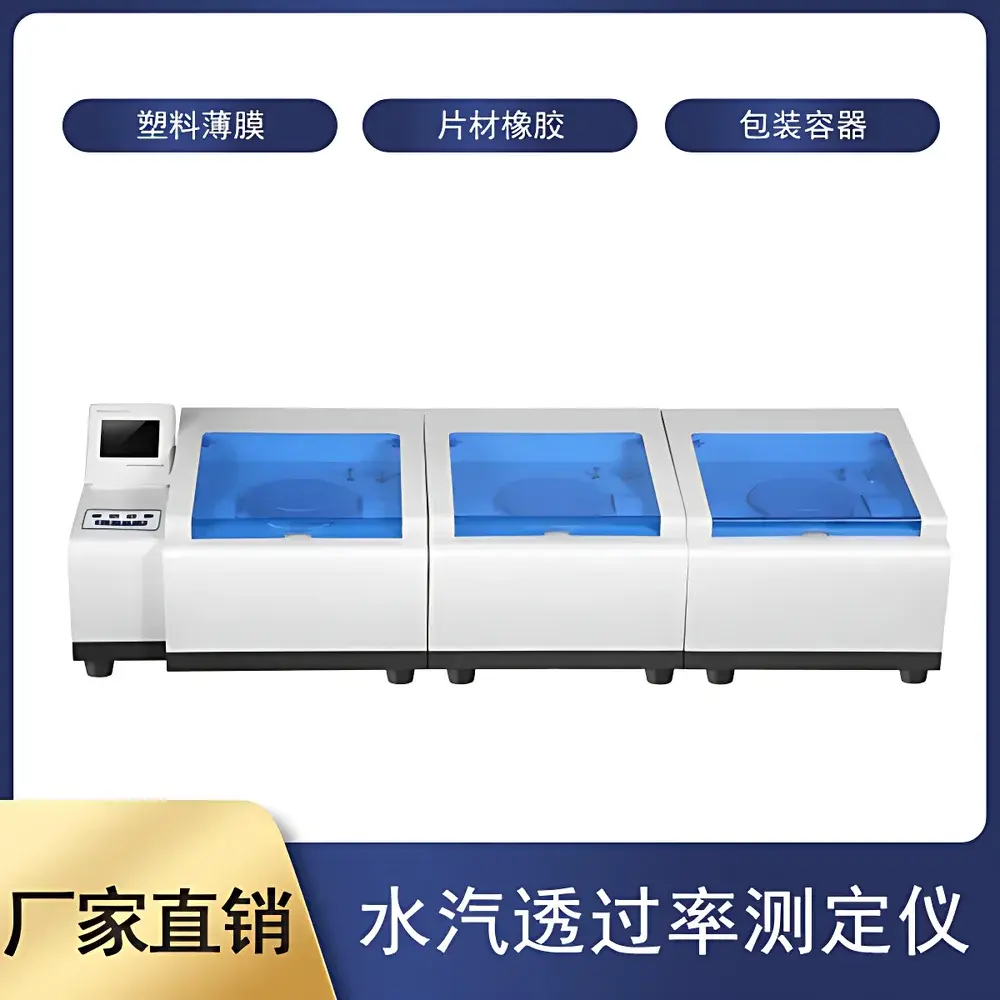
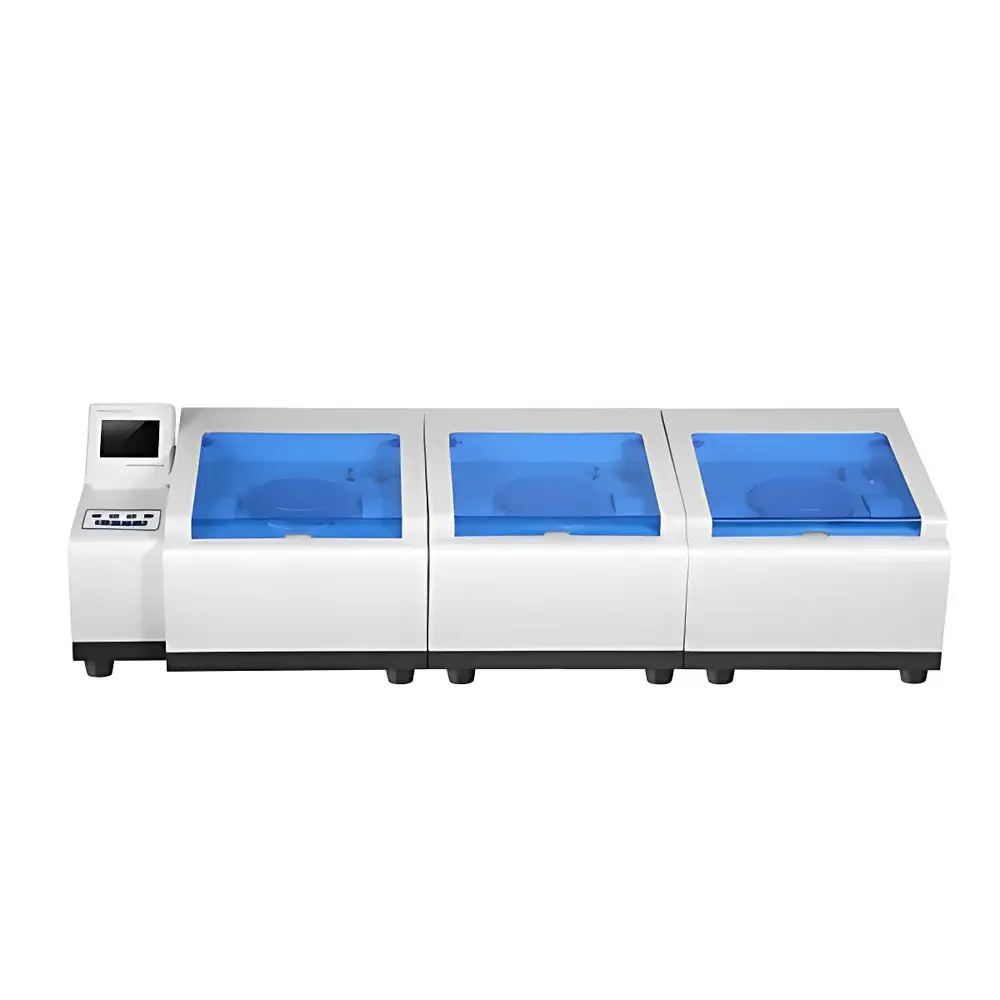
GBPI W533 Gravimetric Water Vapor Transmission Rate (WVTR) Tester
| Brand | GBPI |
|---|---|
| Origin | Guangdong, China |
| Manufacturer Type | Direct Manufacturer |
| Model | W533 |
| Measurement Principle | Gravimetric (Cup Method) |
| Test Range | 0.1–10,000 g/(m²·24h) |
| Accuracy | 0.001 g/(m²·24h) |
| Weight Resolution | 0.1 mg |
| Temperature Control Range | 15–55 °C |
| Temp. Stability | ±0.1 °C |
| Humidity Control Range | 30–90% RH and 100% RH |
| Humidity Stability | ±1% RH |
| Test Area | 86.54 cm² |
| Specimen Diameter | Φ125 mm |
| Max. Specimen Thickness | ≤5 mm |
| Purge Air Velocity | 0.5–2.5 m/s |
| Interface | Φ4 mm polyurethane tubing |
| Supply Pressure | ≥0.2 MPa |
| Capacity | 3 test stations (expandable to 10) |
| Dimensions | 1680 × 500 × 375 mm |
| Weight | 160 kg |
| Power | 1000 W, AC 220 V / 50 Hz |
Overview
The GBPI W533 Gravimetric Water Vapor Transmission Rate (WVTR) Tester is an ISO- and ASTM-compliant laboratory instrument engineered for precise, reproducible measurement of water vapor permeation through packaging and barrier materials. It operates on the standardized gravimetric cup method (also known as the desiccant method), in which a conditioned test specimen separates two controlled environmental chambers: an upper chamber saturated with humid nitrogen (or ambient air at defined RH), and a lower chamber containing desiccant. Water vapor diffuses across the specimen under a defined vapor pressure gradient and is quantitatively absorbed by the desiccant. The mass gain of the desiccant assembly is measured continuously using a high-resolution analytical balance (0.1 mg resolution), enabling calculation of WVTR in g/(m²·24h) per ISO 2528, ASTM E96/E96M, and GB/T 1037. This principle ensures traceable, physics-based results without optical or electrochemical assumptions—critical for regulatory submissions, QC release testing, and material development in regulated industries.
Key Features
- Triple-test-station architecture with independent environmental control per station, supporting parallel evaluation of heterogeneous materials or replicates—reducing inter-test variability and throughput time.
- Electromagnetic programmable step-control temperature system delivering ±0.1 °C stability across 15–55 °C, validated per ASTM D1653 Annex A1 for thermal uniformity.
- Dual-gas-stream humidity regulation (dry + humid N₂ blending) achieving ±1% RH accuracy from 30% to 100% RH, compliant with TAPPI T464 and JIS Z0208 operational tolerances.
- Embedded ARM-based controller with 7-inch color touchscreen interface—enabling full stand-alone operation without external PC; real-time visualization of temperature, RH, cumulative mass gain, and calculated WVTR curves.
- Modular hardware design with plug-in sensor modules (electrolytic RH sensors, PT100 temperature probes) and automatic over-range protection—minimizing downtime and extending service intervals.
- GMP-aligned software architecture compliant with FDA 21 CFR Part 11 and EU Annex 11 requirements: role-based access control (administrator, operator, reviewer), electronic signatures, and immutable audit trails covering system events, method changes, and raw data modifications.
Sample Compatibility & Compliance
The W533 accommodates flat specimens (films, sheets, foils, papers) up to Φ125 mm and 5 mm thick—including high-barrier substrates such as Al foil, metallized PET, SiOₓ-coated films, and PVDC laminates—as well as rigid and flexible containers (bottles, pouches, cups, trays, tubes) via optional fixture kits. Validated applications span pharmaceutical primary packaging (e.g., blister cavities, HDPE bottles per YBB00092003-2015), food-grade multilayer composites (e.g., retort pouches, coffee bags), medical device barriers (sterile wrap films, transdermal patches), photovoltaic backsheet materials (IEC 61215 moisture ingress screening), and automotive fuel tanks (ISO 11614 permeation assessment). All measurements adhere to harmonized standards including ISO 2528:1995, ASTM E96/E96M-2016 (Procedure A & B), GB/T 1037-1988, and DIN 53122-1. Certified reference materials (GBW(E)130543/4) are supplied for routine performance qualification and instrument calibration.
Software & Data Management
The embedded test software provides complete lifecycle data governance. Users define test protocols—including conditioning time, target RH/temperature setpoints, purge duration, and endpoint criteria—via intuitive drag-and-drop workflow configuration. Real-time data acquisition logs mass, temperature, RH, and derived WVTR at user-defined intervals (default: 30-min). All raw and processed data reside in an encrypted local SQLite database with timestamped versioning. Reporting supports automated generation of GLP-compliant PDF or Office-compatible documents, including metadata (operator ID, instrument serial number, calibration status, environmental logs), statistical summaries (mean, SD, CV%), and graphical overlays of replicate traces. Audit trail records capture every login, parameter edit, report export, and calibration event—fully searchable and exportable for internal audits or regulatory inspections.
Applications
This instrument serves critical quality control and R&D functions across vertically regulated sectors. In pharmaceutical manufacturing, it verifies moisture barrier integrity of blister lidding foils and HDPE/PP containers per USP <671> and ICH Q5C stability guidelines. For food packaging developers, it quantifies shelf-life limiting factors in snack pouches, dairy cartons, and frozen meal trays under accelerated aging conditions. Battery manufacturers assess electrolyte retention in lithium-ion cell casings; solar panel producers screen ethylene-vinyl acetate (EVA) encapsulant and Tedlar® backsheet combinations against IEC 61215 humidity freeze test prerequisites. Packaging engineers use its container mode to benchmark seal integrity of vacuum-sealed meat trays or hot-fill PET bottles—directly informing package redesign and shelf-life modeling. Its adaptability to non-standard geometries (e.g., toothpaste tubes, insulin pens, IV bags) makes it indispensable for functional barrier validation beyond flat-film norms.
FAQ
What standards does the W533 comply with?
The instrument meets ISO 2528, ASTM E96/E96M (Procedures A and B), ASTM D1653, GB/T 1037, GB/T 16928, TAPPI T464, DIN 53122-1, JIS Z0208, and YBB00092003-2015.
Can it test high-barrier materials like aluminum foil?
Yes—its high-resolution weighing system (0.1 mg) and extended low-end detection limit (0.1 g/(m²·24h)) enable accurate characterization of ultra-low-permeability substrates when used with appropriate conditioning and extended test durations.
Is the software 21 CFR Part 11 compliant?
Yes—the software implements electronic signatures, role-based permissions, and immutable audit trails for all data-critical actions, satisfying FDA requirements for computerized systems in GxP environments.
How many samples can be tested simultaneously?
The base configuration supports three independent test stations; expansion kits allow scaling to ten stations for high-throughput labs.
Does it support container testing?
Yes—optional fixtures enable WVTR measurement of bottles, pouches, cups, tubes, and trays per ASTM F1249 (modified cup method) and internal validation protocols.
What calibration references are provided?
GBPI supplies NIST-traceable certified reference materials (GBW(E)130543/4) for routine performance verification and instrument calibration, aligned with ISO/IEC 17025 metrological practices.





