
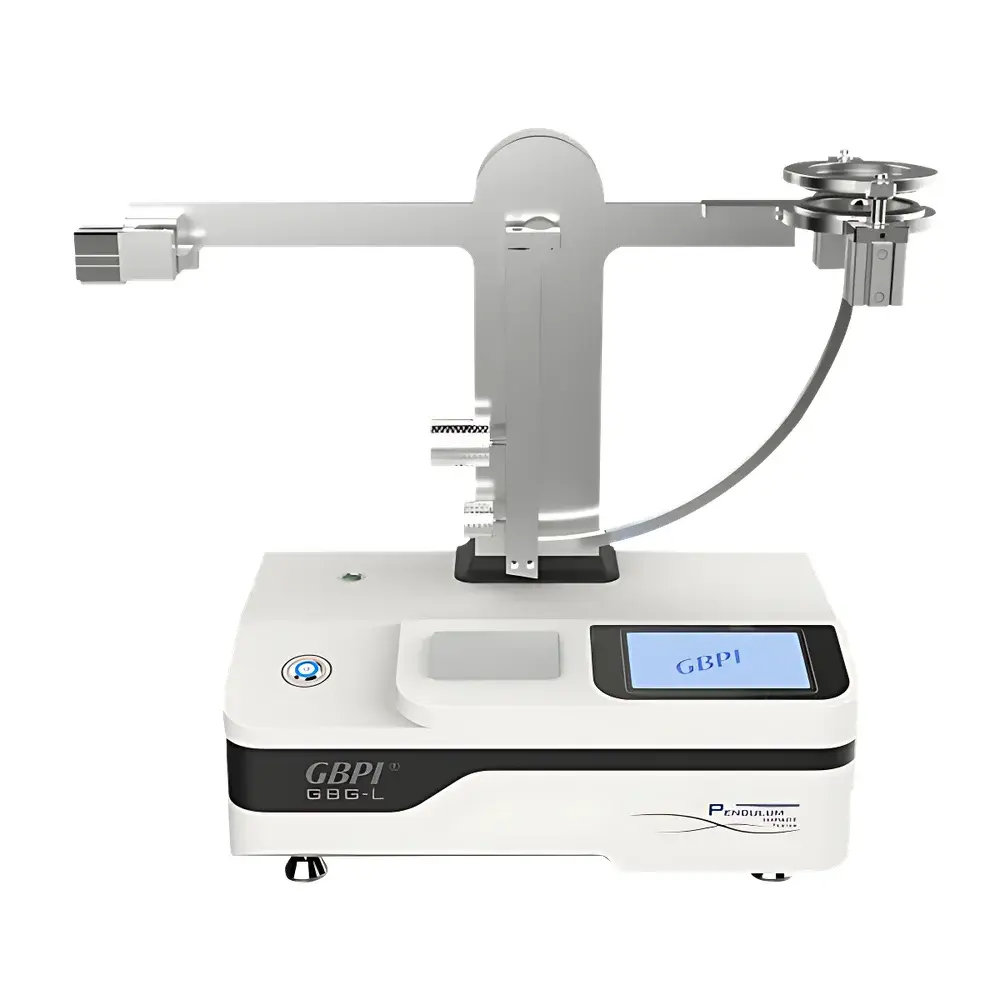
GBPI GBG-L2 Electronic Pendulum Impact Tester
| Brand | GBPI |
|---|---|
| Origin | Guangdong, China |
| Manufacturer Type | Manufacturer |
| Product Category | Domestic |
| Model | GBG-L2 |
| Instrument Type | Pendulum Impact Tester |
| Nominal Impact Energy | 5 J (8 J optional) |
| Energy Resolution | 0.001 J |
| Pendulum Lift Angle | 90° |
| Pendulum Radius | 285 mm |
| Impact Tip Diameter | Φ19 mm and Φ25.4 mm |
| Clamp Aperture | Φ60 mm and Φ89 mm |
| Specimen Size | 100 mm × 100 mm |
| Dimensions (L×W×H) | 773 mm × 378 mm × 606 mm |
| Power Consumption | 75 W |
| Supply Voltage | AC 220 V, 50 Hz |
Overview
The GBPI GBG-L2 Electronic Pendulum Impact Tester is a precision-engineered instrument designed for quantitative evaluation of impact resistance in thin, flexible sheet materials—primarily plastic films, laminates, foils, and paper-based substrates. It operates on the classical pendulum impact principle defined in ASTM D3420 and ISO 6603-2 (equivalent to GB/T 8809 and GB/T 21189), where a calibrated pendulum arm with a hemispherical impact tip strikes a horizontally clamped specimen at a defined velocity. The energy absorbed during fracture—or partial deformation—is calculated from the angular displacement of the pendulum post-impact, measured via high-resolution rotary encoder technology. Unlike mechanical analog systems, the GBG-L2 employs fully electronic energy acquisition with 0.001 J resolution, eliminating parallax error and gear backlash inherent in legacy pointer-type testers. Its rigid cast-iron frame, precision-machined pivot bearing, and pneumatic specimen clamping ensure repeatable alignment and minimal energy loss during transfer—critical for compliance with GLP-aligned testing workflows in R&D labs and QC environments.
Key Features
- Electronic energy measurement with ±0.001 J resolution and traceable calibration path per ISO/IEC 17025 requirements
- Color TFT touchscreen interface with intuitive navigation, real-time impact curve visualization, and multi-language support (English, Chinese, Spanish)
- Pneumatically actuated specimen clamping (user-supplied air source ≥0.6 MPa) ensuring uniform pressure distribution across Φ60 mm or Φ89 mm aperture fixtures
- Dual-tip configuration: interchangeable hemispherical impactors (Φ19 mm and Φ25.4 mm) compliant with ASTM D3420 Annex A1 and GB/T 8809 Clause 5.2
- Automatic pendulum release mechanism synchronized with clamp pressurization to eliminate operator-induced timing variance
- Integrated leveling assistance system with dual-axis digital inclinometer for rapid horizontal alignment verification (±0.1° accuracy)
- Onboard data storage for ≥1,000 test records with timestamp, operator ID, specimen ID, and environmental metadata (optional external temperature/humidity sensor input)
Sample Compatibility & Compliance
The GBG-L2 accommodates standardized 100 mm × 100 mm specimens across diverse material classes including polyolefin-based packaging films (e.g., PE, PP, CPP), metallized PET/AL composites, nylon-based barrier laminates, aluminum foils (≥6 µm thickness), and coated paperboard used in pharmaceutical blister packaging and tobacco cartons. Fixture geometry and impact tip selection align with the dimensional tolerances specified in ASTM D3420–16 Section 6.3 and GB/T 8809–2015 Clause 4. All mechanical components—including pendulum shaft, bearing housing, and anvil base—are manufactured to ISO 2768-mK general tolerances. The system supports audit-ready documentation: test logs include digital signatures, change history, and exportable CSV/Excel reports compatible with LIMS integration. When configured with optional audit trail firmware, it meets FDA 21 CFR Part 11 requirements for electronic records and signatures in regulated pharmaceutical and medical device manufacturing settings.
Software & Data Management
Firmware v3.2+ provides embedded test method templates preloaded with ASTM D3420, GB/T 8809, and ISO 6603-2 parameters—including default impact velocity (3.8 m/s), pendulum mass (3.8 kg), and energy range validation logic. Raw encoder data is sampled at 10 kHz during swing event capture, enabling post-hoc waveform analysis of peak force duration and rebound characteristics. Export formats include .csv (for statistical process control in Minitab/JMP), .pdf (with customizable header/footer and company logo), and .xml (for automated ingestion into enterprise quality management systems). Optional PC-based GBPI TestSuite software enables advanced statistical reporting (X̄-R charts, Cp/Cpk calculation), multi-instrument fleet monitoring, and remote firmware updates via secure HTTPS channel. All data files carry embedded hash signatures to prevent tampering—fully compliant with ISO/IEC 17025 clause 7.5.2 on result integrity.
Applications
This instrument serves as a primary tool for comparative impact toughness screening in packaging development laboratories evaluating seal integrity under drop conditions; for supplier qualification of barrier film suppliers in food and pharma supply chains; and for routine QC release testing of finished pouches, sachets, and lidding foils. It is routinely deployed in accreditation bodies conducting CNAS-CL01 assessments and in university polymer science departments for teaching fracture mechanics fundamentals. Specific use cases include: quantifying embrittlement effects of UV aging on PE films, validating cold-temperature impact performance of retort pouch laminates, assessing delamination resistance in AlOx-coated PET, and benchmarking puncture resistance of kraft paperboard versus synthetic fiber composites.
FAQ
What standards does the GBG-L2 comply with?
ASTM D3420–16, GB/T 8809–2015, GB/T 21189–2007, and ISO 6603-2:2013.
Is an air compressor included with the system?
No—users must provide a clean, dry, oil-free compressed air source rated ≥0.6 MPa (6 bar) and ≤10 L/min flow capacity.
Can the instrument be integrated into a laboratory network?
Yes—via Ethernet port supporting DHCP/Static IP assignment and compatible with standard SNMP v2c monitoring tools.
How often does the system require recalibration?
Annual calibration is recommended; GBPI provides NIST-traceable calibration certificates and offers on-site verification services.
Does the GBG-L2 support multi-specimen batch testing?
Yes—up to 20 specimens can be queued with automatic pass/fail criteria based on user-defined energy thresholds and statistical limits.



