
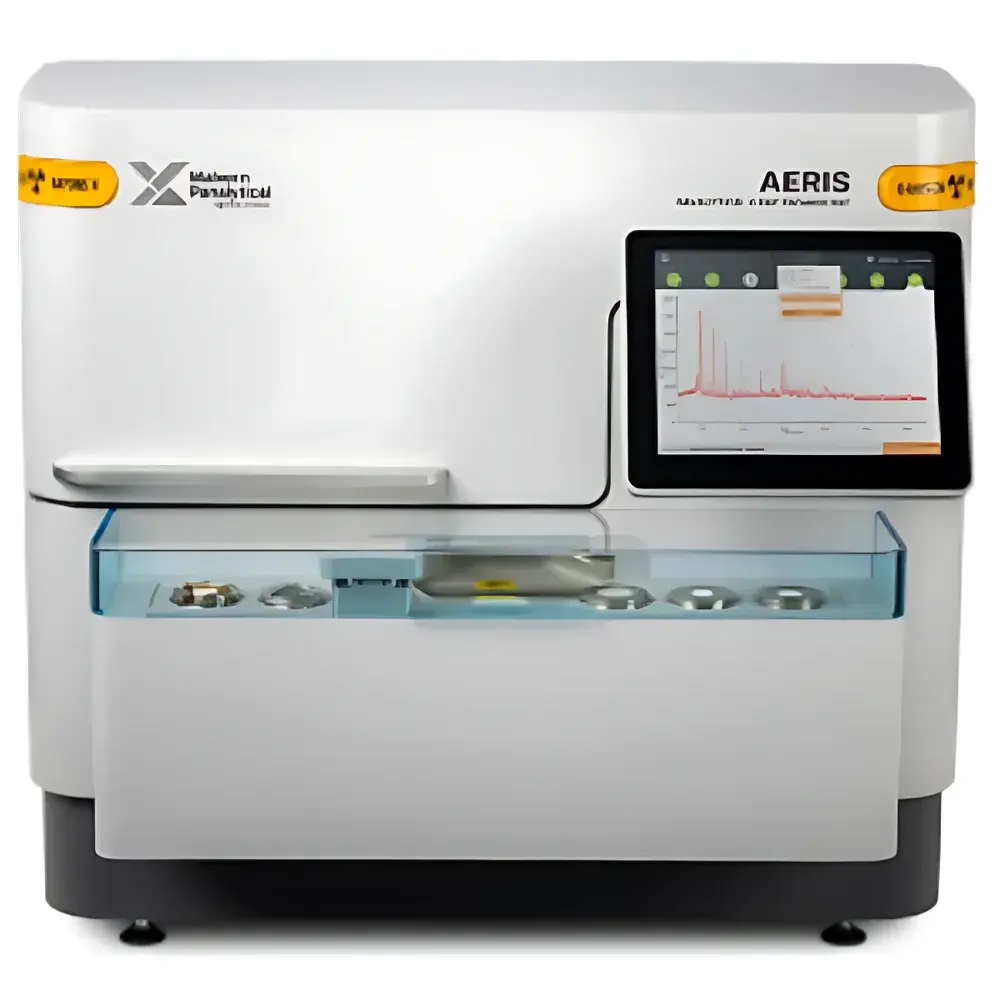
Malvern PANalytical Aeris Cement Edition X-ray Diffractometer
| Brand | Malvern PANalytical |
|---|---|
| Origin | United Kingdom |
| Manufacturer Type | Authorized Distributor |
| Origin Category | Imported |
| Model | Aeris Cement Edition |
| Pricing | Upon Request |
Overview
The Malvern PANalytical Aeris Cement Edition is a benchtop X-ray diffractometer engineered for routine, high-reliability mineralogical phase analysis in cement manufacturing environments. It operates on the fundamental principle of Bragg’s Law (nλ = 2d sinθ), using monochromatic Cu-Kα radiation to generate diffraction patterns from crystalline phases present in raw meal, clinker, blended cements, and final products. Unlike indirect compositional proxies, XRD provides direct identification and quantification of key mineral phases—including alite (C3S), belite (C2S), tricalcium aluminate (C3A), tetracalcium aluminoferrite (C4AF), free lime (CaO), and gypsum—enabling precise correlation with critical performance attributes: compressive strength development, setting time, hydration kinetics, sulfate resistance, and alkali-silica reactivity. Its design targets continuous integration into industrial process control workflows, delivering actionable mineralogical data within minutes—not hours—to support real-time kiln optimization, alternative fuel substitution strategies, and consistent product conformity.
Key Features
- Benchtop architecture with external sample loading—minimizing internal dust ingress and maximizing uptime in high-particulate factory settings
- Direct detection CCD-based detector system optimized for cement matrix complexity and low-phase-concentration sensitivity
- Pre-configured, validated measurement protocols for ISO 20561-compliant clinker and ASTM C1365-22 compliant cement phase analysis
- Integrated 10.1-inch capacitive touchscreen interface enabling full operation without external PC: sample placement → method selection → result visualization in under 30 seconds
- Low infrastructure dependency: single-phase 230 V AC power only—no chilled water, compressed air, or external cooling units required
- Modular automation readiness: standardized mechanical interfaces and digital I/O for seamless integration with conveyor-fed sample handling systems or robotic arms
- Dedicated 51.5 mm industrial sample cup (ISO 17892-4 compatible) and optional 40 mm cup for rapid turnaround on high-volume production lines
Sample Compatibility & Compliance
The Aeris Cement Edition accommodates pressed pellets, loose powders, and semi-compacted samples derived from standard cement plant sampling procedures. All sample preparation workflows align with EN 196-2, ASTM C114, and ISO 679 requirements. Instrument compliance includes CE marking per EU Machinery Directive 2006/42/EC and electromagnetic compatibility per IEC 61326-1. Data integrity meets GLP/GMP expectations through audit-trail-enabled software logging (user actions, method parameters, timestamps). Optional 21 CFR Part 11 compliance packages are available for regulated quality assurance laboratories requiring electronic signature and change-control functionality.
Software & Data Management
Powered by Malvern PANalytical’s HighScore Plus software suite, the system delivers automated phase identification via ICDD PDF-4+ Cement database, Rietveld quantitative analysis (with internal standard or reference intensity ratio methods), and trend reporting aligned with SPC (Statistical Process Control) frameworks. Raw data (.raw, .xye) and processed reports (.pdf, .xlsx) export directly to LIMS via ASTM E1482-compliant XML or OPC UA protocol. Batch processing supports unattended overnight runs; method templates enforce analytical consistency across shifts and operators. All calibration records, detector stability logs, and maintenance history are embedded in the instrument metadata for traceability during internal audits or third-party certification reviews.
Applications
- Real-time clinker mineralogy monitoring to adjust kiln burning zone temperature and residence time
- Quantification of free CaO and β-C2S content as indicators of underburning or overcooling
- Verification of gypsum dehydration state (dihydrate vs. hemihydrate) in blended cements affecting setting behavior
- Tracking pozzolanic phase evolution (e.g., metakaolin, slag, fly ash) in low-carbon cement formulations
- Root-cause analysis of strength deviations or false set incidents through retrospective phase correlation
- Supporting EPD (Environmental Product Declaration) documentation via mineral-specific CO2 emission factor allocation
FAQ
What is the typical analysis time for clinker or finished cement?
Standard quantitative Rietveld analysis requires 5–10 minutes per sample, depending on required precision and phase complexity.
Does the Aeris Cement Edition require external cooling or compressed air?
No—it operates exclusively on standard single-phase 230 V AC power; no auxiliary utilities are needed.
Can it be integrated with existing factory automation systems?
Yes—via digital I/O signals, Modbus TCP, or OPC UA for synchronization with PLCs, MES, or robotic sample handlers.
Is method validation support available for regulatory submissions?
Yes—Malvern PANalytical provides IQ/OQ documentation templates and application notes aligned with ISO/IEC 17025 and ASTM C1365 verification requirements.
How does it interface with Zetium elemental analyzers?
Chemical composition data from Zetium (e.g., SiO2, Al2O3, Fe2O3) can be imported into HighScore Plus to constrain Rietveld refinements and improve phase quantification accuracy.







