
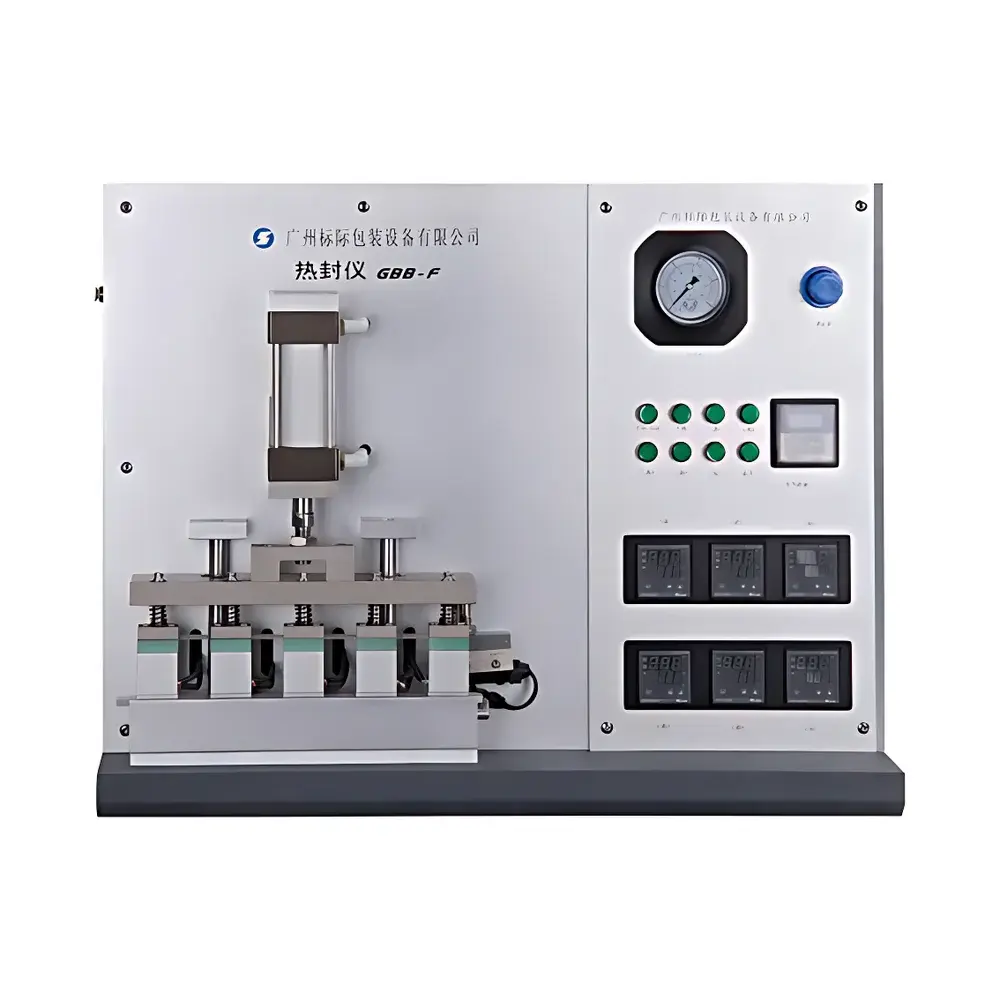
GBPI GBB-F2 Heat Sealing Tester
| Brand | GBPI |
|---|---|
| Origin | Guangdong, China |
| Manufacturer Type | Direct Manufacturer |
| Country of Origin | China |
| Model | GBB-F2 |
| Price Range | USD 4,200 – 7,000 |
| Temperature Range | Ambient to 300 °C |
| Temperature Control Accuracy | ±1 °C |
| Sealing Time Range | 0.01 s to 99.99 h |
| Sealing Pressure Range | 0.05–0.8 MPa |
| Sealing Surface Dimensions | Upper Jaw — Five 35 mm × 10 mm Independent Heating Zones |
| Heating Method | Dual Independent Heating (Upper & Lower Jaws) |
| Actuation | Pneumatic (Compressed Air, 0.5–0.8 MPa) |
| Dimensions (W×D×H) | 700 × 400 × 540 mm |
| Weight | 55 kg |
| Power Rating | 2000 W |
| Electrical Supply | AC 220 V, 50 Hz |
| Compliant Standards | QB/T 2358–1998, ASTM F2029–2016, YBB 00122003–2015 |
Overview
The GBPI GBB-F2 Heat Sealing Tester is an engineered precision instrument designed for quantitative evaluation of thermoplastic packaging film seal integrity under controlled thermal, mechanical, and temporal parameters. Based on the fundamental principle of heat transfer and polymer interdiffusion at the interface—governed by time-temperature-pressure (TTP) relationships—the GBB-F2 enables laboratory-grade determination of optimal sealing conditions for flexible packaging substrates. Its dual-jaw pneumatic architecture replicates industrial horizontal or vertical form-fill-seal (FFS) processes while maintaining metrological traceability. The system supports method development, process validation, and routine quality control in regulated environments where seal strength, hermeticity, and consistency are critical to product shelf life and regulatory compliance.
Key Features
- Five-zone independent temperature control: Upper jaw integrates five discrete 35 mm × 10 mm heating elements, each programmable with ±1 °C stability across 0–300 °C range—enabling gradient sealing studies and multi-material laminate optimization.
- Independent lower-jaw thermal regulation: Heated silicone-padded rod maintains uniform contact pressure distribution and minimizes thermal bridging during dwell cycles.
- Pneumatic actuation system: Operates with clean, dry compressed air (0.5–0.8 MPa), delivering repeatable sealing force with minimal hysteresis and zero mechanical wear on actuation components.
- Dual operational modes: Fully automated sequence execution (predefined TTP profiles) and manual foot-switch-triggered mode for rapid prototyping or operator-guided parameter sweeps.
- Modular sealing tooling: Standardized mounting interface allows customization of jaw geometry—including radius, edge profile, surface finish (e.g., matte vs. polished), and anti-adhesion coatings (e.g., ceramic-reinforced PTFE)—to match specific substrate requirements.
- Traceable calibration architecture: Integrated Pt100 sensors support on-site verification using NIST-traceable reference probes; no disassembly required for sensor recalibration.
Sample Compatibility & Compliance
The GBB-F2 accommodates a broad spectrum of thermoplastic films and laminates—including LDPE, HDPE, PP, PET, aluminum foil composites, and pharmaceutical-grade barrier structures (e.g., Alu–PVC, Alu–Alu). It is validated for use in accordance with internationally recognized standards: ASTM F2029–2016 (Standard Test Method for Making Heat-Sealed Packages for Use in Integrity Testing), QB/T 2358–1998 (Plastic Film Heat Seal Strength Test Method), and YBB 00122003–2015 (Heat Seal Strength Test for Pharmaceutical Packaging Materials). Its design supports GLP-compliant workflows through auditable parameter logging and user-accessible calibration records—fully aligned with FDA 21 CFR Part 11 data integrity expectations when integrated with compliant LIMS or electronic lab notebook systems.
Software & Data Management
While the GBB-F2 operates via intuitive front-panel controls with real-time parameter display, optional RS-232/USB connectivity enables integration with third-party data acquisition platforms. All sealing events—including setpoints, actual temperatures (per zone), applied pressure, dwell duration, and timestamp—are recorded internally with millisecond resolution. Exportable CSV logs facilitate statistical process control (SPC) analysis, trend monitoring per material lot, and root-cause investigation during out-of-specification (OOS) events. Audit trails include operator ID, session start/end times, and modification history—supporting ISO/IEC 17025 accreditation requirements for testing laboratories.
Applications
- Optimization of sealing parameters for sterile barrier packaging used in medical device manufacturing (ISO 11607–1).
- Validation of heat seal integrity in pharmaceutical blister and pouch packaging per USP and EP 3.2.1.
- Comparative analysis of seal performance across aging conditions (e.g., accelerated shelf-life testing per ICH Q1A).
- Root-cause analysis of delamination, channel leaks, or weak seals in food packaging subjected to retort, freezing, or vacuum conditions.
- Development of sustainable mono-material packaging solutions requiring precise thermal input control to avoid degradation.
FAQ
Does the GBB-F2 support automated data export to LIMS?
Yes—via optional serial or USB interface, raw sealing logs (including per-zone temperature curves and pressure transients) can be streamed or batch-exported in CSV format compatible with major LIMS and ELN platforms.
Can sealing jaws be replaced in-house without service technician support?
Yes—jaw modules feature standardized quick-release fasteners and plug-and-play thermal sensor connectors; replacement and re-calibration are documented in the included technical manual.
Is the pneumatic system compatible with standard lab-grade nitrogen or oil-free air compressors?
Yes—the unit requires only clean, dry compressed air meeting ISO 8573–1 Class 3:4:4 specifications; no external lubrication or specialized gas supply is needed.
How is temperature uniformity verified across the five upper zones?
Uniformity is confirmed during factory acceptance testing using calibrated infrared thermography and contact probe mapping; certificate of conformance includes measured delta-T values across all zones at 120 °C and 250 °C setpoints.
What documentation is provided for regulatory submissions?
GBPI supplies a full IQ/OQ protocol package, traceable calibration certificates (NIST-traceable references), and test reports demonstrating conformance to ASTM F2029–2016 and QB/T 2358–1998—available upon request for audit readiness.





