
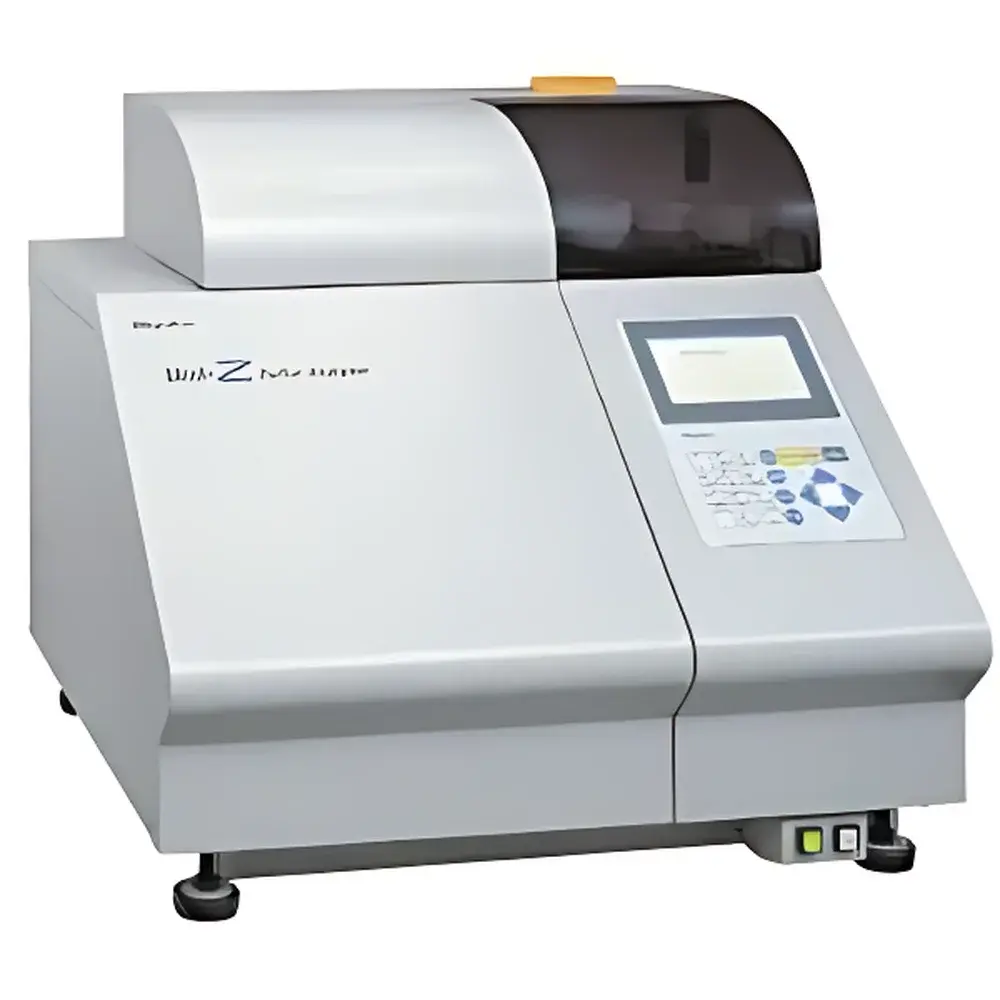
Rigaku Mini-Z Benchtop Wavelength Dispersive X-Ray Fluorescence Spectrometer
| Brand | Rigaku |
|---|---|
| Origin | Japan |
| Model | Mini-Z |
| Type | Wavelength Dispersive XRF (WDXRF) |
| Configuration | Benchtop |
| Compliance | ASTM D2622, ISO 20884, JIS K 2541-7 |
| Detection Limit (S) | 0.3 ppm |
| Repeatability (S at 10 ppm) | σ = 0.17 ppm |
| S Quantification Range | 1 ppm – 4 wt% |
| Sample Capacity | 6-position automated changer |
| Power Requirement | 220 V AC, 2 A |
| Cooling | Air-cooled (no water required) |
| Dimensions | 640 × 580 × 580 mm (W × D × H) |
| Weight | 65 kg |
Overview
The Rigaku Mini-Z is a benchtop wavelength dispersive X-ray fluorescence (WDXRF) spectrometer engineered for high-precision, routine elemental analysis—specifically optimized for total sulfur determination in petroleum fuels and related hydrocarbon matrices. Unlike energy dispersive XRF (EDXRF), the Mini-Z employs Bragg diffraction from precisely aligned analyzing crystals to isolate characteristic X-ray lines with superior spectral resolution, enabling accurate peak-to-background discrimination essential for low-level quantification. Its fixed optical path and monochromator-based detection architecture eliminate the need for vacuum or helium purge, supporting operation under ambient atmospheric conditions. Designed for industrial laboratories, refinery QC facilities, and contract testing labs, the Mini-Z delivers regulatory-grade data traceable to ASTM D2622 (Standard Test Method for Sulfur in Petroleum Products by Wavelength Dispersive XRF), ISO 20884 (Petroleum products — Determination of sulfur content of motor fuels — Wavelength dispersive X-ray fluorescence spectrometry), and JIS K 2541-7 (Methods of test for petroleum products — Determination of sulfur content — WDXRF method). No sample digestion, dilution, or chemical derivatization is required—solid, liquid, or viscous fuel samples are analyzed directly in standard sample cups.
Key Features
- Patented optical system optimized for sulfur Kα line isolation, minimizing interferences from Cl, Ca, and transition metal lines common in crude-derived fuels
- Air-cooled X-ray tube and detector assembly—zero reliance on external cooling water or cryogenic gases
- 6-position automatic sample changer enabling unattended batch analysis with configurable dwell times per sample
- Touchscreen-integrated user interface with guided workflow for method selection, calibration verification, and report generation
- High-stability sealed X-ray tube (Pd anode, 50 W nominal power) ensuring long-term intensity reproducibility across daily operation
- Compact footprint (640 × 580 × 580 mm) and 65 kg mass facilitate installation on standard lab benches without structural reinforcement
- Compliance-ready audit trail logging for GLP/GMP environments, including operator ID, timestamped calibration checks, and raw spectrum archives
Sample Compatibility & Compliance
The Mini-Z accepts liquid fuel samples (gasoline, diesel, jet fuel, biodiesel blends), lubricating oils, and distillates in standardized polyethylene or Mylar-bottomed sample cups (32 mm diameter). Viscous or sediment-laden samples may be homogenized prior to loading but require no acid digestion, ashing, or solvent extraction. The instrument’s measurement protocol adheres strictly to the spectral acquisition parameters defined in ISO 20884 Annex B and JIS K 2541-7 Clause 7—specifically peak integration over 2θ = 6.8° ± 0.1° (S Kα at ~2.308 Å using LiF(200) crystal) with background correction at adjacent 2θ positions. All factory calibrations are traceable to NIST SRM 2721 (Sulfur in Fuel Oil) and CRM-certified reference materials from Conostan and AccuStandard. Full compliance documentation—including IQ/OQ protocols, uncertainty budgets per GUM (JCGM 100:2008), and 21 CFR Part 11–compatible electronic signature support—is available upon request.
Software & Data Management
Operation is managed via Rigaku’s proprietary Z-Analyzer software, a Windows-based application compliant with FDA 21 CFR Part 11 requirements. It supports role-based access control (administrator, analyst, reviewer), electronic signatures with biometric or token-based authentication, and immutable audit trails recording every spectrum acquisition, calibration update, and report export event. Quantitative results are generated using fundamental parameter (FP) algorithms validated against matrix-matched standards; optional empirical calibration curves can be built using up to 12 reference points. Data exports conform to ASTM E1382-compliant .csv and .txt formats, while raw spectra are stored in vendor-neutral .rif format for third-party reprocessing. Network deployment supports centralized license management and remote diagnostics via secure TLS 1.2 encrypted channels.
Applications
- Routine sulfur screening in refinery product streams per EPA 40 CFR Part 1093 and EU EN 590 specifications
- Verification of ultra-low-sulfur diesel (ULSD, ≤15 ppm S) and gasoline (≤10 ppm S) compliance
- Quality control of marine fuels (IMO 2020 sulfur cap verification)
- Stability monitoring of hydrotreating catalyst performance via feedstock/product sulfur differentials
- Research applications in fuel formulation, additive interaction studies, and biofuel sulfur speciation modeling
FAQ
Does the Mini-Z require helium or vacuum purging for sulfur analysis?
No—its WDXRF optics operate reliably in air; no gas supply or evacuation system is needed.
Can the Mini-Z analyze solid samples such as catalysts or particulate filters?
Yes, provided they are presented as flat, homogeneous pressed pellets or thin films within the standard sample cup geometry.
Is method validation support included with the system?
Yes—Rigaku provides pre-validated ASTM D2622 and ISO 20884 method templates, along with uncertainty estimation tools and CRM correlation reports.
What maintenance intervals are recommended for routine operation?
X-ray tube output is monitored daily via internal reference channel; annual preventive maintenance includes crystal alignment verification and detector gain calibration.
How is data integrity ensured during multi-shift laboratory use?
Z-Analyzer enforces electronic signatures, time-stamped audit logs, and write-once/read-many (WORM) archive options compliant with ALCOA+ principles.
Related Products






