
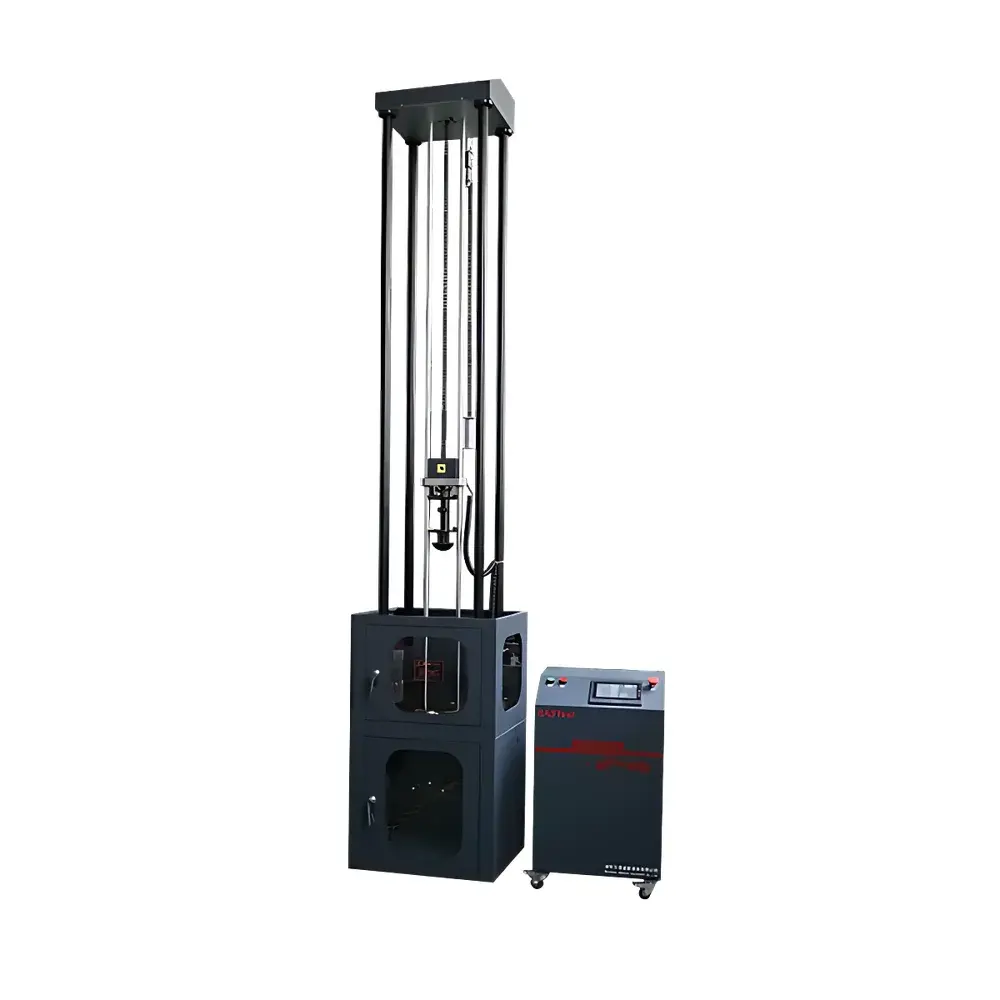
SASTEST KCJ1000 Series Pipe Drop Weight Impact Tester
| Brand | SASTEST |
|---|---|
| Origin | Guangdong, China |
| Manufacturer Type | Direct Manufacturer |
| Product Category | Domestic |
| Model | KCJ1000 |
| Instrument Type | Drop Weight Impact Tester |
| Impact Energy | 300 J |
| Maximum Lifting Height | 2000 mm |
| Hammer Head Radii | D25/SR50 and D90/SR50 |
| Max Sample Diameter | Φ400 mm (KCJ1302-A) to Φ1600 mm (KCJ1302-D) |
| Compliance Standards | GB/T 14152-2001, GB/T 10002.1-2006, GB 6112-1985 |
Overview
The SASTEST KCJ1000 Series Pipe Drop Weight Impact Tester is an industrial-grade, fully automated mechanical impact testing system engineered for precise evaluation of external impact resistance in thermoplastic pipes and flat-sheet nonmetallic materials. Based on the classical drop-weight principle—where a calibrated hammer mass is elevated to a defined height and released under gravity—the instrument delivers controlled kinetic energy (up to 300 J) onto standardized specimens. This method conforms to fundamental impact mechanics governed by the equation E = mgh, ensuring traceable, repeatable energy input across test cycles. Designed specifically for quality assurance in pipe manufacturing and materials R&D, the KCJ1000 meets stringent requirements for reproducibility, positional accuracy, and operational safety in regulated laboratory and production environments.
Key Features
- Fully automated operation sequence: automatic zero-point calibration of hammer and specimen, motorized lifting to user-defined height (up to 2000 mm), real-time height verification via encoder feedback, and post-impact hammer capture.
- Dual-hammer configuration support: interchangeable D25/SR50 and D90/SR50 impact heads compliant with GB/T 14152-2001 and GB 6112-1985 for standardized evaluation of varying wall thicknesses and material stiffness.
- High-precision elevation control: Siemens S7-1200 PLC-based motion controller with integrated position sensing ensures ±1 mm repeatability in lift height and eliminates manual adjustment errors.
- Secondary impact prevention mechanism: mechanical-dynamic damping system actively suppresses rebound-induced re-strike, preserving specimen integrity and data fidelity during brittle fracture analysis.
- Modular sample stage: vertically adjustable worktable with fine-positioning capability enables rapid alignment of pipes up to Φ1600 mm (KCJ1302-D variant) while maintaining coaxiality with the hammer’s vertical trajectory.
- Robust guidance system: hardened linear guide rods minimize lateral deviation and aerodynamic drag, ensuring consistent free-fall dynamics and reducing measurement uncertainty associated with angular deviation.
- Integrated safety architecture: interlocked access door sensors, emergency stop circuitry, and transparent polycarbonate shielding comply with ISO 13857 and IEC 60204-1 for operator protection during high-energy impact events.
Sample Compatibility & Compliance
The KCJ1000 accommodates a broad spectrum of nonmetallic structural materials, including PVC-U, PE, PP-R, CPVC, ABS, fiberglass-reinforced plastic (FRP), ceramic composites, and rigid polymer sheets. Its modular base design supports four optional sample diameter configurations (Φ400 mm to Φ1600 mm), allowing seamless transition between standard pipe sizes used in municipal water supply, drainage, and industrial conduit applications. The system is validated against three principal Chinese national standards: GB/T 14152-2001 (clockwise rotation method for thermoplastic pipes), GB/T 10002.1-2006 (PVC-U water supply pipe specifications), and GB 6112-1985 (generalized drop-weight impact test methodology). While not certified to ASTM D2444 or ISO 3127, its mechanical design and control logic are functionally equivalent and readily adaptable for cross-standard correlation studies under GLP-compliant test protocols.
Software & Data Management
The KCJ1000 operates via an embedded HMI panel with touch-enabled interface, eliminating dependency on external PCs. All critical parameters—including impact height, hammer mass, calculated energy, test date/time stamp, and pass/fail status—are logged locally with non-volatile memory backup. The built-in power-loss recovery feature retains all active settings and last-executed test records following unexpected shutdowns, satisfying basic audit-trail requirements for internal QA documentation. Data export is supported via USB port in CSV format for integration into LIMS or statistical process control (SPC) platforms. Although the system does not implement FDA 21 CFR Part 11 electronic signature functionality, its deterministic PLC firmware and immutable event logging provide sufficient traceability for ISO/IEC 17025-accredited laboratories performing routine conformity assessments.
Applications
This tester serves as a core instrumentation platform in multiple technical domains: incoming raw material screening for extrusion plants; batch release testing per GB/T 10002.1-2006 compliance; failure mode analysis of cracked or deformed piping systems; comparative study of impact-modified vs. virgin polymer formulations; and academic research on temperature-dependent ductile-to-brittle transitions in polymeric materials. It is routinely deployed by provincial quality inspection institutes, university polymer engineering departments, third-party certification bodies (e.g., CNAS-accredited labs), and municipal infrastructure procurement agencies verifying supplier-submitted impact performance declarations.
FAQ
What standards does the KCJ1000 directly support?
GB/T 14152-2001, GB/T 10002.1-2006, and GB 6112-1985 — all applicable to thermoplastic pipe impact assessment under Chinese regulatory frameworks.
Can the system be configured for ASTM D2444 testing?
While not pre-certified to ASTM D2444, the KCJ1000’s adjustable height (0–2000 mm), dual-hammer options, and programmable release logic allow method adaptation; users must validate equivalence per their internal SOPs.
Is remote monitoring or Ethernet connectivity available?
No native Ethernet or IoT interface is included; data retrieval is limited to local USB export. Optional RS-485 serial output may be added for SCADA integration upon request.
What maintenance intervals are recommended for the lifting mechanism?
Lubrication of chain drive and guide rods every 500 test cycles; annual calibration of height encoder and load cell (if equipped with force-sensing option) is advised for metrological continuity.
Does the system include test report generation software?
The onboard HMI displays real-time parameters and stores raw test logs, but formal report formatting (e.g., PDF with logo, signature fields) requires external spreadsheet or LIMS integration.



