
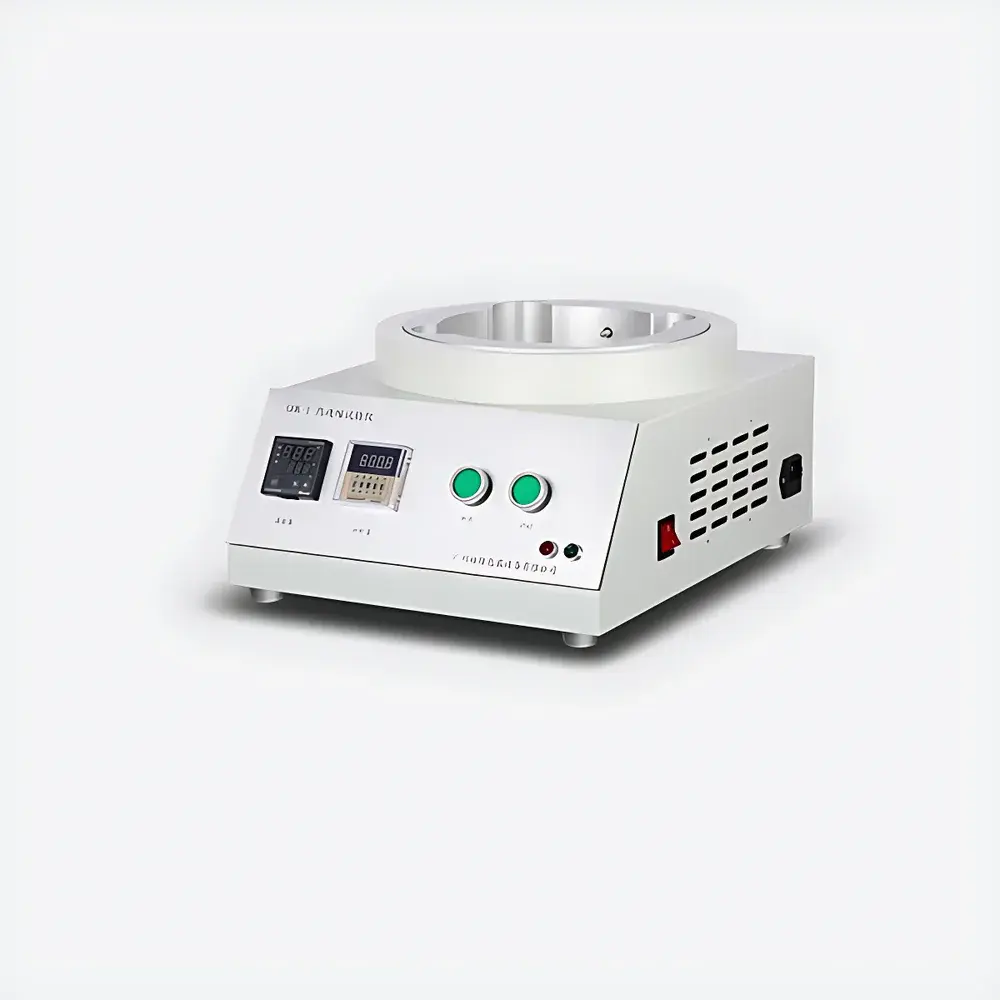
GBPI GBK-1 Advanced Thermal Shrinkage Tester
| Brand | GBPI |
|---|---|
| Origin | Guangdong, China |
| Manufacturer Type | Direct Manufacturer |
| Origin Category | Domestic (China) |
| Model | GBK-1-aa |
| Quotation | Upon Request |
| Sample Size | ≤140 × 140 mm |
| Temperature Range | Ambient to 250 °C |
| Temperature Control Accuracy | ±1 °C |
| Dimensions | 320 × 400 × 260 mm |
| Power Rating | 1500 W |
| Electrical Supply | AC 220 V, 50 Hz |
Overview
The GBPI GBK-1 Advanced Thermal Shrinkage Tester is a precision-engineered laboratory instrument designed for quantitative evaluation of thermal shrinkage behavior in polymeric films and laminates under controlled liquid-bath heating conditions. Operating on the principle of dimensional change measurement following exposure to elevated temperatures in a thermally stabilized fluid medium, the GBK-1 enables repeatable determination of percentage shrinkage in both machine direction (MD) and transverse direction (TD). This methodology aligns with standardized thermal contraction testing protocols widely adopted in packaging R&D, quality assurance, and regulatory compliance workflows. The system is calibrated and validated for use in environments requiring traceable temperature control and stable thermal homogeneity—critical parameters for assessing film stability during sterilization, retort processing, shrink-sleeve labeling, and pharmaceutical blister packaging applications.
Key Features
- High-stability aluminum alloy liquid bath with optimized thermal conductivity and low thermal inertia, ensuring rapid equilibration and minimal temperature gradient across the test zone.
- Integrated digital LCD interface with real-time display of setpoint temperature, actual bath temperature, and elapsed test duration; supports intuitive parameter configuration without external software.
- Robust mechanical architecture featuring corrosion-resistant internal components and sealed heating elements compatible with water, glycerol, and silicone oil media—enabling safe operation up to 250 °C.
- Compact footprint (320 × 400 × 260 mm) and integrated safety interlocks including over-temperature cutoff and dry-run protection, meeting IEC 61010-1 requirements for laboratory electrical equipment.
- Compliant with dual-standard thermal shrinkage methodology: fully supports QB/T 13519 (Chinese national standard for plastic film thermal shrinkage) and ASTM D2732 (Standard Test Method for Uniaxial Shrinkage of Plastic Film and Sheeting).
Sample Compatibility & Compliance
The GBK-1 accommodates flat, non-porous specimens up to 140 × 140 mm, including BOPP, PET, PVC, PE, PVDC-coated, and multilayer barrier films used in food packaging, medical device pouches, pharmaceutical blister lidding, and shrink-sleeve labels. Specimen mounting utilizes non-deforming stainless steel frame fixtures to minimize edge constraint effects during thermal exposure. All operational procedures and calibration routines are documented per GLP principles. The instrument’s temperature control subsystem is traceably calibrated against NIST-traceable reference thermometers, and its performance verification protocol satisfies internal QA requirements for ISO/IEC 17025-accredited laboratories. While not FDA 21 CFR Part 11–compliant out-of-the-box (as it lacks electronic audit trail functionality), its physical test output—dimensional measurements recorded manually or via external calipers—may be incorporated into compliant data management systems.
Software & Data Management
The GBK-1 operates as a standalone hardware platform with no embedded firmware-based data logging or network connectivity. Temperature and timing parameters are entered and monitored locally via the front-panel LCD interface. Users record shrinkage results manually using calibrated digital calipers or optical measurement systems (e.g., vision-based metrology tools), then enter values into LIMS or Excel-based reporting templates. For laboratories implementing computerized systems, GBPI provides optional CSV-formatted test report templates aligned with ASTM D2732 reporting conventions—including MD/TD shrinkage %, average shrinkage, and standard deviation across replicate specimens. These templates support integration with validated ELN platforms when paired with appropriate SOPs governing manual data transcription and review.
Applications
- Quality control of heat-shrinkable labels and sleeves in beverage and consumer goods packaging lines.
- Evaluation of thermal stability in pharmaceutical blister foil laminates subjected to steam sterilization or hot-fill processes.
- R&D screening of novel biopolymer films (e.g., PLA, PHA) for controlled-shrink applications in sustainable packaging.
- Validation of film uniformity and anisotropy by comparing MD vs. TD shrinkage profiles at multiple setpoints (e.g., 80 °C, 120 °C, 180 °C).
- Regulatory submission support for packaging materials under USP , EP 3.2.1, and Chinese Pharmacopoeia Chapter 9630 (Packaging Material Characterization).
FAQ
What liquid media are compatible with the GBK-1 bath system?
Water, glycerol, and silicone oil are commonly used; selection depends on required upper temperature limit and viscosity constraints. Water is suitable up to ~95 °C; glycerol supports testing up to 200 °C; silicone oil enables full-range operation to 250 °C.
Does the GBK-1 include automatic shrinkage calculation?
No—the instrument measures temperature and time only. Shrinkage percentage must be calculated externally using pre- and post-test dimensional measurements.
Is the GBK-1 certified to ISO 9001 or CE?
Yes—GBPI holds ISO 9001:2008 certification, and the GBK-1 carries CE, FCC, and CCC markings confirming conformity with applicable EU electromagnetic compatibility and safety directives.
Can the GBK-1 be used for ASTM D1204 testing?
No—ASTM D1204 specifies linear shrinkage measurement in air oven environments; the GBK-1 implements liquid-bath immersion per ASTM D2732 and QB/T 13519.
What maintenance is required for long-term accuracy?
Annual verification of temperature sensor calibration using a certified reference thermometer is recommended; periodic cleaning of the aluminum bath interior with isopropyl alcohol prevents residue buildup from thermal degradation of media.





