
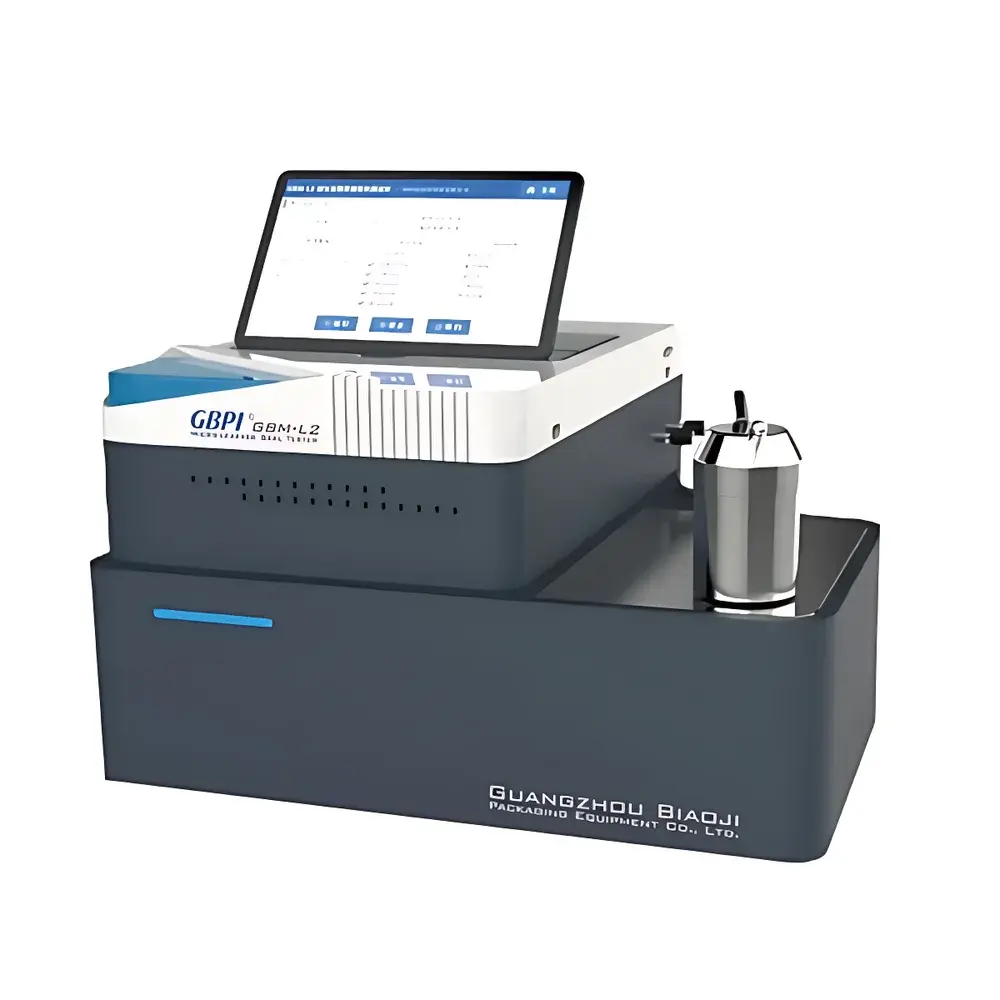
GBPI AUTO GBM-L2A Dual-Pressure Vacuum Decay & Pressure Decay Micro-Leak Tester
| Brand | GBPI (Guangzhou GBPI Packaging Instruments) |
|---|---|
| Origin | Guangdong, China |
| Manufacturer Type | Direct Manufacturer |
| Country of Origin | China |
| Model | AUTO GBM-L2A |
| Price | USD 42,000 (FOB Guangdong) |
| Absolute Pressure Range | 0–300 kPa |
| Differential Pressure Range | −2 to +2 kPa |
| Detection Sensitivity | 1–3 µm |
| Equilibration/Test Time | 1–3600 s |
| Vacuum Purge Time | 1–3600 s |
| Set Flow Rate | 0–3 mL/min |
| Sensor Accuracy | ±0.1% FS (Absolute & Differential) |
| Test Chamber | Custom-Fabricated per Sample Geometry |
| Power Supply | AC 220 V, 50 Hz |
| Ambient Temp. | 20–30 °C |
| Relative Humidity | ≤80% RH (non-condensing) |
| Dimensions (W×D×H) | 495 × 455 × 280 mm |
Overview
The GBPI AUTO GBM-L2A Dual-Pressure Vacuum Decay & Pressure Decay Micro-Leak Tester is an engineered solution for non-destructive, quantitative integrity verification of sterile pharmaceutical primary packaging. It operates on two complementary physical principles—vacuum decay and pressure decay—enabling reliable detection of micro-leaks as small as 1 µm in rigid and semi-rigid containers. Unlike single-mode testers, the AUTO GBM-L2A employs synchronized dual-sensor architecture (absolute and differential pressure transducers) with independent vacuum and pressure circulation loops, eliminating false-negative outcomes commonly observed when testing evacuated lyophilized vials using vacuum decay alone. The system complies with the fundamental physical assumptions of gas flow through orifices under laminar and transitional regimes, as defined in ASTM F2338-2009(2013) and USP , and is validated for use in GMP-regulated environments requiring full data traceability and method robustness.
Key Features
- Dual-pressure methodology: Simultaneous vacuum decay and positive pressure decay modes, enabling unambiguous leak assessment across diverse headspace conditions—including fully evacuated, nitrogen-purged, or ambient-filled containers.
- High-fidelity sensor suite: Industrial-grade absolute pressure sensor (0–300 kPa) and differential pressure sensor (±2 kPa), both calibrated to ±0.1% full scale, ensuring reproducible quantification of minute pressure differentials over extended test durations.
- Imported critical components: Oil-lubricated vacuum pump (3 L/s pumping speed, ≤50 dB(A) noise, ultimate vacuum ≤5 Pa) and UK-manufactured mass flow controller (resolution: 0.001 mL/min), supporting precise synthetic leak simulation for method qualification per ASTM F2095.
- GMP-compliant human-machine interface: 11-inch capacitive touchscreen with intuitive workflow navigation, multi-level user authentication (administrator/operator/auditor), and built-in audit trail compliant with FDA 21 CFR Part 11 and EU Annex 11 requirements.
- Modular chamber design: Fully customizable test cavity geometry—including nested fixtures for multi-size vial families (e.g., 2R, 5R, 10R ampoules)—ensuring optimal seal interface, minimal dead volume, and consistent thermal equilibration.
Sample Compatibility & Compliance
The AUTO GBM-L2A is validated for direct integrity testing of Class I and II sterile packaging systems per ISO 11607-1 and USP . It accommodates standard pharmaceutical formats including glass and polymer ampoules (1–20 mL), vials (2–50 mL), pre-filled syringes (1–10 mL), ophthalmic dropper bottles, HDPE containers, IV bags, and flexible pouches. All test protocols adhere to the procedural rigor of YY/T 0681.18–2020 (Chinese Pharmacopoeia supplement) and ASTM F2338–2009(2013). The instrument’s pressure-based measurement principle eliminates reliance on tracer gases or dye ingress, satisfying regulatory preference for deterministic, physics-based methods over probabilistic alternatives such as bubble emission or microbial challenge.
Software & Data Management
Firmware-integrated test software supports method creation, parameter locking, real-time curve visualization (pressure vs. time), automatic pass/fail classification based on user-defined delta-P thresholds, and export of raw data in CSV and PDF formats. Audit trail records include timestamped entries for user login/logout, method modification, test initiation/abortion, result approval/rejection, and calibration events—all digitally signed and tamper-evident. Data storage complies with ALCOA+ principles (Attributable, Legible, Contemporaneous, Original, Accurate, Complete, Consistent, Enduring, Available), and backup archives may be configured to network drives or encrypted USB media per site-specific IT policies.
Applications
- Final container closure integrity testing (CCIT) of lyophilized products where residual vacuum interferes with conventional vacuum decay interpretation.
- Comparative leak rate mapping across production batches to support continuous process verification (CPV) and lifecycle management per ICH Q5C and Q9.
- Method suitability studies for container-closure system (CCS) qualification, including worst-case defect modeling and sensitivity boundary determination.
- Stability study support: periodic CCIT at accelerated and real-time conditions to assess seal degradation kinetics.
- Cross-industry adaptation for high-value food packaging (e.g., retort pouches, aseptic cartons) and specialty chemical containers requiring hermeticity assurance.
FAQ
Does the AUTO GBM-L2A require helium or other tracer gases?
No. It is a tracer-gas-free, pressure-based system relying solely on native headspace composition.
Can it detect leaks in aluminum-sealed vials with rubber stoppers?
Yes—provided the sealing interface is mechanically stable during test cycling; fixture design must prevent stopper displacement under vacuum or pressure load.
Is validation documentation provided with the instrument?
Yes. Factory-issued IQ/OQ protocols, sensor calibration certificates (NIST-traceable), and a comprehensive User Requirements Specification (URS) template are included.
What maintenance intervals are recommended?
Vacuum pump oil inspection every 500 operating hours; full oil change every 2,000 hours; annual recalibration of both pressure sensors by accredited metrology lab.
How is method transfer supported between laboratories?
The system supports export/import of complete test methods—including chamber configuration profiles, timing sequences, and pass/fail logic—ensuring analytical equivalence across sites.






