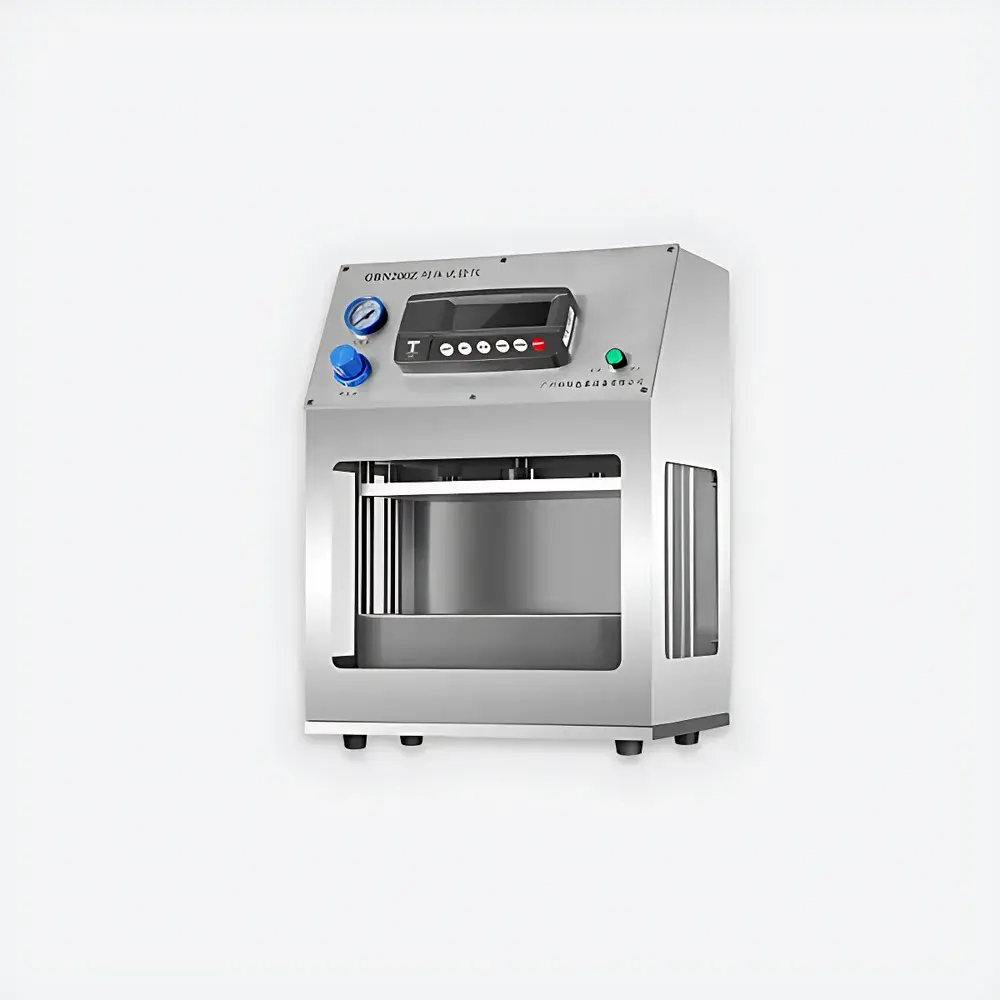
GBPI GBN200Z Pneumatic Container Burst Strength Tester
| Brand | GBPI |
|---|---|
| Origin | Guangdong, China |
| Manufacturer | Yes |
| Country of Origin | China |
| Model | GBN200Z |
| Price Range | USD 1,400 – 7,200 |
| Test Range | 0–200 kgf |
| Resolution | 0.01 kgf |
| Stroke | 0–100 mm |
| Compression Plate Dimensions | 200 × 140 mm (optional) |
| Air Supply | Compressed air, 0–0.6 MPa |
| Air Inlet | Φ8 mm pneumatic tubing |
| Test Stations | 1 (up to 3 optional) |
| Dimensions | 360 × 260 × 500 mm |
| Power | 1000 W |
| Input | AC 220 V, 50 Hz |
| Compliance | GB/T 16491, GB/T 4857.16, ASTM D642, ASTM D4169, TAPPI T804, ISO 2872, ISO 12048, JIS Z0212 |
Overview
The GBPI GBN200Z Pneumatic Container Burst Strength Tester is an engineered solution for quantitative assessment of compressive load resistance and burst integrity in flexible and semi-rigid packaging containers—including pouches, sachets, blister packs, stand-up bags, and sealed film-based assemblies. Designed in accordance with fundamental principles of uniaxial static compression testing, the instrument applies controlled, pneumatically actuated force perpendicular to the specimen surface until structural failure or predefined pressure threshold is reached. Its architecture integrates closed-loop pressure regulation, real-time force feedback, and programmable dwell-hold functionality—enabling repeatable evaluation of both initial deformation behavior and ultimate failure modes under standardized loading conditions. The system meets the mechanical test requirements defined in international transport simulation and package integrity standards, serving as a critical verification tool in pre-shipment qualification, shelf-life stability studies, and regulatory submission dossiers.
Key Features
- Pneumatically driven compression mechanism ensures smooth, vibration-free force application with minimal thermal drift and high reproducibility across repeated cycles.
- High-resolution digital load cell (0.01 kgf resolution) calibrated traceably to national metrological standards, supporting GLP-compliant data integrity.
- Adjustable compression stroke (0–100 mm) accommodates variable specimen heights—from flat laminated films to vertically oriented pillow packs.
- Modular compression plate configuration (standard 200 × 140 mm; optional custom dimensions) allows adaptation to diverse container geometries and contact-area requirements.
- Intuitive LCD interface displays real-time force, displacement, peak load, and elapsed test time; supports parameter presetting and manual override during active compression.
- Multi-station option (up to three independent test heads) enables parallel evaluation of replicate samples or comparative analysis across material batches without sequential repositioning.
Sample Compatibility & Compliance
The GBN200Z accepts specimens ranging from 30 mm × 30 mm laboratory coupons to full-format retail packaging (max. 180 mm width × 250 mm height). It is validated for use with heat-sealed PE/PP laminates, aluminum foil composites, PET/AL/PE structures, pharmaceutical blister foils, and medical device pouches meeting ISO 11607-1 requirements. All test protocols align with normative clauses in ISO 2872 (packaging—compression testing of filled transport packages), ISO 12048 (flexible intermediate bulk containers), ASTM D642 (determining compressive resistance of shipping containers), and GB/T 4857.16 (Chinese national standard for packaging compression testing). Equipment calibration and performance verification procedures conform to ISO/IEC 17025:2017 requirements, and GBPI’s internal test reports include uncertainty budgets per ILAC-P14.
Software & Data Management
While the base GBN200Z operates via embedded firmware with local data logging (up to 1,000 test records stored internally), optional PC-based software (GBPI TestSuite v3.2) provides extended capabilities: automated report generation compliant with FDA 21 CFR Part 11 (electronic signatures, audit trails, user role management), export to CSV/PDF/XLSX formats, statistical process control (SPC) charting (X̄-R, Cpk), and integration with LIMS environments via TCP/IP or RS232. Raw data files retain timestamped metadata—including operator ID, environmental temperature/humidity (if external sensor connected), calibration certificate ID, and test method reference—ensuring full traceability for GMP audits and regulatory inspections.
Applications
- Quality control of final packaged goods in food, pharmaceutical, and personal care manufacturing lines.
- Evaluation of seal strength robustness under simulated warehouse stacking loads (ASTM D4169 DC13–DC18 profiles).
- Comparative analysis of barrier film formulations subjected to accelerated aging (e.g., 40°C/75% RH for 30 days) prior to compression validation.
- Validation of new packaging designs against ISTA 3A or ASTM D6804 criteria for e-commerce distribution channels.
- Supporting root-cause investigations of field failures related to crush damage, delamination, or seal rupture during logistics handling.
FAQ
What standards does the GBN200Z directly support out-of-the-box?
The instrument includes preloaded test templates for GB/T 16491, GB/T 4857.16, ASTM D642, and ISO 2872, with configurable parameters matching clause-specific requirements.
Is third-party calibration documentation included with shipment?
Yes—each unit ships with a factory calibration certificate traceable to CNAS-accredited reference standards, valid for 12 months under normal operating conditions.
Can the GBN200Z be integrated into an automated packaging line for inline QA sampling?
It is designed for lab-based, off-line testing; however, optional I/O signals (0–10 V analog output, dry-contact pass/fail relay) enable basic PLC interfacing for semi-automated sample routing workflows.
Does the system require compressed air conditioning (e.g., filtration, drying)?
Yes—GBPI recommends supplying clean, oil-free, desiccated air at ≤5 µm particulate filtration and dew point ≤3°C to prevent pneumatic cylinder contamination and ensure long-term valve reliability.
How frequently should the load cell be recalibrated?
Annual recalibration is recommended; however, users performing >500 tests/month or operating in high-humidity environments should verify accuracy quarterly using certified deadweight standards.