
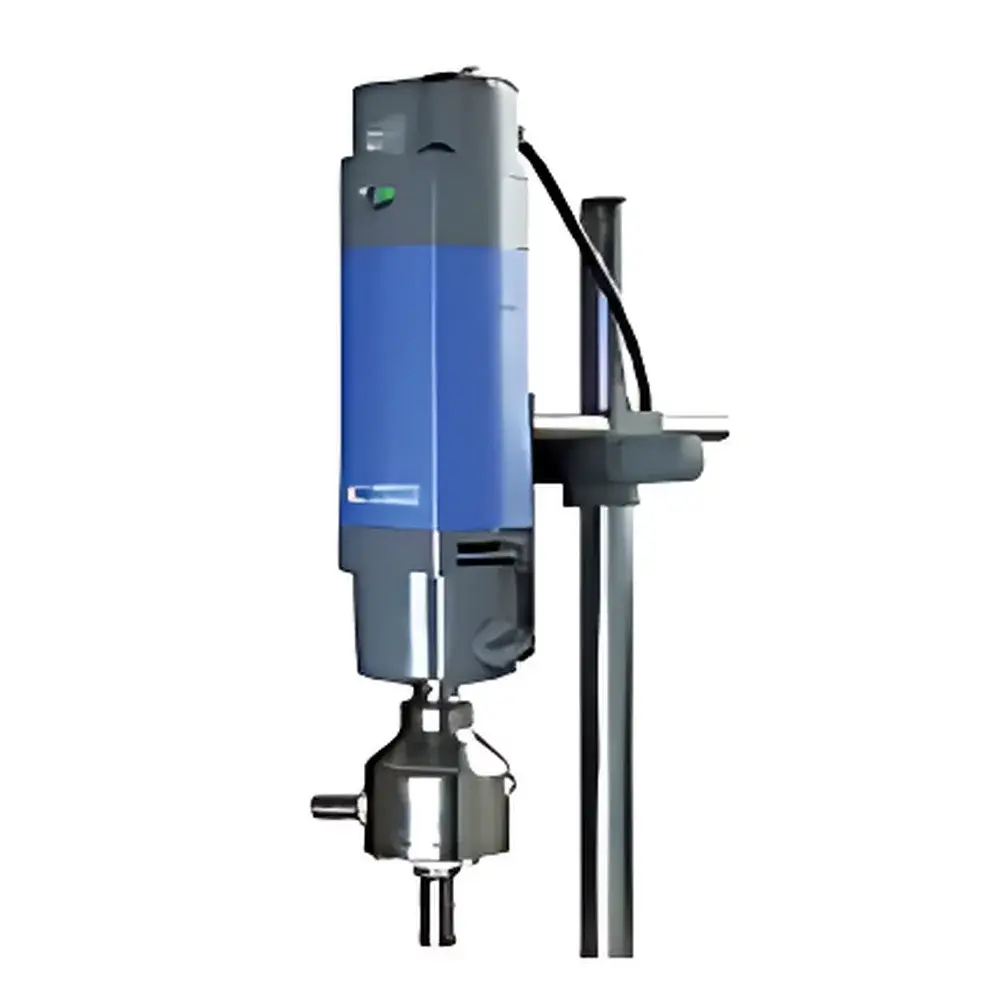
IKA UTL50 Basic Inline Continuous Disperser
| Brand | IKA |
|---|---|
| Origin | Germany |
| Model | UTL50 |
| Flow Rate (H₂O) | 24 L/min |
| Speed Range | 4000–10000 rpm |
| Contact Materials | AISI 316L Stainless Steel & FFPM Elastomers |
| Max Operating Pressure | 6 bar |
| Min Vacuum Level | 1 mbar |
| Max Operating Temperature | 180 °C |
| Housing Dimensions (W×D×H) | 130 × 150 × 500 mm |
| Weight | 6.1 kg |
| Chamber Volume | 94 mL |
| Ambient Temperature Range | 5–40 °C |
| Relative Humidity Limit | ≤80% |
| IP Rating | IP21 |
Overview
The IKA UTL50 Basic Inline Continuous Disperser is an engineered solution for controlled, scalable dispersion and homogenization of liquid-phase formulations in laboratory and pilot-scale environments. Designed around a robust inline flow-through architecture, it operates on the principle of high-shear rotor-stator interaction—where fluid is continuously drawn into the dispersion chamber, subjected to intense mechanical energy via the rotating S 50KV-G45G-IL knife head, and expelled under controlled backpressure or vacuum. Unlike batch homogenizers, the UTL50 enables real-time process integration with upstream feed systems and downstream collection or reaction vessels, supporting reproducible particle size reduction, emulsification, and deagglomeration without dead volume or thermal accumulation. Its compact vertical footprint (130 × 150 × 500 mm) facilitates installation in constrained spaces, including fume hoods, gloveboxes, or modular pilot lines.
Key Features
- Continuous inline operation with 24 L/min water-equivalent throughput—optimized for consistent shear history across variable viscosities up to 5,000 mPa·s
- Adjustable rotational speed range (4000–10000 rpm) enabling precise control over specific energy input (kWh/m³) and resultant droplet/particle size distribution
- Pressure- and vacuum-compatible design: rated for continuous operation up to 6 bar gauge pressure and down to 1 mbar absolute vacuum—enabling degassed processing and closed-loop recirculation
- Corrosion-resistant wetted path: AISI 316L stainless steel housing and rotor/stator components, sealed with fluorinated peroxide-cured fluoroelastomer (FFPM) gaskets compliant with FDA 21 CFR 177.2600
- Thermally stable construction: validated for uninterrupted operation at temperatures up to 180 °C, supporting solvent-based, high-boiling-point, or thermally activated dispersion protocols
- Modular integration capability: designed for direct coupling with the DK50.11 continuous-flow chamber to eliminate air entrapment during startup/shutdown; compatible with R2723 telescopic support and R271 collet chuck for alignment-critical installations
Sample Compatibility & Compliance
The UTL50 accommodates aqueous, organic, and semi-viscous media—including polymer solutions, pigment suspensions, nanoemulsions, and pharmaceutical pre-formulations. Its 94 mL chamber volume ensures minimal hold-up while maintaining laminar-to-transitional flow regimes across the operational Reynolds number range (Re ≈ 2,000–15,000), supporting predictable scale-up to production-grade inline dispersers. The device complies with DIN EN 60529 (IP21) for protection against vertically falling drips and solid objects >12.5 mm, and meets CE marking requirements under the EU Machinery Directive 2006/42/EC. All wetted materials conform to ISO 10993-5 cytotoxicity testing and are suitable for GLP-compliant development workflows where material traceability and extractables profiling are required.
Software & Data Management
The UTL50 Basic model operates via analog speed control (0–10 V DC input) and does not include embedded digital interfaces or onboard data logging. However, it is fully compatible with external programmable logic controllers (PLCs) and industrial SCADA systems through standard 4–20 mA process signal integration. When deployed in regulated environments (e.g., pharmaceutical development labs operating under FDA 21 CFR Part 11 or EU Annex 11), users may implement audit-trail-capable supervisory systems to record speed setpoints, run duration, temperature feedback (via optional PT100 sensor mounting), and pressure/vacuum transducer outputs. IKA’s optional Labworldsoft platform supports remote configuration of auxiliary units but is not natively integrated with the UTL50 Basic variant.
Applications
- Preparation of stable oil-in-water and water-in-oil emulsions for cosmetic and food-grade prototypes
- Dispersion of nanoscale pigments and quantum dots in coating resins under inert atmosphere
- Deagglomeration of ceramic nanopowders in non-aqueous solvents prior to spray drying or slip casting
- In-line homogenization of liposomal drug carriers during microfluidic-assisted manufacturing
- Continuous wet-milling of API suspensions for oral suspension formulation development
- Vacuum-assisted degassing and dispersion of silicone elastomer precursors prior to curing
FAQ
Can the UTL50 operate continuously for extended periods (e.g., >8 hours)?
The UTL50 is rated for intermittent duty cycles in laboratory settings; continuous operation beyond 2 hours requires active cooling of the motor housing and verification of bearing thermal limits per IKA Technical Bulletin TB-UTL50-2023.
Is the DK50.11 chamber required for vacuum operation?
No—the UTL50 itself is vacuum-rated to 1 mbar independently; however, the DK50.11 chamber is necessary to achieve true air-free priming and eliminate entrapped gas during startup in sensitive formulations.
What maintenance intervals are recommended for the S 50KV-G45G-IL dispersing knife?
Under standard aqueous use at 6000 rpm, inspect knife wear and stator clearance every 200 operating hours; replace if radial runout exceeds 0.05 mm or surface pitting covers >5% of cutting edge area.
Does the unit support CIP/SIP protocols?
The UTL50 is not designed for full Clean-in-Place or Steam-in-Place cycles; its IP21 rating and FFPM seals do not withstand saturated steam exposure above 121 °C or aggressive caustic recirculation.
Can flow rate be accurately metered without an external control valve?
The open outlet configuration delivers nominal 24 L/min at 10000 rpm with water at 20 °C; for quantitative flow control, IKA recommends integrating a calibrated Coriolis mass flowmeter upstream and a pneumatically actuated diaphragm control valve downstream.
Related Products



