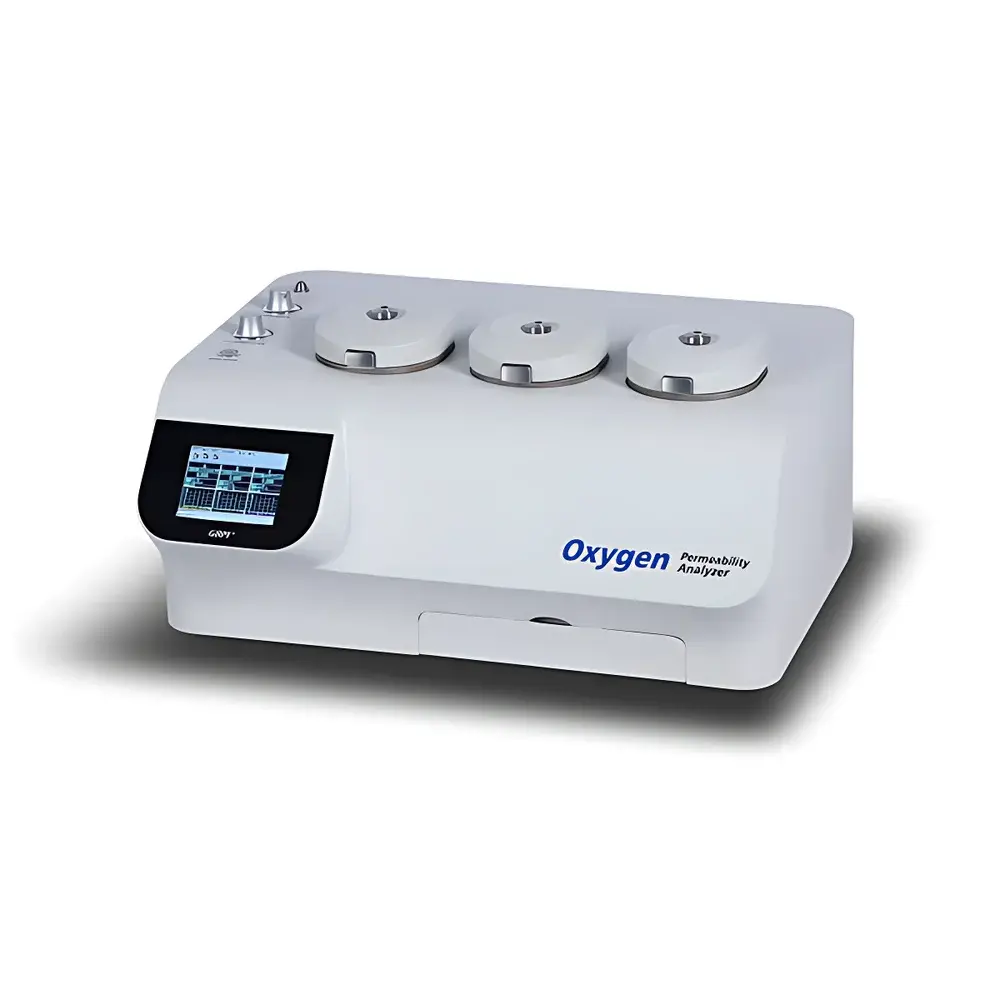
GBPI Y310 Oxygen Transmission Rate (OTR) Analyzer
| Brand | GBPI |
|---|---|
| Origin | Guangdong, China |
| Manufacturer Type | Manufacturer |
| Origin Category | Domestic |
| Model | Y310-aa |
| Price Range | USD 14,000 – 70,000 |
| Test Principle | Coulometric Sensor Method (ASTM D3985 / ISO 15105-2) |
| OTR Range (Film) | 0.02–16,500 cm³/(m²·24h·0.1 MPa) |
| Extended Range (with Mask) | up to 260,000 cm³/(m²·24h·0.1 MPa) |
| OTR Resolution | 0.001 cm³/(m²·24h·0.1 MPa) |
| Temperature Control | 15–45 °C (optional 5–50 °C), ±0.1 °C accuracy |
| Humidity Control | 0–90 %RH, ±1 %RH accuracy |
| Test Area | 50.24 cm² |
| Specimen Size | Ø100 mm |
| Max Thickness | ≤3 mm |
| Sample Capacity | 1–3 specimens per test cycle |
| Carrier Gas Pressure | 0.1–0.2 MPa |
| Gas Inlet | 1/8″ metal tubing |
| Dimensions | 610 × 550 × 400 mm |
| Weight | 57.1 kg |
| Power | 1000 W, AC 220 V, 50 Hz |
| Compliance | GB/T 19789–2005, ASTM D3985, ASTM F1927, ASTM F1307, ASTM F2622, ISO 15105-2, YBB00082003–2015, DIN 53380-3, JIS K-7126-B |
Overview
The GBPI Y310 Oxygen Transmission Rate (OTR) Analyzer is a precision laboratory instrument engineered for quantitative determination of oxygen permeation through polymeric films, laminates, foils, and rigid or flexible packaging containers. It operates on the coulometric sensor principle—a gravimetrically traceable electrochemical method standardized in ASTM D3985 and ISO 15105-2—where oxygen molecules permeating across a test specimen are carried by a nitrogen purge stream into a high-stability coulometric oxygen sensor. The resulting electrical current is linearly proportional to oxygen molar flow, enabling direct calculation of OTR in SI-aligned units (cm³/m²·24h·0.1 MPa). Unlike optical or paramagnetic detection methods, the coulometric approach delivers inherent zero-drift stability, long-term baseline integrity, and immunity to background gas interference—critical for regulatory-grade measurements in pharmaceutical primary packaging, medical device barrier validation, and high-barrier solar backsheet qualification.
Key Features
- Triple independent test chambers with synchronized environmental control—enabling parallel analysis of up to three dissimilar specimens under identical temperature/humidity conditions.
- High-resolution OTR measurement down to 0.001 cm³/m²·24h·0.1 MPa, validated using NIST-traceable GBW(E)130497/8 certified reference materials issued by China’s National Institute of Metrology.
- Integrated dual-gas humidity generation system (dry + saturated N₂ mixing) achieving ±1 %RH stability across 0–90 %RH range—essential for evaluating moisture-sensitive barrier structures such as PVOH-coated PET or SiOₓ-deposited films.
- ARM-based embedded controller supporting standalone operation; no host PC required for routine testing, data logging, or method execution.
- Electromagnetic programmable temperature control (15–45 °C standard, 5–50 °C optional) with ±0.1 °C uniformity—eliminating external chiller dependency and thermal lag artifacts.
- Modular hardware architecture with field-replaceable oxygen sensors, gas manifolds, and humidity modules—minimizing downtime during preventive maintenance or calibration verification.
Sample Compatibility & Compliance
The Y310 accommodates flat sheet specimens (Ø100 mm, ≤3 mm thick) including plastic films, metallized laminates, aluminum foil, ceramic substrates, and elastomeric sheets. With optional container fixtures (bottle, pouch, cup adapters), it quantifies OTR for 3D packaging formats per ASTM F1307 and ISO 15105-2 Annex B protocols. All measurement procedures conform to Good Laboratory Practice (GLP) and align with FDA 21 CFR Part 11 requirements via role-based user authentication, full audit trail (system, method, and data-level), and electronic signature support. Certified compliance includes GB/T 19789–2005, ASTM D3985 (film), ASTM F1927 (high-barrier), ASTM F2622 (multi-layer), YBB00082003–2015 (Chinese pharmacopoeia), and JIS K-7126-B (Japanese industrial standard).
Software & Data Management
The GBPI OTR Studio software features a Windows-native GUI with real-time visualization of OTR, O₂ concentration, temperature, and RH trends—including dynamic zoom, overlay comparison, and curve masking. Automated report generation supports export to PDF, Excel, and Word formats with configurable templates compliant with ISO/IEC 17025 documentation requirements. Database architecture enables SQL-based querying of historical runs, method versions, calibration logs, and user activity records. Role-based access control defines distinct permissions for Administrators, Operators, and Reviewers—including granular rights over method editing, result approval, and audit log deletion prevention. All data modifications are immutably timestamped and attributed—ensuring full ALCOA+ (Attributable, Legible, Contemporaneous, Original, Accurate, Complete, Consistent, Enduring, Available) compliance.
Applications
The Y310 serves critical quality assurance functions across regulated and industrial sectors: barrier validation of blister foil lidding in pharmaceutical packaging per USP ; shelf-life modeling of retort pouches and vacuum-sealed trays in food manufacturing; qualification of ethylene-vinyl alcohol (EVOH) coextrusions for automotive fuel tanks; evaluation of encapsulation integrity for OLED displays and perovskite solar cells; and release testing of transdermal patches where oxygen-induced drug degradation compromises efficacy. Its extended-range mask configuration supports R&D screening of ultra-high-permeability materials (e.g., breathable medical fabrics) up to 260,000 cm³/m²·24h·0.1 MPa—extending utility beyond conventional barrier assessment into functional material development.
FAQ
What standards does the Y310 comply with for pharmaceutical packaging validation?
The instrument meets ASTM F1307 (rigid and semi-rigid containers), ASTM D3985 (flat films), and YBB00082003–2015—the Chinese Pharmacopoeia standard for OTR testing of medicinal plastic packaging materials.
Can the Y310 measure OTR of aluminum foil without pinhole artifacts?
Yes. Its sub-milligram sensitivity (0.001 cm³/m²·24h·0.1 MPa resolution) and coulometric detection enable reliable quantification of ultra-low-permeability metals when tested with validated blank correction and chamber leak-rate verification per ISO 15105-2 Annex A.
Is remote monitoring supported for multi-site laboratories?
The embedded ARM platform supports Ethernet/IP connectivity and OPC UA server integration, allowing secure remote status polling, alarm notification, and method deployment via enterprise LIMS or MES systems.
How is sensor longevity ensured under continuous operation?
The coulometric cell incorporates automatic over-range protection and adaptive zero-point compensation—reducing drift and extending service intervals to ≥18 months under typical QC workloads.
Does GBPI provide metrological traceability documentation?
Yes. Each unit ships with a factory calibration certificate referencing GBW(E)130497/8 national standard substances, and GBPI’s CNAS-accredited calibration laboratory (No. CNAS L9238) offers accredited recalibration services.