
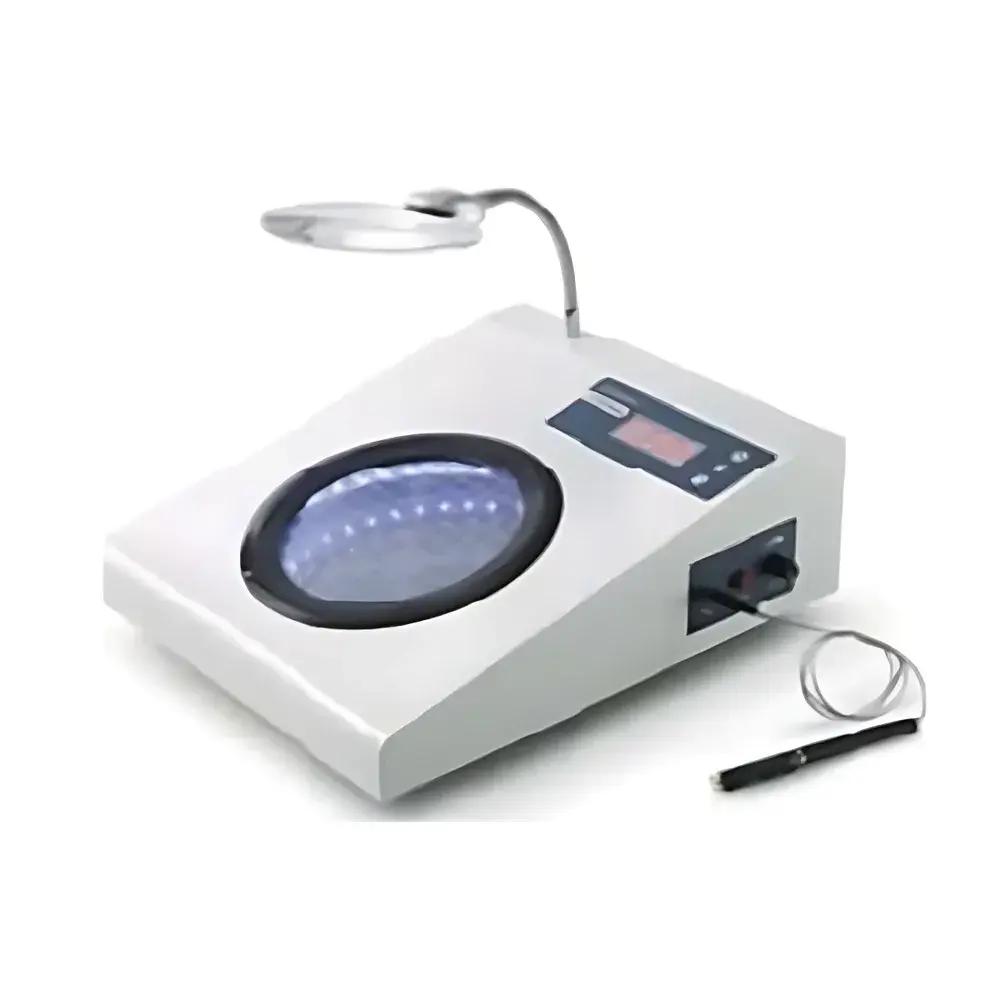
ZiQi ZMC-II and ZMC-III Manual Colony Counters
| Brand | ZiQi |
|---|---|
| Origin | Shanghai, China |
| Manufacturer Type | Direct Manufacturer |
| Product Category | Domestic |
| Models | ZMC-II, ZMC-III |
| Instrument Type | Manual Colony Counter |
| Sample Type | Liquid Culture Media |
| Counter Capacity | 0–999 |
| Counting Dish Diameter | φ115 mm (ZMC-II), φ155 mm (ZMC-III) |
| Light Source | LED Strip with Dimmer (ZMC-III), Energy-Saving Fluorescent Ring Lamp (ZMC-II) |
| Illumination Power | 16 W (ZMC-II), 50 W (ZMC-III) |
| Magnification | 3× Adjustable Lens |
| Power Supply | 220 V, 50 Hz |
| Dimensions | 268 × 225 × 90 mm (ZMC-II), 360 × 360 × 180 mm (ZMC-III) |
| Counting Interface | Digital CMOS-Based Display with Increment/Decrement Functionality |
| Acoustic Feedback | Audible Beep per Count |
| Viewing Chamber | Deep Black Background Illuminated via Lateral or Dual-Side LED Lighting |
Overview
The ZiQi ZMC-II and ZMC-III Manual Colony Counters are precision-engineered instruments designed for reliable, operator-guided enumeration of microbial colonies grown on standard Petri dishes. Based on visual detection principles compliant with ISO 4833-1:2013, FDA-BAM Chapter 3, and USP , these devices support quantitative microbiological analysis in quality control laboratories, food safety testing facilities, pharmaceutical QC/QA units, and academic research settings. Unlike automated image-based systems, the ZMC series employs a human-in-the-loop methodology—leveraging high-contrast optical viewing, ergonomic illumination, and tactile counting feedback—to ensure traceable, auditable, and reproducible colony enumeration without algorithmic interpolation or segmentation ambiguity. The counters operate under standardized dilution protocols: when colony counts exceed 300 CFU per plate, users are directed to perform serial dilution and recount—aligning with regulatory expectations for statistical validity and reporting accuracy.
Key Features
- CMOS-integrated digital counter with three-digit display (0–999 range), supporting both increment and decrement functions for error correction during manual tallying.
- Deep-black background counting chamber optimized for contrast enhancement; lateral fluorescent (ZMC-II) or dual-side adjustable LED illumination (ZMC-III) ensures uniform, glare-free visualization across agar surfaces.
- Ergonomic metal gooseneck lamp arm (ZMC-III) enables precise positioning of top illumination, improving edge visibility and reducing parallax errors during dense colony assessment.
- Variable-height counting platform: elevated dish stage facilitates effortless placement and removal of standard 90 mm and 150 mm Petri dishes—compatible with both conventional and reinforced agar media.
- Acoustic confirmation (audible beep) for each counted colony, minimizing transcription errors and enabling hands-free verification in high-throughput workflows.
- 3× magnifying lens mounted on flexible articulating arm, allowing real-time focal adjustment without repositioning the culture plate.
Sample Compatibility & Compliance
The ZMC-II and ZMC-III accept standard circular Petri dishes (up to φ155 mm for ZMC-III) filled with nutrient agar, tryptic soy agar (TSA), plate count agar (PCA), or selective media such as VRBA or XLD. Both models accommodate liquid-inoculated pour plates and spread plates prepared per ISO 7218 or AOAC 977.27 guidelines. The instruments conform to general laboratory equipment safety standards IEC 61010-1 and are routinely deployed in GLP-compliant environments where manual counting is mandated for method validation or audit trail integrity. While not standalone 21 CFR Part 11 compliant (as they lack electronic signature or audit log functionality), their analog-digital hybrid architecture supports integration into validated workflows when paired with controlled documentation practices.
Software & Data Management
These are standalone hardware-only instruments with no embedded software, network interface, or data export capability—intentionally designed to eliminate cybersecurity risks, firmware dependencies, or calibration drift associated with embedded processors. All counting data must be manually recorded in laboratory notebooks or LIMS-integrated spreadsheets. This architecture ensures long-term operational stability, zero firmware obsolescence, and full compliance with paper-based SOPs required in certain regulated manufacturing contexts (e.g., compendial testing under USP ). Optional accessories include calibrated reference plates and traceable counting templates for internal performance verification.
Applications
- Quantitative aerobic plate counts (APC) in food, beverage, and cosmetic raw material release testing.
- Environmental monitoring (EM) in cleanrooms per ISO 14644-1, including settle plate and contact plate enumeration.
- Water microbiology analysis per ISO 9308-1 and EPA Method 1603.
- Pharmaceutical non-sterile product bioburden testing per USP and Ph. Eur. 2.6.12.
- Teaching laboratories requiring pedagogically transparent, principle-based enumeration tools without black-box automation.
FAQ
What is the maximum colony count supported by the ZMC-II and ZMC-III?
Both models support up to 999 colonies per plate; however, per ISO 4833-1 and FDA-BAM guidance, counts exceeding 300 CFU are considered statistically unreliable and require sample dilution and recount.
Are replacement parts available for the LED lighting system?
Yes—ZMC-III uses industry-standard 12 V DC LED strips with integrated dimming circuitry; replacement modules are supplied directly by ZiQi with documented photometric specifications.
Can the ZMC-III accommodate square or rectangular petri dishes?
No—the counting chamber is circular and optimized for round Petri dishes (φ90 mm, φ100 mm, and φ150 mm); non-circular vessels may obstruct illumination uniformity or occlude peripheral colonies.
Is there a calibration certificate included with shipment?
Each unit ships with a factory-verified functional test report; NIST-traceable calibration certificates are available upon request at additional cost and require annual recalibration per ISO/IEC 17025-accredited service providers.
How does the ZMC series differ from automated colony imagers?
It eliminates dependency on image recognition algorithms, training datasets, or software updates—making it suitable for labs prioritizing method transparency, low total cost of ownership, and minimal IT infrastructure requirements.




