
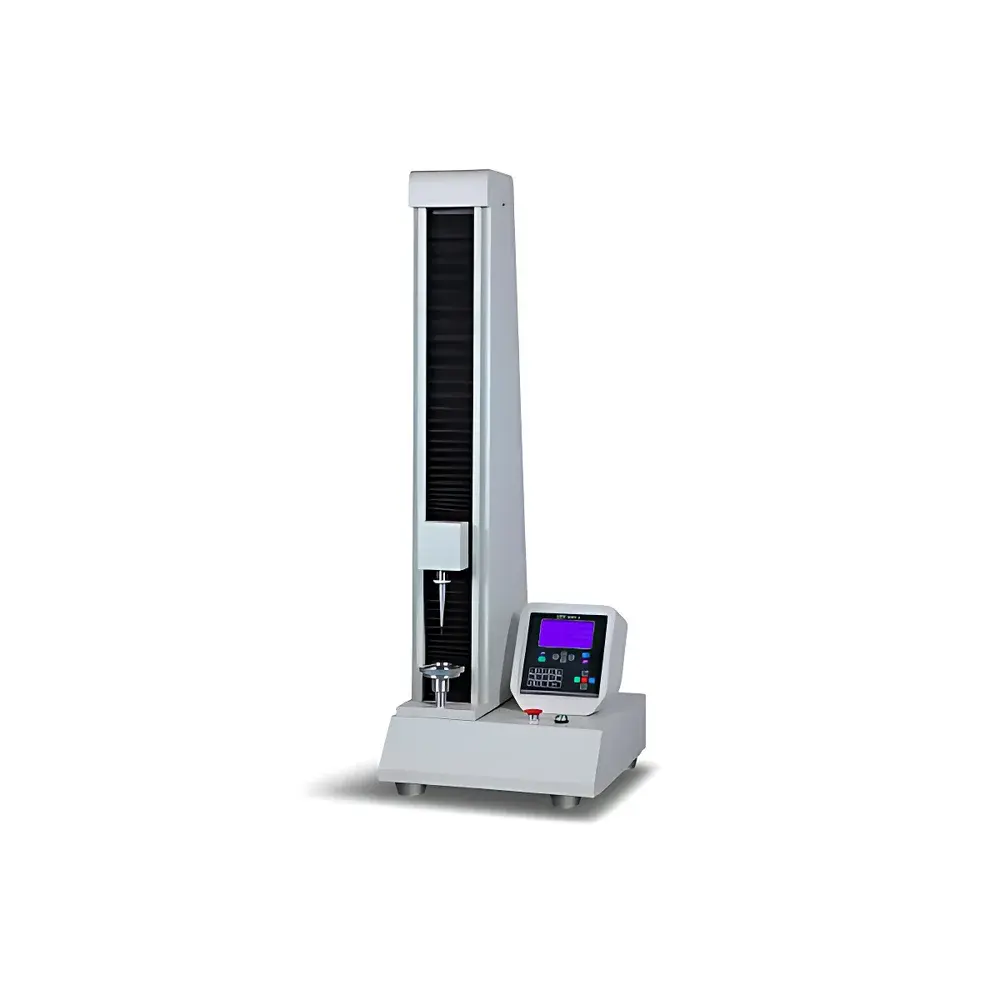
GBPI GBH-1RA Universal Electronic Tensile Tester for Mask and Medical Packaging Materials
| Brand | GBPI |
|---|---|
| Origin | Guangdong, China |
| Manufacturer Type | Direct Manufacturer |
| Country of Origin | China |
| Model | GBH-1RA |
| Instrument Type | Electromechanical Tensile Testing Machine |
| Max Test Load | 1.5 kN |
| Force Range | 0–500 N (optional 0–1500 N) |
| Elongation Capacity | up to 1400% |
| Force Accuracy | ±0.5% of reading (Class 0.5) |
| Crosshead Travel | 750 mm |
| Displacement Resolution | ±0.5% of reading |
| Effective Sample Width | 30 mm (customizable to 50 mm) |
| Test Speed | 0–500 mm/min, continuously variable |
| Power Supply | AC 220 V, 50 Hz |
| Rated Power | 1000 W |
| Dimensions (W×D×H) | 600 × 600 × 1300 mm |
| Weight | 70 kg |
Overview
The GBPI GBH-1RA Universal Electronic Tensile Tester is a precision-engineered single-column electromechanical testing system designed specifically for mechanical property evaluation of nonwovens, melt-blown fabrics, spunbond layers, laminated medical packaging films, and other critical components used in surgical masks, respirators (e.g., N95/KN95), and sterile barrier systems. It operates on the principle of controlled uniaxial force application via high-fidelity servo-motor-driven loading, enabling quantitative measurement of tensile strength, elongation at break, yield point, modulus, peel adhesion (e.g., nose-bridge tape bonding), seal integrity (hot-tack and heat-seal strength per ASTM F88), puncture resistance (ASTM D3787), tear propagation (Elmendorf or trouser tear per ASTM D1938), and compressive deformation under standardized conditions. Its architecture conforms to ISO 7500-1 (static calibration of force-measuring systems) and ASTM E4 (load verification procedures), ensuring metrological traceability and regulatory readiness for quality control laboratories operating under ISO 13485, FDA 21 CFR Part 820, or China’s YY/T 0466.1 requirements.
Key Features
- Class 0.5 force accuracy (±0.5% of reading) certified per JJG 139 and ISO 37, validated across full 0–500 N range (extendable to 0–1500 N with optional load cell)
- High-resolution displacement sensing with ±0.5% repeatability over 750 mm travel, supporting extended elongation tests up to 1400%—critical for elastic mask earloop materials and soft nonwovens
- Dual-mode control architecture: embedded microprocessor-based controller (standalone operation) or PC-integrated mode via RS232 interface with real-time data streaming at 100 Hz sampling rate
- Modular fixture system compatible with standard 30 mm jaw width (50 mm optional), plus dedicated fixtures for ASTM D882 film tensile, ASTM F88 seal strength, ASTM D1938 tear, and ASTM D3787 fabric puncture
- Imported precision ball-screw transmission system coupled with AC servo motor ensures smooth, low-drift loading and long-term mechanical stability (>10,000 cycles without recalibration)
- Comprehensive safety suite: hardware-based emergency stop, dual-limit switches, overload cut-off, and software-enforced parameter constraints to prevent specimen or machine damage
- Open data structure supporting direct export to CSV/Excel; customizable report templates compliant with GLP audit trails (user ID, timestamp, test parameters, raw curve data)
Sample Compatibility & Compliance
The GBH-1RA accommodates diverse specimen geometries and material classes relevant to personal protective equipment (PPE) manufacturing and regulatory validation. Standardized test specimens include ASTM D882 strips (15 mm wide × 150 mm long), ISO 527 Type 1BA dumbbells, and YY 0469-defined mask layer coupons (e.g., 25 mm × 100 mm for filtration media tensile). It fully supports national and international standards referenced in Chinese Pharmacopoeia (YBB series), GB/T 1040 (plastics), GB/T 8808 (peel strength), GB/T 2792 (180° peel), GB/T 7753 (adhesive shear), and ASTM D3330 (pressure-sensitive adhesives). All test methods are pre-configured in firmware with automatic parameter loading—eliminating manual setup errors during routine QC workflows.
Software & Data Management
The included Windows-based testing software provides ISO/IEC 17025-compliant data governance features: user role management (administrator/operator), electronic signature support, audit trail logging (all parameter changes, test starts/stops, data exports), and encrypted database storage. Real-time stress–strain curves are overlaid for comparative analysis (e.g., batch-to-batch consistency of melt-blown web strength). Raw force/displacement time-series data are stored in IEEE 754 double-precision format, enabling post-hoc reprocessing using third-party tools (MATLAB, Python pandas). Calibration certificates (traceable to NIM or CNAS-accredited labs) can be digitally attached to test records. Optional integration with LIMS via HL7 or ASTM E1384 message protocols is supported through API extension.
Applications
- Tensile characterization of electrospun/melt-blown polypropylene filtration layers per YY 0469 Annex A and ISO 13485 clause 7.5.2
- Hot-tack strength evaluation of ultrasonic-welded mask earloops (ASTM F1921)
- Peel adhesion testing of nose-bridge aluminum strip laminates (GB/T 2790)
- Compression resilience of foam nose pads (ISO 3386-1)
- Tear resistance of SMS (spunbond-meltblown-spunbond) composite nonwovens (ASTM D1938)
- Seal strength validation for sterilization pouches used in mask packaging (ASTM F88, ISO 11607-2)
- Educational use in polymer science and biomedical engineering curricula for mechanical property correlation studies
FAQ
Does the GBH-1RA comply with FDA 21 CFR Part 11 requirements for electronic records?
Yes—the software includes configurable audit trail, electronic signatures, and data integrity controls aligned with Part 11 Subpart B expectations. Full validation documentation (IQ/OQ/PQ protocols) is available upon request.
Can the system perform simultaneous multi-channel force measurement?
Yes—its modular load cell interface supports up to four independent analog input channels, enabling dual-load-cell configurations for differential tension or biaxial force monitoring.
Is calibration traceable to national metrology institutes?
All factory calibrations are traceable to China National Institute of Metrology (NIM) or CNAS-accredited labs, with certificate of calibration supplied with each instrument.
What is the recommended maintenance schedule?
Routine inspection every 6 months; ball-screw lubrication annually; load cell verification every 12 months or after 5,000 test cycles—per GB/T 17590 and ISO 17025 Clause 6.4.10.
Are pneumatic grips available as a factory option?
Yes—pneumatically actuated clamps (0.3–0.7 MPa supply pressure) are available as optional accessories, improving repeatability for low-modulus nonwovens and reducing operator-induced variability.



