
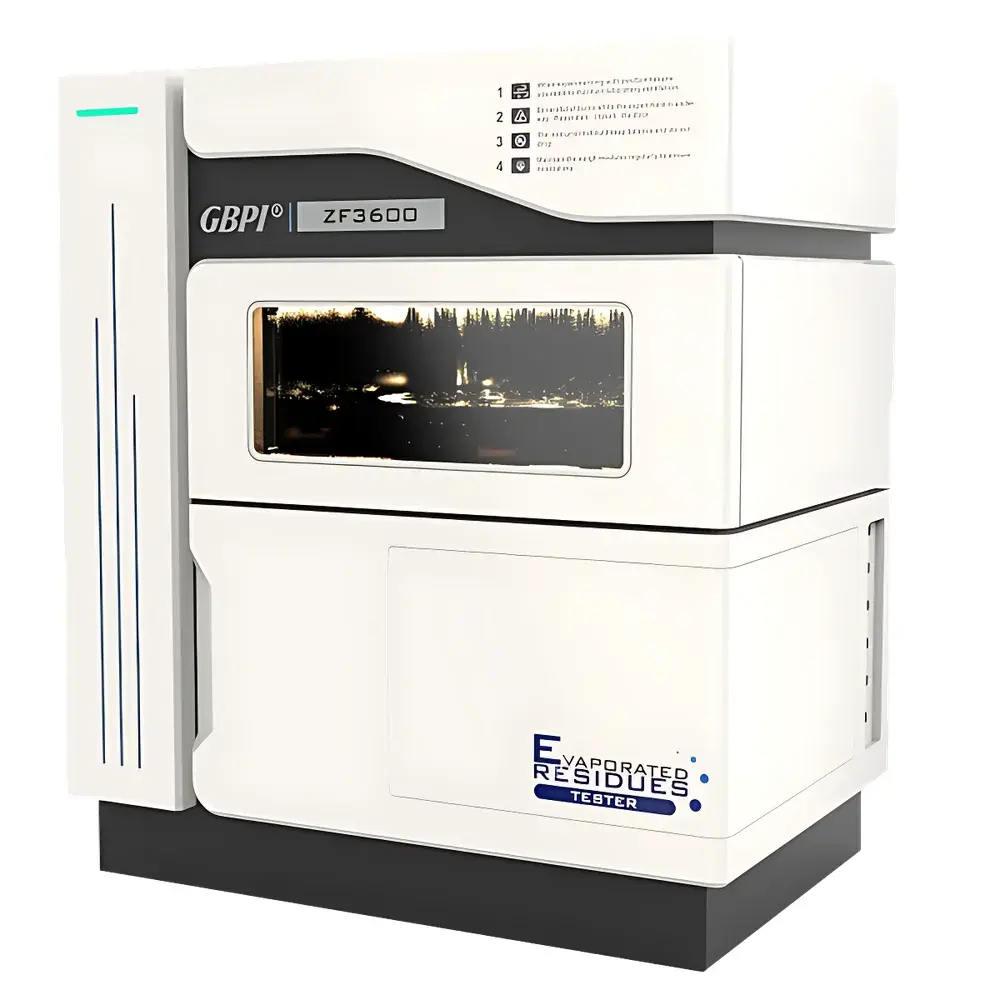
GBPI ZF3600A Total Migration and Non-Volatile Residue Analyzer
| Brand | GBPI |
|---|---|
| Origin | Guangdong, China |
| Manufacturer Type | Manufacturer |
| Country of Origin | China |
| Model | ZF3600A |
| Pricing | Upon Request |
| Measurement Range | 0 g–80 g |
| Balance Resolution | 0.01 mg |
| Balance Capacity | 0 g–220 g |
| Constant-Weight Tolerance | 0.3 mg (user-configurable) |
| Water Bath Temperature Range | Ambient to 100 °C |
| Drying Chamber Temperature Range | Ambient to 125 °C |
| Temperature Control Accuracy | ±0.5 °C |
| Sample Positions | 36 |
| Evaporating Dish Volume | 50 mL or 100 mL (selectable) |
| Pneumatic Interface Diameter | Φ8 mm |
| Dimensions (L×W×H) | 1200 mm × 850 mm × 1335 mm |
| Power Supply | 220 V, 50 Hz |
| Rated Power | 7000 W |
| Operating System | Windows 10 Pro 64-bit |
Overview
The GBPI ZF3600A Total Migration and Non-Volatile Residue Analyzer is an integrated, fully automated gravimetric system engineered for regulatory-compliant determination of total migration, non-volatile residue (NVR), evaporable residue, and dissolved solids in aqueous and organic extracts. It operates on the principle of controlled solvent evaporation followed by precision gravimetric analysis under thermally stabilized conditions—fully aligned with standardized drying and weighing protocols defined in pharmacopoeial and food contact material regulations. The instrument implements a sequential thermal workflow: sample introduction into pre-conditioned evaporating dishes; water-bath evaporation below the boiling point of the extraction medium; forced-air drying at 105 °C; active cooling under inert, humidity-controlled conditions; and iterative high-resolution weighing until constant mass is achieved (≤0.3 mg deviation over two consecutive cycles). Its dual-chamber architecture—comprising a thermostatically regulated water bath and a separately controlled drying/cooling chamber—eliminates cross-contamination risks and environmental interference, ensuring metrological integrity across extended batch runs.
Key Features
- Fully automated sample handling: Pneumatically actuated dispensing system with ≤0.1 mL residual volume per cycle, eliminating manual pipetting and operator-induced variability.
- Integrated dual-temperature control: Independent electromagnetic heating modules for water bath (ambient–100 °C) and drying chamber (ambient–125 °C), both maintained within ±0.5 °C accuracy via PID feedback loops.
- Triple high-precision balance configuration: Three imported analytical balances (0.01 mg resolution, 220 g capacity), each housed in a thermally isolated, water-jacketed enclosure to decouple weighing from thermal transients during drying/cooling phases.
- 36-position parallel processing: Independent dish positioning with individual thermal history tracking, enabling concurrent testing of heterogeneous matrices—including purified water, ethanol, hexane, acetic acid, chloroform, and solid pharmaceuticals.
- Solvent recovery subsystem: Integrated recirculating chiller with large-volume coolant reservoir achieves chamber cooldown to ambient temperature within 30 minutes; solvent recovery efficiency exceeds 90% via condensate collection bottles.
- GMP-aligned software architecture: Compliant with FDA 21 CFR Part 11 and EU Annex 11 requirements, featuring role-based access control, electronic signatures, audit trail logging (system events, user actions, measurement timestamps), and configurable test parameter templates.
Sample Compatibility & Compliance
The ZF3600A supports regulatory testing across multiple international frameworks. For purified water analysis, it fulfills USP , EP 9.0 WATER, PURIFIED, and ChP 2020 Vol. II specifications. In packaging safety assessment, it executes GB 31604.8–2016, EN 1186-3:2002 Method A, and Korean MOHW Chapter IV Section 2-8 for non-volatile residue in food-contact materials. For tobacco industry applications, it conforms to GB/T 9740–2008 for cigarette tipping paper extractables. In environmental and potable water analysis, it satisfies GB 8538–2016 (mineral water), DZ/T 0064.9–2021 (groundwater), GB/T 14415–2007 (thermal spring water), and GB/T 5750.4–2006 (drinking water). Solid dosage forms are evaluated per ChP 2020 Vol. IV “Extractables” and “Loss on Drying”, as well as USP Water Determination.
Software & Data Management
The embedded Windows 10 Pro 64-bit platform hosts a modular, icon-driven interface designed per ISPE GAMP 5 and PIC/S Annex 11 guidelines. All test parameters—including evaporation time, drying duration, cooling delay, target temperature ramps, and constant-weight criteria—are programmable per method. Real-time visualization includes synchronized plots of mass vs. time, chamber temperature, and relative humidity. Raw data (mass, T, RH, timestamps) are stored in encrypted SQLite databases with SHA-256 hashing; export formats include CSV, PDF, and XML for LIMS integration. Electronic signature workflows support multi-level approval chains, while audit trails record all user logins, parameter changes, result modifications, and instrument status transitions—retained for ≥36 months per ALCOA+ principles.
Applications
- Pharmaceutical quality control: Purified water NVR testing per pharmacopoeial monographs; extractables profiling of primary and secondary packaging components.
- Food safety laboratories: Total migration quantification from plastic, paper, and composite food-contact materials under simulated-use conditions.
- Tobacco product compliance: Non-volatile residue analysis in cigarette filter tipping papers per national standards.
- Environmental monitoring: Total dissolved solids (TDS) determination in groundwater, mineral water, and wastewater effluents.
- Chemical manufacturing: Residue verification in reagent-grade solvents and synthesis intermediates.
- Academic research: Gravimetric moisture content, loss on drying (LOD), and extractable residue studies in herbal medicines and botanical preparations.
FAQ
What regulatory standards does the ZF3600A directly support?
It natively supports ChP 2020, USP , EP 9.0, GB 31604.8–2016, EN 1186-3:2002, GB/T 9740–2008, GB 8538–2016, and DZ/T 0064.9–2021 through preconfigured method templates and audit-trail-ready execution.
Can the instrument handle volatile organic solvents safely?
Yes—its sealed dual-chamber design, integrated solvent recovery system, and explosion-proof pneumatic controls meet IEC 60079-0 requirements for Class II hazardous locations when operated with appropriate ventilation.
Is remote diagnostics and data access supported?
Yes—the system integrates with GBPI’s cloud-based Laboratory IoT Platform, enabling secure remote login, real-time instrument status monitoring, historical data retrieval, firmware updates, and video-assisted troubleshooting.
How is balance stability ensured during thermal cycling?
Each balance resides in a thermally buffered, water-circulated isolation chamber; mechanical vibration damping and air suspension minimize micro-disturbances, achieving repeatability ≤0.02 mg (RSD <0.1%) across 100 consecutive weighings.
Does the software support 21 CFR Part 11 compliance out-of-the-box?
Yes—role-based authentication, biometric or token-based electronic signatures, immutable audit logs, and automatic backup archiving are enabled by default without third-party add-ons.





