
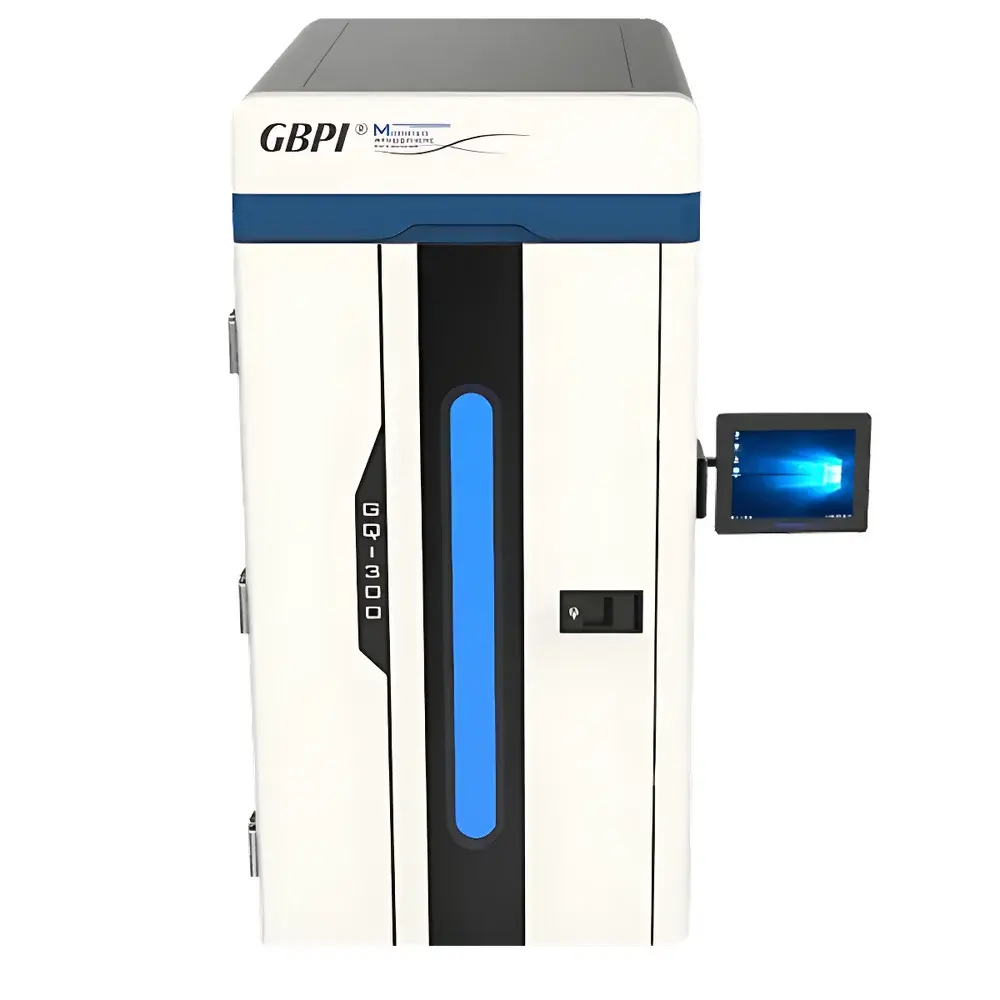
GBPI GQ-300B Controlled Atmosphere Storage Test Chamber
| Brand | GBPI |
|---|---|
| Model | GQ-300B |
| Origin | Guangdong, China |
| Manufacturer | GBPI Packaging Instruments Co., Ltd. |
| Gas Measurement Range | O₂: 0–30% (v/v), CO₂: 0–20% (v/v), C₂H₄: 0–200 ppm |
| Gas Measurement Accuracy | O₂: ±0.01% (v/v), CO₂: ±0.01% (v/v), C₂H₄: ±0.1 ppm |
| Gas Purity Requirement | ≥99.9% for O₂, CO₂, N₂, and C₂H₄ |
| Gas Flow Control | 0–500 mL/min per gas (O₂, CO₂, N₂) |
| Temperature Range | −5°C to +45°C |
| Temperature Uniformity | ±0.5°C |
| Humidity Range | Ambient to 95% RH |
| Humidity Stability | ±3% RH |
| Refrigeration Capacity | 1 HP |
| Humidifier Power | 50 W |
| Illumination Power | 10 W |
| Chamber Material | Color-coated steel exterior, stainless-steel interior |
| Dimensions (W×D×H) | 935 mm × 1290 mm × 1850 mm |
| Total Power Consumption | 3 kW |
| Number of Independent Test Chambers | 3 |
| Power Supply | AC 220 V |
Overview
The GBPI GQ-300B Controlled Atmosphere Storage Test Chamber is a precision-engineered research-grade instrument designed for controlled atmosphere (CA) storage simulation and shelf-life evaluation of perishable biological commodities. It operates on the principle of dynamic gas composition regulation—utilizing mass flow-controlled injection and continuous real-time monitoring of O₂, CO₂, C₂H₄, and N₂—to replicate and optimize post-harvest storage environments. Unlike static storage chambers, the GQ-300B actively maintains target gas partial pressures through closed-loop feedback control, enabling rigorous experimental replication of commercial CA protocols used in cold chain logistics, horticultural research, and food quality assurance. Its triple-chamber architecture allows parallel testing under divergent atmospheric conditions, supporting factorial experimental design without cross-contamination or thermal interference.
Key Features
- Three fully independent test chambers with isolated gas delivery, humidity generation, ethylene catalytic removal, UV-free LED lighting, ozone-based sterilization, condensate drainage, and internal illumination systems.
- Integrated microprocessor-based controller with 24-inch full-HD capacitive touchscreen interface; supports individual parameter programming per chamber—including setpoints for temperature, relative humidity, O₂/CO₂/C₂H₄ concentration, gas flow rates, sterilization duration, and lighting cycles.
- High-fidelity gas sensing using factory-calibrated, imported electrochemical (O₂, CO₂) and semiconductor metal-oxide (C₂H₄) sensors, delivering trace-level detection stability and long-term baseline repeatability.
- PID-controlled thermoregulation via resistive heating elements and scroll-type compressors; eliminates mechanical relay wear and ensures uniform thermal distribution across each chamber volume.
- Ultrasonic high-frequency humidification system operating independently per chamber; delivers rapid RH ramping without introducing thermal load or localized condensation.
- Ozone-based microbial decontamination module with programmable cycle timing and automatic termination; validated for surface bioburden reduction in accordance with ISO 14644-1 Class 8 cleanroom-compatible practices.
- Catalytic ethylene oxidation unit integrated with vacuum-assisted gas exchange pump—enabling sub-5-minute C₂H₄ clearance from 100 ppm to <1 ppm under standard operating conditions.
Sample Compatibility & Compliance
The GQ-300B accommodates heterogeneous sample types including whole fruits (e.g., apples, strawberries), leafy vegetables (e.g., spinach, lettuce), cut flowers (e.g., roses, lilies), nursery stock, fresh meat cuts, seafood fillets, and baked goods. Each chamber’s stainless-steel interior and non-porous gasketed double-glazed door minimize organic residue retention and facilitate GLP-compliant cleaning validation. The system meets structural and electrical safety requirements per IEC 61010-1:2010 and supports audit-ready data integrity when operated with external time-stamped logging software. While not certified to FDA 21 CFR Part 11 out-of-the-box, its deterministic control logic, parameter lockout functions, and exportable CSV/Excel-formatted datasets enable straightforward integration into regulated QA/QC workflows compliant with ISO 22000, HACCP, and USP environmental monitoring guidelines.
Software & Data Management
All operational parameters—including real-time gas concentrations (O₂, CO₂, C₂H₄), chamber temperature and humidity, sterilization status, lighting state, and alarm logs—are timestamped and stored internally for up to 30 days. Data export is supported via USB 2.0 port in UTF-8 encoded CSV format, compatible with MATLAB, Python pandas, JMP, and LIMS platforms. Optional RS-485 Modbus RTU interface enables integration with building management systems (BMS) or centralized laboratory data acquisition networks. No proprietary runtime or subscription licensing is required; firmware updates are delivered as signed binary files via secure FTP.
Applications
- Post-harvest physiology studies evaluating respiration rate modulation under varying O₂/CO₂ ratios.
- Development and validation of commercial CA protocols for export-grade produce logistics.
- Accelerated shelf-life testing of minimally processed ready-to-eat salads and pre-cut fruit packs.
- Evaluation of ethylene-sensitive cultivars (e.g., kiwifruit, avocados) under catalytic C₂H₄ suppression regimes.
- Comparative analysis of antimicrobial efficacy between ozone pulses and alternative sanitizers in low-moisture floral storage.
- Humidity-dependent texture degradation modeling in baked products during extended ambient hold periods.
- Regulatory submission support for novel packaging claims requiring ISO 11607-1 compliant environmental stress conditioning.
FAQ
Does the GQ-300B include built-in gas generators?
No. Users must supply externally sourced, high-purity gases (O₂, CO₂, N₂, and C₂H₄) at ≥99.9% purity, equipped with pressure-reducing regulators delivering 0–0.4 MPa output.
Can all three chambers operate at different temperatures simultaneously?
No. Temperature is controlled uniformly across all chambers via a shared refrigeration/heating manifold; only humidity, gas composition, lighting, and sterilization parameters are independently adjustable.
What is the minimum detectable ethylene concentration?
The system achieves a lower limit of quantitation (LLOQ) of 0.1 ppm for C₂H₄, verified per ISO 17025-accredited calibration procedures.
Is remote monitoring supported?
Yes—via optional Ethernet-to-Modbus gateway hardware; native Wi-Fi or cloud connectivity is not included but can be implemented at the facility level using third-party industrial IoT gateways.
How often do gas sensors require recalibration?
Annual recalibration is recommended under continuous operation; sensor drift compensation algorithms extend functional calibration intervals up to 18 months when used in low-C₂H₄ environments (<5 ppm average exposure).






