
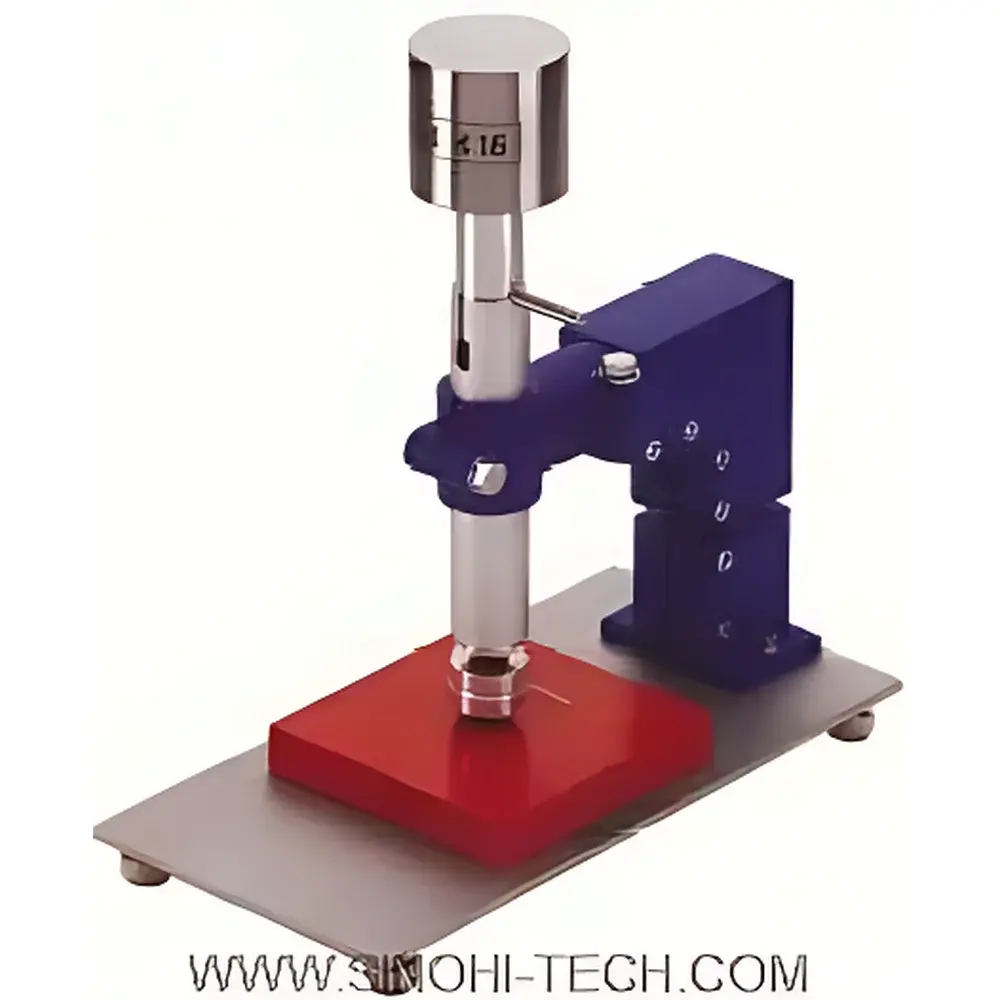
Erichsen #416 Complete Drying Tester
| Origin | Germany |
|---|---|
| Manufacturer Type | Authorized Distributor |
| Origin Category | Imported |
| Model | #416 |
| Pricing | Upon Request |
Overview
The Erichsen #416 Complete Drying Tester is a precision mechanical instrument engineered for the standardized assessment of complete drying (also termed “through-dry” or “hard-dry”) of organic coatings—including paints, varnishes, lacquers, and related film-forming systems—on rigid substrates. It operates on the principle of controlled mechanical deformation followed by angular displacement, as defined in ISO 9117-3:2017 (“Paints and varnishes — Determination of drying time — Part 3: Complete drying test”) and EN ISO 29117:2012 (“Coatings — Determination of drying behaviour — Complete drying test”). Unlike surface-dry or tack-free assessments, this method evaluates whether the coating has achieved full crosslinking and cohesive integrity throughout its entire thickness, such that no permanent plastic deformation or interfacial disruption occurs under localized shear stress.
Key Features
- Compliant mechanical actuation system with calibrated vertical loading and precise 90° rotational torque application
- Standardized test probe assembly comprising a 1500 g total mass (including load weight and articulated probe), mounted via universal ball-and-socket joint for consistent force transmission
- Replaceable nylon monofilament testing element (100 × 100 mm, Ø 0.12 mm), installed per test using O-ring fixation to ensure uniform contact geometry and eliminate fiber fatigue effects
- Integrated elastomeric interface: 50 IRHD rubber pad (per ISO 48-1:2018) mounted at probe tip to distribute nominal pressure and prevent point-load damage to substrate
- Adjustable leveling feet with built-in spirit level (supplied) enabling rapid horizontal alignment—critical for reproducible normal-force application across variable substrate topographies
- Compact benchtop footprint (approx. 150 × 300 × 305 mm) and lightweight aluminum–steel hybrid construction (net weight ~4.5 kg) optimized for QC lab integration and mobility between testing stations
Sample Compatibility & Compliance
The #416 tester accommodates flat, rigid panels up to 300 × 300 mm (e.g., steel, glass, aluminum, or coated wood substrates), provided surface roughness remains within Ra ≤ 3.2 µm to avoid spurious indentation artifacts. It is validated exclusively for solvent-borne, water-borne, and UV-curable coatings applied at standard wet film thicknesses (typically 60–120 µm per ISO 2808). All operational procedures align with GLP-aligned laboratory practice: test timing (10 s dwell + 2 s lift delay), probe replacement frequency (single-use per measurement), and environmental conditioning (23 ± 2 °C / 50 ± 5 % RH per ISO 3270) are explicitly mandated in ISO 9117-3. The instrument itself bears no CE marking but conforms to essential safety requirements for mechanical testing devices under EU Machinery Directive 2006/42/EC when operated per manual instructions.
Software & Data Management
The Erichsen #416 is a fully manual, non-electronic instrument—no firmware, embedded software, or digital output is present. Consequently, it requires no calibration certificates traceable to national metrology institutes, nor does it generate electronic records. However, its design supports audit-ready documentation: each test must be logged manually with timestamp, substrate ID, coating batch, ambient conditions, and pass/fail outcome per ISO 9117-3 Annex A. For laboratories operating under FDA 21 CFR Part 11 or ISO/IEC 17025, handwritten records may be supplemented with digital photography of post-test surfaces (with scale reference) and archived alongside raw data sheets. No proprietary software is required or supplied.
Applications
- Final release testing of industrial maintenance coatings prior to handling or stacking
- Validation of curing schedules for thermoset powder coatings in automotive OEM lines
- Batch-to-batch consistency verification in architectural paint manufacturing
- Accelerated drying studies under controlled humidity/temperature chambers (when used with environmental enclosures)
- Root-cause analysis of incomplete crosslinking in high-solids or low-VOC formulations
- Supporting technical service reports for customer complaints related to blocking or marring
FAQ
Is the #416 tester suitable for flexible substrates such as PVC films or rubber sheets?
No. ISO 9117-3 specifies rigid, non-deformable panels only. Flexible substrates introduce uncontrolled bending moments that invalidate the defined stress state.
Why must the nylon filament be replaced before every test?
Repeated use causes micro-fraying, reduced tensile modulus, and inconsistent fiber–coating interaction; ISO 9117-3 mandates single-use filaments to preserve test repeatability and inter-laboratory comparability.
Does the instrument require periodic recalibration?
No formal recalibration is specified. However, users must verify probe mass (1500 g ± 2 g) annually using Class M2 weights traceable to NIST or equivalent NMIs, and confirm rubber pad hardness (50 ± 2 IRHD) per ISO 48-1 at six-month intervals.
Can results from the #416 be correlated to pendulum hardness or gloss measurements?
Not directly. Complete drying reflects bulk cohesive strength, whereas pendulum hardness measures surface viscoelastic recovery and gloss reflects topography. These are complementary—not substitutable—quality indicators.
What is the minimum recommended substrate thickness for reliable testing?
Substrates must be ≥ 0.8 mm thick (e.g., standard steel test panels per ISO 1514) to prevent flexure-induced false negatives during probe rotation.



