
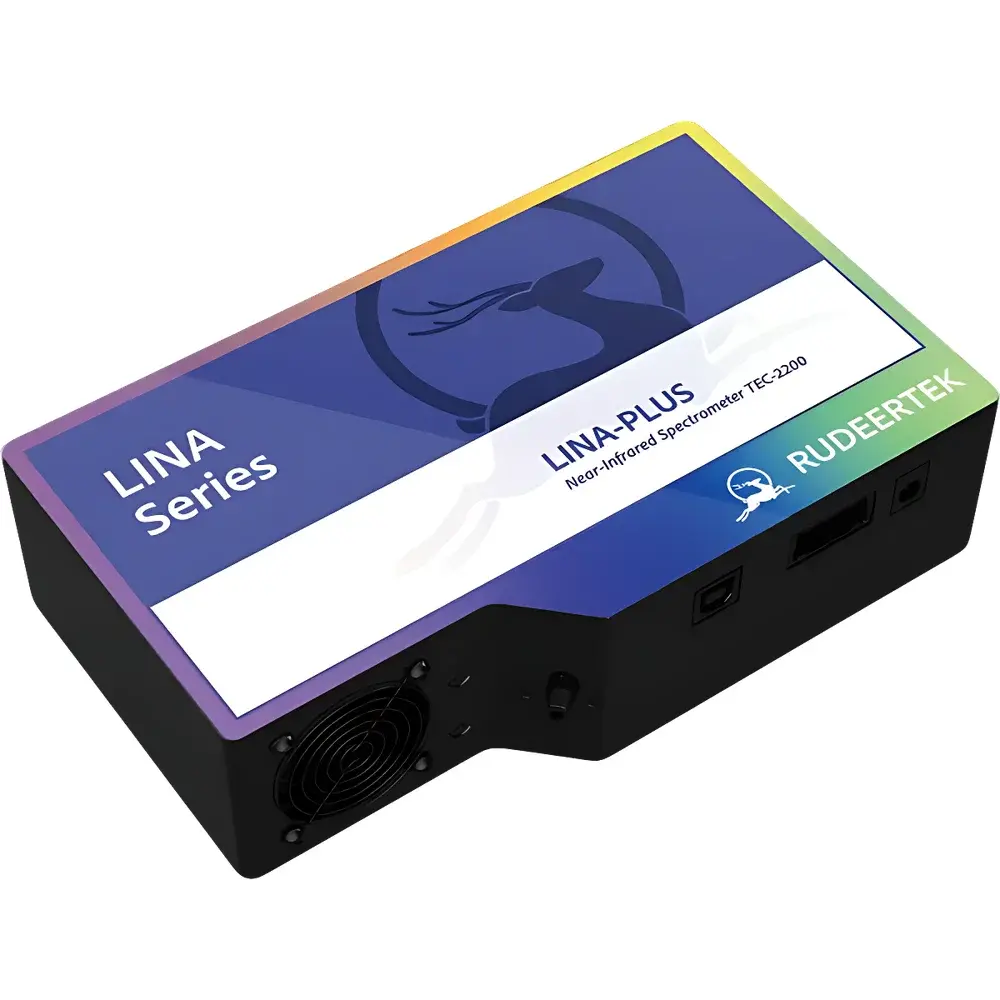
LINA-PLUS High-SNR Cooled Near-Infrared Fiber Optic Spectrometer
| Brand | Luqi Technology |
|---|---|
| Origin | Anhui, China |
| Manufacturer Type | OEM Manufacturer |
| Spectral Range | 900–2200 nm |
| Detector | TEC-cooled InGaAs linear array (2-stage cooling) |
| Optical Resolution | ~5.8 nm (with 50 μm slit) |
| SNR | 5500:1 (full signal) |
| Dynamic Range | 8000:1 (single acquisition) |
| Stray Light | <1% |
| F-number | f/4 |
| Optical Design | Crossed Czerny-Turner |
| Slit Options | 10/25/50/75/100 μm |
| Pixel Array | 256 or 512 × 1 pixels |
| Pixel Size | 50/25 μm × 250 μm |
| Integration Time | 1 ms – 10 s |
| Linearity | ≥0.998 |
| A/D Resolution | 16-bit |
| Cooling Capacity | ΔT ≤ 40 °C below ambient |
| Interface | USB 2.0 Type-B, Digital I/O, SMA905 fiber port |
| Weight | 1.25 kg |
| OS Support | Windows 7/10/11 (32/64-bit) |
Overview
The LINA-PLUS is a high-performance, thermoelectrically cooled near-infrared (NIR) fiber optic spectrometer engineered for demanding quantitative and qualitative analysis in laboratory, industrial, and field-deployable applications. Operating across the 900–2200 nm spectral window—encompassing key overtones and combination bands of C–H, O–H, and N–H bonds—the instrument leverages a two-stage thermoelectric cooler (TEC) to stabilize an InGaAs linear array detector at temperatures up to 40 °C below ambient. This active thermal management significantly suppresses dark current, enabling sustained high signal fidelity during extended integration periods. Its crossed Czerny-Turner optical architecture with f/4 throughput ensures optimal light collection efficiency and minimal aberration across the full NIR range. Designed for integration into automated analytical platforms—including process analyzers, handheld NIR probes, and benchtop QC systems—the LINA-PLUS delivers reproducible spectral data under variable environmental conditions without requiring liquid nitrogen or external chillers.
Key Features
- Two-stage TEC cooling system for InGaAs detector, achieving stable operating temperatures up to 40 °C below ambient—critical for low-noise, long-integration measurements
- High signal-to-noise ratio of 5500:1 (at full signal saturation) and dynamic range of 8000:1 per single acquisition—supporting both weak-absorption and high-concentration sample analysis
- Optimized optical design featuring a crossed Czerny-Turner configuration with f/4 aperture, delivering uniform spectral response and reduced astigmatism across 900–2200 nm
- Selectable entrance slits (10, 25, 50, 75, or 100 μm) allow precise trade-offs between resolution (~5.8 nm at 50 μm) and throughput
- Low stray light (<1%) ensured by precision-aligned baffling, optimized grating coatings, and internal blackening—essential for accurate quantitation in complex matrices
- 16-bit analog-to-digital conversion with linearity ≥0.998 supports robust calibration transfer and multivariate modeling (e.g., PLS, PCA)
- Compact, ruggedized aluminum housing (1.25 kg) with SMA905 fiber interface, USB 2.0 Type-B host connection, and opto-isolated digital I/O for external trigger/synchronization
Sample Compatibility & Compliance
The LINA-PLUS is compatible with standard 400–600 μm core multimode silica fibers and integrates seamlessly with transmission cells, diffuse reflectance probes, integrating spheres, and flow-through cuvettes. It meets fundamental requirements for spectroscopic instrumentation under ISO/IEC 17025-accredited laboratories when operated within validated configurations. While not pre-certified for regulatory submission, its hardware architecture—including non-volatile memory for calibration persistence, deterministic timing control, and traceable wavelength/intensity calibration—supports implementation in GLP and GMP environments. The device complies with CE electromagnetic compatibility (EMC) directives and RoHS material restrictions. Firmware and driver stacks are designed for deterministic behavior, facilitating audit-ready documentation for FDA 21 CFR Part 11 compliance when paired with appropriate software validation protocols.
Software & Data Management
The spectrometer operates via a vendor-provided SDK supporting C/C++, Python (PyUSB), and LabVIEW APIs, enabling full control over integration time (1 ms–10 s), averaging, and hardware triggering. Raw spectra are acquired as 16-bit integer arrays; wavelength calibration coefficients (pixel-to-nm mapping) and radiometric correction factors are stored in non-volatile memory and applied in real time. Third-party chemometric software—including Unscrambler X, MATLAB Statistics and Machine Learning Toolbox, and open-source libraries such as scikit-learn—can directly ingest exported ASCII or HDF5 spectral files. Timestamped metadata (integration time, temperature, slit width, gain settings) is embedded in all exports, ensuring traceability for method development and routine verification. No proprietary runtime or subscription-based software is required for basic operation or data export.
Applications
- Quantitative analysis of moisture, protein, fat, and starch in agricultural commodities (grains, seeds, forage) per ASTM E1655 and ISO 12099
- In-line monitoring of polymer composition, crystallinity, and additive concentration during extrusion or film casting
- Pharmaceutical raw material identification and blend uniformity assessment compliant with USP <1119>
- Quality control of lithium-ion battery electrode slurries and dried cathode/anode films
- Non-destructive authentication of fuels, lubricants, and specialty chemicals based on spectral fingerprinting
- Environmental soil organic carbon (SOC) estimation using calibrated PLS regression models
FAQ
What cooling level does the two-stage TEC achieve, and how does it impact measurement stability?
The dual-stage TEC stabilizes the InGaAs detector at up to 40 °C below ambient temperature, reducing dark current by approximately one order of magnitude compared to uncooled operation. This enables consistent baseline stability over multi-hour acquisitions and improves repeatability in low-light scenarios.
Can the LINA-PLUS be synchronized with external equipment such as pumps or shutter controllers?
Yes—via its opto-isolated digital I/O lines, the spectrometer supports TTL-level hardware triggering for start/stop acquisition, external clock synchronization, and status feedback, making it suitable for time-resolved or pump-probe NIR experiments.
Is wavelength calibration traceable to NIST standards?
Factory calibration uses certified rare-earth oxide emission lamps (e.g., Holmium Oxide) and deuterium/halogen sources. End users may perform re-calibration using NIST-traceable line sources; calibration coefficients are user-writable and retained in onboard memory.
Does the device support continuous scanning mode for kinetic studies?
Yes—acquisition rates up to 100 spectra per second (depending on integration time and USB bandwidth) are achievable in streaming mode, with timestamp precision better than ±100 µs.
Are firmware updates provided, and how are they deployed?
Firmware updates are distributed as signed binary packages via the manufacturer’s secure portal. Updates are performed via USB using the included utility and preserve all user calibration data and configuration settings.
Related Products




