
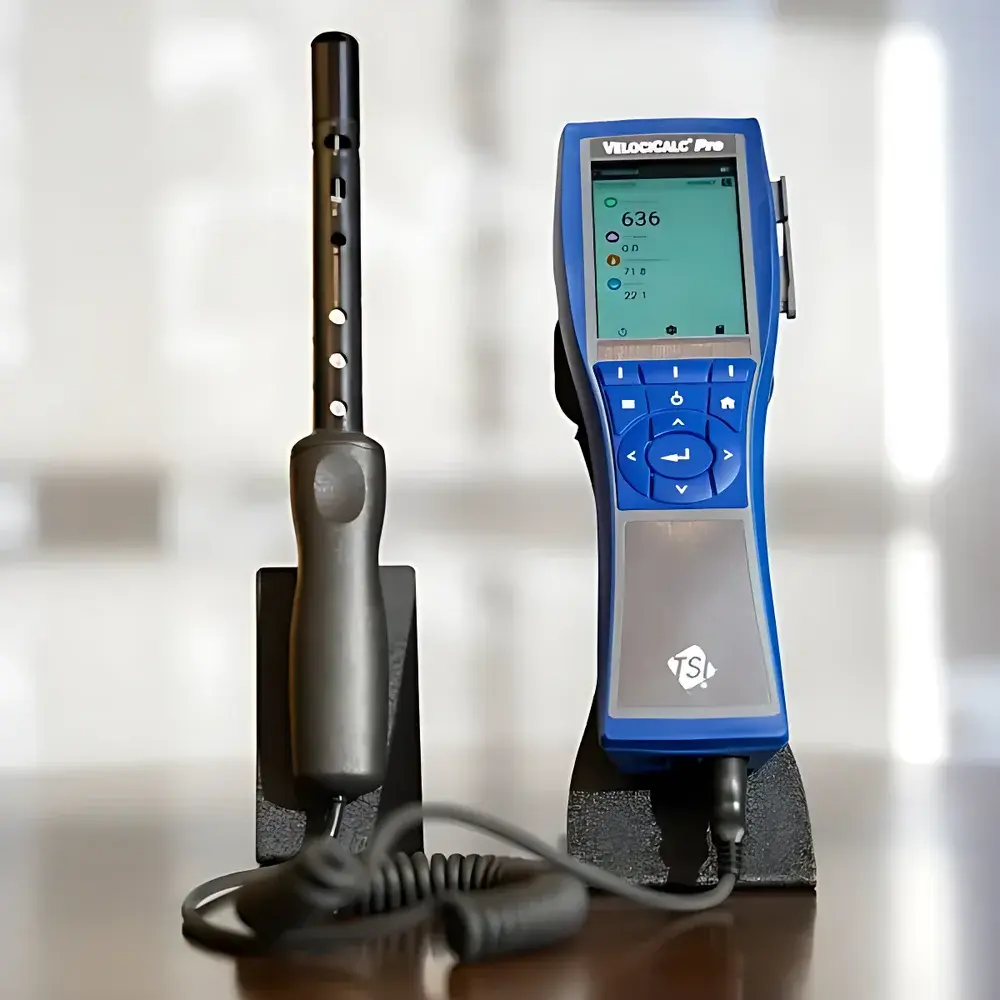
TSI VelociCalc™ 9600 / 9630 / 9650-NB Multi-Function Air Velocity and Flow Meter
| Brand | TSI |
|---|---|
| Origin | USA |
| Model | VelociCalc™ 9600 / 9630 / 9650-NB |
| Air Velocity Range (Pitot Tube, 9630/9650-NB) | 1.27–78.7 m/s |
| Accuracy (at 10.16 m/s) | ±1.5% |
| Resolution | 0.01 m/s |
| Static/Differential Pressure Range | −3735 to +3735 Pa |
| Accuracy | ±1% of reading ±1 Pa |
| Resolution | 0.1 Pa |
| Barometric Pressure Range | 517.15–930.87 mmHg |
| Operating Temperature | 5–45 °C |
| Dimensions | 8.1 × 24.1 × 4.1 cm |
| Weight | 0.41 kg |
| Data Storage | 200 test IDs / 162,200 samples |
| Sampling Interval | 1 s – 1 h |
| Time Constants | 1, 5, 10, 20, 30, 60, 90 s |
Overview
The TSI VelociCalc™ 9600, 9630, and 9650-NB series are precision-engineered multi-function air velocity and volumetric flow meters designed for HVAC commissioning, laboratory ventilation validation, cleanroom certification, and indoor air quality (IAQ) assessment. These instruments operate on fundamental principles of thermal anemometry (for hot-wire and hot-film probes), pitot tube-based dynamic pressure measurement (for duct traverse applications), and electrochemical or NDIR sensing (for CO₂ and CO detection). Each model integrates a calibrated barometric pressure sensor and ambient temperature input to enable real-time air density compensation—critical for accurate volumetric-to-mass flow conversion under variable environmental conditions. The 9600 series is built around a modular architecture that decouples sensor intelligence from the main unit: all calibration data, probe-specific K-factors, and linearization coefficients are stored within each plug-and-play probe, ensuring traceability and eliminating recalibration drift during field use.
Key Features
- High-resolution color display with simultaneous real-time visualization of up to six parameters—including velocity, temperature, humidity, CO₂, differential pressure, and calculated airflow—enhancing situational awareness during complex duct traverses or cabinet face velocity surveys.
- Intuitive menu-driven interface with context-sensitive on-screen prompts, reducing operator training time and minimizing setup errors in GxP-regulated environments.
- Ergonomic housing with integrated rare-earth magnets and a foldable probe stand enables hands-free mounting on ferrous ductwork, fume hood frames, biosafety cabinet casings, or HVAC plenums—supporting repeatable positioning per EN 12599 and ASHRAE 111 protocols.
- User-programmable soft keys allow rapid access to frequently used workflows such as “Duct Traverse,” “Room Ventilation Check,” or “CO₂-Based Outdoor Air Calculation”—accelerating routine QA/QC tasks without menu navigation.
- Modular probe ecosystem: All probes—including thermal anemometers (models 960, 962, 964, 966), vane anemometers (995), pitot tubes, IAQ probes (980, 982), and thermocouple surface sensors (792, 764)—are NIST-traceable and supplied with individual calibration certificates compliant with ISO/IEC 17025 requirements.
- Onboard calculation engine supports standardized airflow algorithms including logarithmic Chebyshev (ASHRAE 111), equal-area (ASHRAE 111), and EN 16211 grid-based duct traverses—with automatic grid point generation, dwell-time guidance, and statistical validation of measurement repeatability.
Sample Compatibility & Compliance
The VelociCalc™ platform is validated for use across diverse sampling matrices and regulatory frameworks. For HVAC system balancing and TAB (Testing, Adjusting, and Balancing), it meets ASTM D1076 (Standard Specification for Instruments Used in Measuring Airflow) and complies with ASHRAE Guideline 12-2020 for infection control. In cleanroom environments, its adherence to ISO 14644-3:2019 Annex B ensures reproducible face velocity measurements across HEPA-filtered laminar flow hoods and biological safety cabinets. For pharmaceutical facilities operating under FDA 21 CFR Part 11, the instrument’s audit trail-capable data logging (with timestamp, operator ID, probe serial number, and environmental metadata) supports electronic record integrity when paired with TSI’s TrakPro™ Lite software. All models conform to IEC 61000-4 electromagnetic compatibility standards and UL/CSA safety certifications for Class I, Division 2 hazardous locations.
Software & Data Management
Data export and post-processing are supported via USB or optional Bluetooth connectivity to TrakPro™ Lite software—a Windows-based application enabling report generation in PDF or Excel formats with embedded compliance statements (e.g., “Meets EN 12599:2012 Section 6.3.2 for static pressure uncertainty”). Raw datasets include full metadata: probe type, calibration expiration date, atmospheric pressure, ambient temperature, user-defined K-factor, and measurement time-stamp. The instrument stores up to 162,200 individual samples across 200 unique test IDs, with configurable sampling intervals from 1 second to 1 hour—sufficient for extended stability monitoring per ISO 14644-2:2015 Annex C. Audit logs record all configuration changes, probe swaps, and zero-calibration events—enabling full traceability required under GLP and GMP quality systems.
Applications
- HVAC system commissioning and fault diagnosis—quantifying supply/return airflows, identifying duct leakage, verifying damper actuation, and validating design airflow rates against ASHRAE 62.1 ventilation requirements.
- Cleanroom classification per ISO 14644-1:2015—measuring uniformity of unidirectional airflow velocity at filter face and workplane levels.
- Laboratory safety cabinet certification per NSF/ANSI 49 and EN 12469—performing face velocity mapping, inflow velocity verification, and smoke visualization correlation.
- Indoor air quality investigations—calculating outdoor air intake percentage using CO₂ differential method (ASHRAE Standard 62.1), assessing thermal comfort via wet-bulb globe temperature (WBGT) derivation, and trending CO exposure against OSHA PEL thresholds.
- Energy efficiency audits—estimating sensible and latent heat transfer rates (BTU/h, kW) using measured airflow, dry-bulb/wet-bulb temperatures, and psychrometric properties.
FAQ
How does air density compensation improve volumetric flow accuracy?
Air density compensation adjusts for local barometric pressure and temperature variations, converting measured velocity into true mass-normalized airflow—essential for comparing performance across altitudes or seasonal conditions.
Can the same probe be used interchangeably across all three models (9600, 9630, 9650-NB)?
Yes—all thermal, vane, IAQ, and pitot probes are mechanically and electrically compatible with any 9600-series meter; however, pressure-related calculations (e.g., duct airflow) require the built-in differential pressure sensor present only in the 9630 and 9650-NB models.
What standards govern duct traverse measurement procedures supported by the 9650-NB?
The 9650-NB implements ASHRAE 111-2013 (logarithmic Chebyshev and equal-area methods), EN 16211:2017 (grid-based velocity integration), and EN 12599:2012 (static pressure and velocity uniformity criteria) with automated compliance flagging.
Is firmware update capability available, and how is traceability maintained after updates?
Firmware updates are performed via USB using TSI-signed binaries; each update generates a firmware revision log entry with date/time stamp and SHA-256 hash—preserved in the device’s internal audit trail.
Does the instrument support 21 CFR Part 11-compliant electronic signatures?
While the standalone meter does not host electronic signature functionality, its encrypted data export format and full audit trail meet predicate rule requirements when integrated into a validated LIMS or ELN environment with external e-signature controls.







