
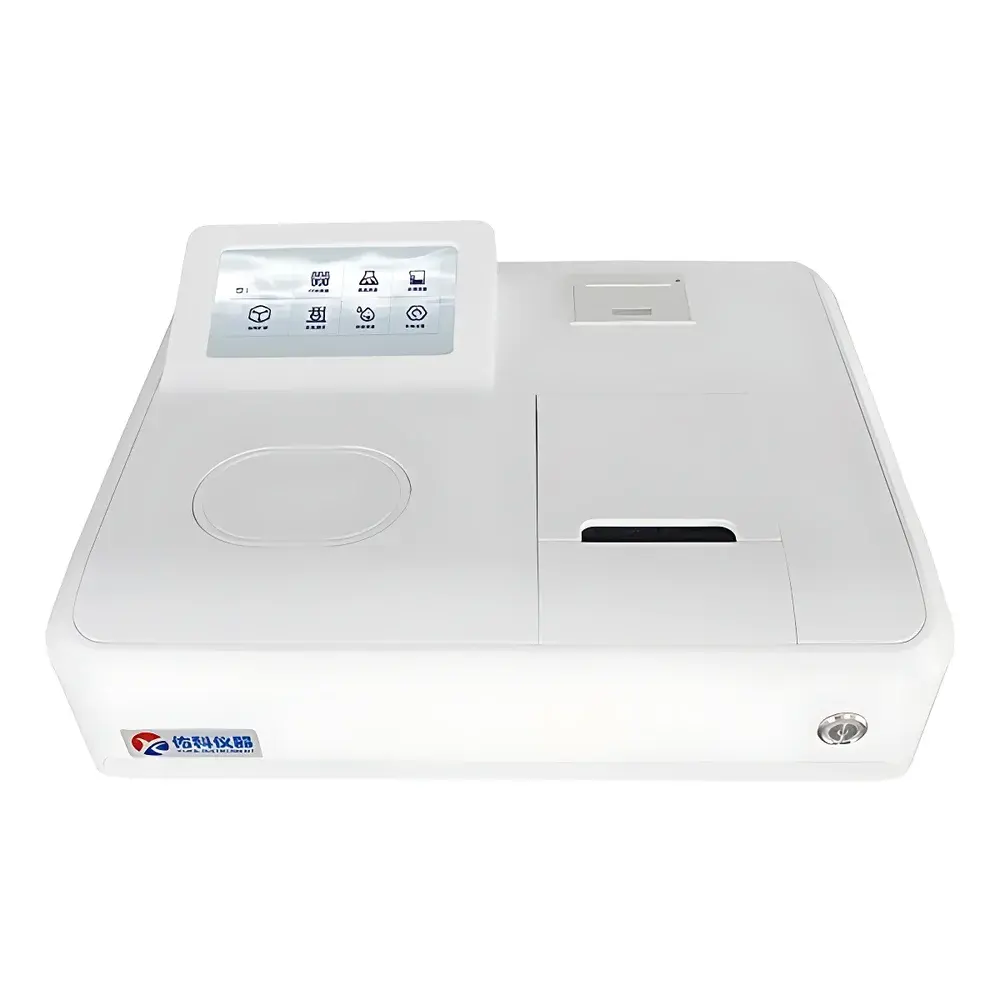
Yoke ITS2002 Multi-Parameter Water Quality Analyzer
| Brand | Yoke |
|---|---|
| Origin | Shanghai, China |
| Manufacturer Type | Direct Manufacturer |
| Instrument Type | Laboratory Water Quality Analyzer |
| Model | ITS2002 |
| Detection Parameters | COD, Ammonia-N, Total Phosphorus, Total Nitrogen (any two simultaneously) |
| Wavelength Accuracy | ±0.5 nm |
| Display | 5.6-inch Color Touchscreen GUI |
| Data Storage | ≥5000 records (5 factory curves + 195 user-expandable curves) |
| Light Source | Cold LED with Narrow-Band Interference Filter, Lifetime ≥100,000 hours |
| Processor | ARM9 core |
| Internal Memory | 512 MB |
| Connectivity | USB 2.0, RS-232 serial port |
| Printer | Built-in thermal printer |
| Measurement Method Compliance | GB/T 11914–1989 (COD), HJ 535–2009 (NH₃-N), GB/T 11893–1989 (TP), HJ 636–2012 (TN) |
| Reagent Compatibility | Lab-YY pre-mixed reagent kits |
Overview
The Yoke ITS2002 Multi-Parameter Water Quality Analyzer is a benchtop spectrophotometric analyzer engineered for precise, standardized quantification of key water quality parameters in environmental monitoring laboratories, municipal wastewater facilities, and academic research settings. It operates on the principle of narrow-band interference filter-based absorbance photometry—employing cold LED light sources at defined wavelengths to detect analyte-specific colorimetric reactions. Each parameter is measured using nationally validated methods: COD via rapid digestion with potassium dichromate (GB/T 11914–1989), ammonia-nitrogen via Nessler’s reagent (HJ 535–2009), total phosphorus via molybdate blue reaction (GB/T 11893–1989), and total nitrogen via alkaline persulfate digestion followed by UV absorbance measurement (HJ 636–2012). The instrument supports dual-parameter simultaneous analysis from its four-core assay set, enabling efficient batch testing without hardware reconfiguration.
Key Features
- 5.6-inch high-resolution color touchscreen with intuitive graphical user interface (GUI), designed for ergonomic operation and minimal training overhead.
- High-stability optical architecture featuring precision narrow-band interference filters (±0.5 nm wavelength accuracy) and long-life cold LED illumination (≥100,000 hours), ensuring repeatability across extended operational cycles.
- Dual-channel measurement capability: users select any two of COD, ammonia-N, total phosphorus, or total nitrogen for concurrent analysis within a single run.
- Onboard ARM9 processor with 512 MB internal memory supports rapid data processing, real-time curve fitting, and seamless navigation between calibration, measurement, and reporting modes.
- Built-in thermal printer enables immediate hard-copy output of current readings, historical datasets, and calibration reports—reducing reliance on external peripherals.
- Comprehensive data management: stores ≥5,000 test records; includes 5 preloaded factory calibration curves and up to 195 user-defined curves with adjustable segmental K-coefficients for non-linear response modeling.
- USB 2.0 and RS-232 interfaces facilitate bidirectional data exchange with LIMS, Excel, or custom laboratory software; supports export in CSV format.
- Optimized for use with Lab-YY certified pre-mixed reagent kits—minimizing manual preparation steps, reducing inter-operator variability, and improving method-to-method consistency.
Sample Compatibility & Compliance
The ITS2002 accepts standard 10–25 mm round glass or quartz cuvettes (10 mm pathlength recommended) and accommodates liquid samples ranging from clarified surface water and drinking water to moderately turbid wastewater effluents. Sample volume requirement is 2.5–5.0 mL per assay. All detection protocols align with Chinese national environmental standards (GB and HJ series), ensuring regulatory acceptability for routine compliance reporting. While not certified for ISO/IEC 17025 accreditation out-of-the-box, the system supports GLP-aligned workflows through full audit trails (time-stamped calibration logs, user ID tagging, versioned curve archives), and can be integrated into 21 CFR Part 11–compliant environments when paired with validated third-party data management software.
Software & Data Management
Instrument firmware provides embedded calibration management, including multi-point linear and segmented non-linear curve generation, slope/intercept validation, and automatic blank subtraction. All curve parameters—including K-factors, intercepts, and wavelength assignments—are editable and version-controlled. Data files retain metadata such as date/time stamp, operator ID (configurable), method ID, cuvette ID (if barcoded), and raw absorbance values at each wavelength. USB export generates timestamped CSV files compatible with statistical analysis tools (e.g., Minitab, JMP) and regulatory submission templates. No cloud connectivity or proprietary software installation is required—operation is fully self-contained.
Applications
- Routine monitoring of influent and effluent streams in municipal and industrial wastewater treatment plants.
- Quality assurance testing for drinking water distribution systems and source water assessment.
- Environmental impact studies requiring field-deployable lab-grade precision under controlled conditions.
- Educational laboratories conducting EPA-equivalent method training and student-led water chemistry experiments.
- Third-party testing labs performing contract analyses for local environmental agencies under GB-standard mandates.
FAQ
Does the ITS2002 support automatic wavelength selection for different parameters?
Yes—the instrument auto-selects the optimal interference filter wavelength (e.g., 620 nm for COD, 420 nm for ammonia-N) based on the selected assay module.
Can users import custom calibration curves from external spectrophotometers?
No—curves must be generated in situ via standard addition or reference standard series; however, up to 195 user-defined curves may be stored and recalled.
Is the thermal printer compatible with continuous label stock?
It accepts standard 57 mm thermal paper rolls only; adhesive-backed labels are not supported.
What is the minimum detectable concentration for total phosphorus?
The lower limit of quantitation (LLOQ) is 0.01 mg/L, verified per GB/T 11893–1989 using potassium dihydrogen phosphate reference standards.
Does the system meet ASTM D1253 or ISO 6060 requirements for COD measurement?
It implements the chemical principle of ASTM D1253 and ISO 6060 but is validated exclusively against GB/T 11914–1989; cross-method correlation data are available upon request.
Related Products







