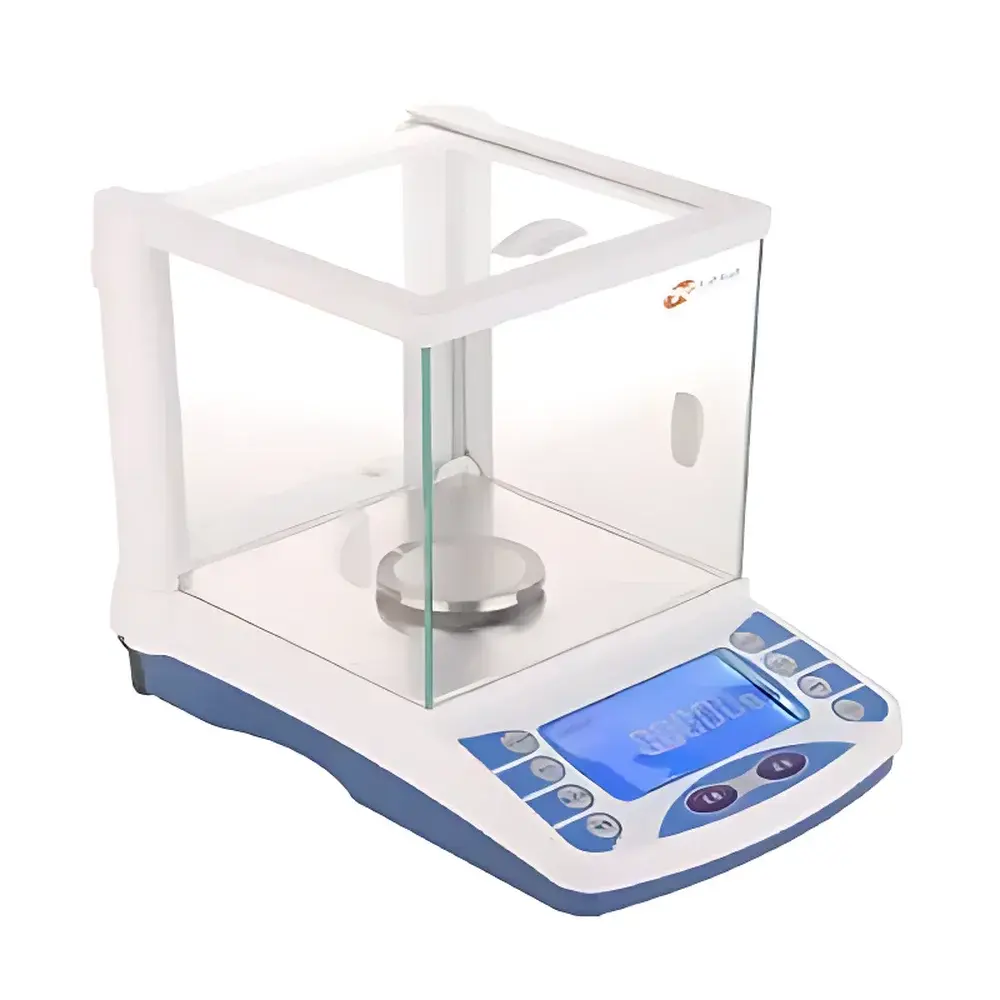
Yoke FA1004C Advanced Analytical Balance with Internal Auto-Calibration
| Brand | Yoke |
|---|---|
| Origin | Shanghai, China |
| Manufacturer Type | Direct Manufacturer |
| Instrument Type | Analytical Balance |
| Capacity | 0–100 g |
| Readability | 0.1 mg |
| Repeatability | ≤ ±0.1 mg |
| Pan Diameter | Ø80 mm |
| Net Weight | 8 kg |
| Dimensions (W×D×H) | 350 × 215 × 340 mm |
| Packaging Dimensions | 480 × 375 × 515 mm |
| Working Height Under Draft Shield | 240 mm |
| Calibration Method | Internal Motorized Auto-Calibration |
| Interface | RS232C Serial Output |
Overview
The Yoke FA1004C is a high-precision analytical balance engineered for laboratories requiring consistent, traceable mass measurement at the 0.1 mg readability level. It operates on electromagnetic force compensation (EMFC) principle — where sample weight is counterbalanced by a precisely controlled electromagnetic current — ensuring linearity, stability, and minimal drift over time. Designed for routine QC testing, formulation development, and academic research, the FA1004C integrates internal motorized auto-calibration to maintain metrological integrity without manual intervention, reducing operator dependency and supporting compliance with ISO/IEC 17025, USP , and GLP documentation requirements.
Key Features
- Electromagnetic force compensation (EMFC) sensor architecture delivering long-term stability and high reproducibility (≤ ±0.1 mg repeatability)
- Internal motorized auto-calibration system activated automatically at user-defined intervals or temperature thresholds (±1.5 °C change), ensuring continuous accuracy across environmental fluctuations
- Five-sided transparent draft shield with ergonomic sliding doors and optimized airflow management for rapid stabilization and reduced convection error
- Backlit large-format LCD display (128 × 64 pixels) with adjustable contrast, enabling clear readability under varied ambient lighting conditions
- Integrated RS232C serial interface compliant with standard ASCII protocol, enabling direct connection to PCs, label printers, or LIMS without additional drivers
- Robust aluminum alloy housing and reinforced base structure minimizing vibration transmission and improving operational resilience in shared lab environments
- Comprehensive built-in diagnostics including real-time sensor health monitoring, overload detection, and linear four-point calibration verification
Sample Compatibility & Compliance
The FA1004C accommodates standard laboratory samples up to 100 g on its Ø80 mm stainless steel weighing pan. Its 240 mm working height beneath the draft shield supports volumetric flasks, crucibles, and small reaction vessels. The balance meets international regulatory expectations for analytical instrumentation: it supports audit-ready operation via timestamped calibration logs and event tracking; complies with OIML R76-1 Class I accuracy requirements for analytical balances; and provides traceable performance when used with certified reference weights (e.g., ASTM E617 Class S-1). While not inherently 21 CFR Part 11 compliant, its RS232 output enables integration with validated third-party data acquisition software supporting electronic signatures and audit trails.
Software & Data Management
Data export is natively supported via ASCII-formatted RS232C output, compatible with Excel, LabChart, and most LIMS platforms using standard terminal emulation (e.g., Tera Term, PuTTY). The balance stores up to 99 calibration events with timestamps, temperature readings, and deviation values — accessible via front-panel navigation. Optional Yoke Balance Utility Software (v3.2+) enables automated batch reporting, statistical process control (SPC) charting, and CSV log export with configurable metadata fields (operator ID, sample ID, location). All data transfers are unidirectional and non-volatile, preserving instrument firmware integrity during communication.
Applications
- Pharmaceutical quality control: active pharmaceutical ingredient (API) weighing, tablet content uniformity testing per USP
- Chemical synthesis: stoichiometric reagent dispensing, gravimetric titrant standardization
- Materials science: density determination of powders and thin films via buoyancy correction
- Environmental testing: filter weighing for particulate matter (PM2.5/PM10) analysis per EPA Method 201A
- Food & beverage QA: moisture loss assays, additive concentration verification
- Academic teaching labs: fundamental metrology instruction, uncertainty budgeting exercises
FAQ
What calibration standards are required for initial setup?
No external weights are required for daily operation due to internal motorized calibration. However, periodic verification (e.g., quarterly) using NIST-traceable Class S-1 or Class M-1 weights is recommended per ISO/IEC 17025 Clause 6.5.
Does the FA1004C support external calibration with user-provided weights?
Yes — external calibration mode is accessible via service menu and supports multi-point linearity verification using up to four user-defined mass points.
Can the balance be integrated into a networked laboratory environment?
While lacking native Ethernet or Wi-Fi, the RS232C port supports connection to serial-to-Ethernet converters for centralized data aggregation in enterprise systems.
Is the draft shield removable for cleaning or large-sample handling?
The five-sided glass shield is fully detachable without tools; all components are autoclavable up to 121 °C for sterile applications.
What environmental conditions affect measurement stability?
Optimal operation occurs at 18–23 °C with ≤50% RH and minimal air currents. Built-in temperature compensation corrects for thermal drift within ±1.5 °C of the last calibration point.