
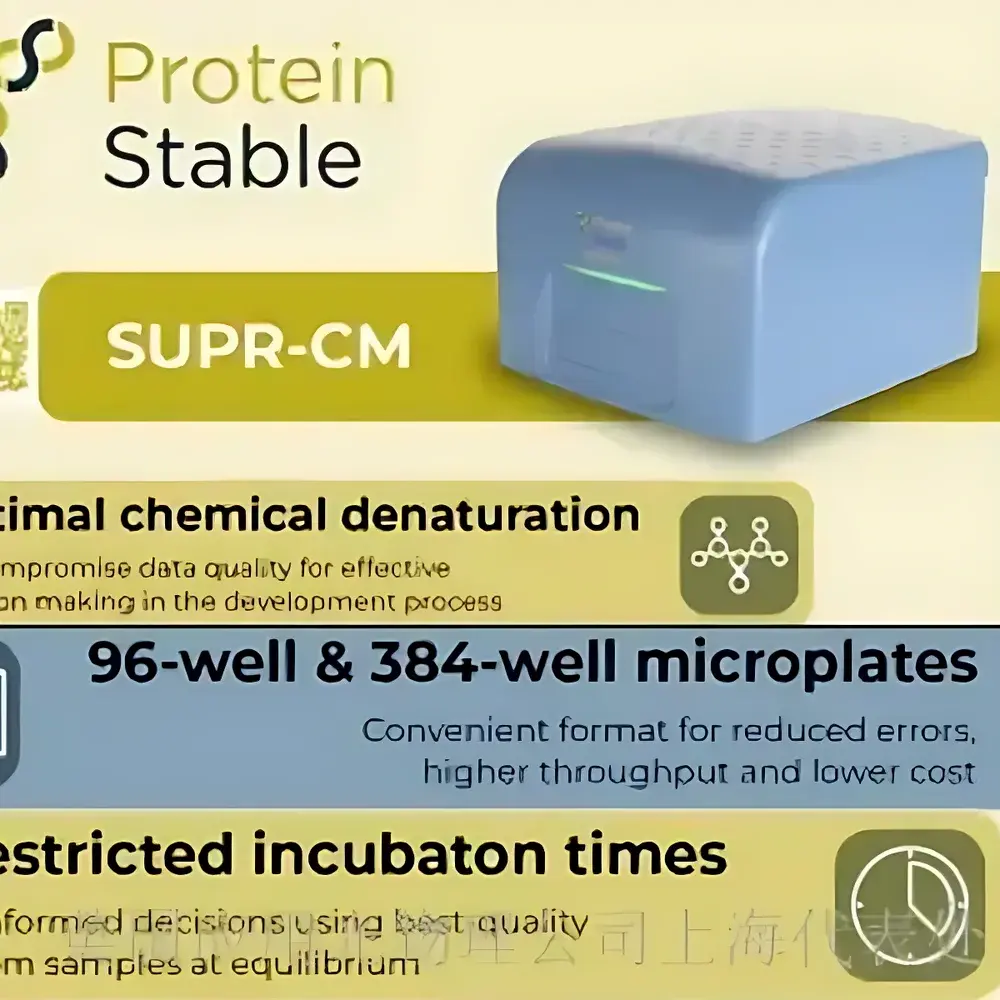
Applied Photophysics SUPR-CM Protein Chemical Stability Analyzer
| Brand | Applied Photophysics |
|---|---|
| Origin | United Kingdom |
| Manufacturer Type | Authorized Distributor |
| Origin Category | Imported Instrument |
| Model | SUPR-CM |
| Price Range | USD 135,000 – 270,000 |
Overview
The Applied Photophysics SUPR-CM Protein Chemical Stability Analyzer is a dedicated, high-throughput instrument engineered for the quantitative determination of protein conformational stability under chemical denaturation conditions. It operates on the principle of intrinsic tryptophan and tyrosine fluorescence spectroscopy, enabling real-time monitoring of protein unfolding transitions as a function of denaturant concentration (e.g., guanidine hydrochloride or urea). By fitting the resulting sigmoidal unfolding curves using a two-state thermodynamic model, the SUPR-CM calculates the midpoint of denaturation (Cm)—a rigorously defined thermodynamic parameter reflecting the denaturant concentration at which 50% of the protein population is unfolded. This value serves as a robust, comparative metric for formulation screening, excipient optimization, and candidate ranking in biopharmaceutical development. Designed specifically for early-stage liquid formulation development, the system delivers Cm data with high reproducibility and minimal sample consumption—critical for conserving precious clinical-stage protein therapeutics.
Key Features
- Ultra-rapid acquisition: Full Cm determination in ≤2.5 minutes per sample, enabled by synchronized gradient generation, temperature-controlled microplate handling, and high-sensitivity fluorescence detection.
- Native fluorescence detection: Excitation at 280 nm and emission collection between 300–400 nm ensure selective, label-free quantification of intrinsic aromatic amino acid signals without chemical modification or extrinsic dyes.
- High-throughput compatibility: Fully supports standard 96-well and 384-well microplates, allowing parallel analysis of up to 384 formulations per run under identical thermal and kinetic conditions.
- Unrestricted incubation capability: Integrated plate incubation module maintains precise temperature control (4–40 °C, ±0.1 °C) for extended equilibration periods—essential for slow-folding proteins or low-kinetic-barrier transitions.
- Robust optical architecture: Dual-monochromator design minimizes stray light; thermoelectrically cooled CCD detector ensures high signal-to-noise ratio even at low fluorescence intensities typical of dilute protein samples.
Sample Compatibility & Compliance
The SUPR-CM accommodates a broad range of therapeutic protein formats, including monoclonal antibodies (mAbs), antibody–drug conjugates (ADCs), Fc-fusion proteins, and recombinant enzymes in buffered aqueous solutions. Sample volume requirements are optimized for microplate workflows (20–100 µL per well), supporting formulation matrices containing common excipients (e.g., sucrose, trehalose, polysorbates, histidine, acetate). The system complies with key regulatory expectations for analytical method development in biologics: data integrity is maintained via audit-trail-enabled software (aligned with FDA 21 CFR Part 11 requirements), and all raw spectral data, curve-fitting parameters, and metadata are stored in vendor-neutral, timestamped binary files. Instrument qualification protocols (IQ/OQ/PQ) are available and support GLP and GMP environments.
Software & Data Management
Control and analysis are performed using the SUPR-CM Analysis Suite—a Windows-based application featuring automated protocol execution, real-time spectral visualization, and batch-mode Cm calculation using non-linear least-squares regression. The software implements built-in quality checks—including baseline correction, scatter correction, and goodness-of-fit assessment (R² ≥ 0.995 threshold)—to flag outliers prior to reporting. All results are exportable to CSV, PDF, or XML formats; integration with LIMS platforms is supported via configurable API endpoints. Raw fluorescence spectra and derivative plots (e.g., first derivative for inflection point confirmation) are retained alongside processed Cm values, ensuring full traceability for regulatory submissions and internal knowledge management.
Applications
- Rapid excipient screening: Comparative evaluation of buffer species, pH, ionic strength, and stabilizing sugars across hundreds of combinations in a single day.
- Formulation robustness assessment: Identification of degradation-prone conditions during forced degradation studies (e.g., elevated temperature + denaturant).
- Candidate molecule ranking: Objective prioritization of lead candidates based on Cm differentials (>0.5 M denaturant shift considered statistically significant under controlled replicates).
- Stability-indicating method development: Generation of reference Cm baselines for comparability studies during process changes or scale-up.
- Structure–function correlation: Correlation of Cm shifts with functional activity loss measured in orthogonal assays (e.g., ELISA, SPR, or cell-based potency).
FAQ
What denaturants are compatible with the SUPR-CM system?
Guanidine hydrochloride (GdnHCl) and urea are fully supported; custom denaturant gradients can be programmed via the software interface.
Does the instrument require fluorescent labeling of the protein?
No—detection relies exclusively on endogenous tryptophan/tyrosine fluorescence; no labeling, purification, or modification steps are needed.
Can Cm data generated on the SUPR-CM be used in regulatory filings?
Yes—when operated within validated protocols and with appropriate documentation (e.g., system suitability, calibration records, and raw data archiving), Cm is accepted as a stability indicator in ICH Q5C and WHO TRS 1015 guidance documents.
Is temperature control mandatory during Cm measurement?
While isothermal conditions are recommended for thermodynamic consistency, the system allows user-defined temperature ramps or static setpoints to assess thermal–chemical coupling effects.
How is data reproducibility verified across instruments?
Applied Photophysics provides inter-laboratory performance qualification kits, including NIST-traceable reference proteins (e.g., lysozyme, BSA), to establish cross-site Cm precision (typical CV < 2.5% for triplicate runs).





