
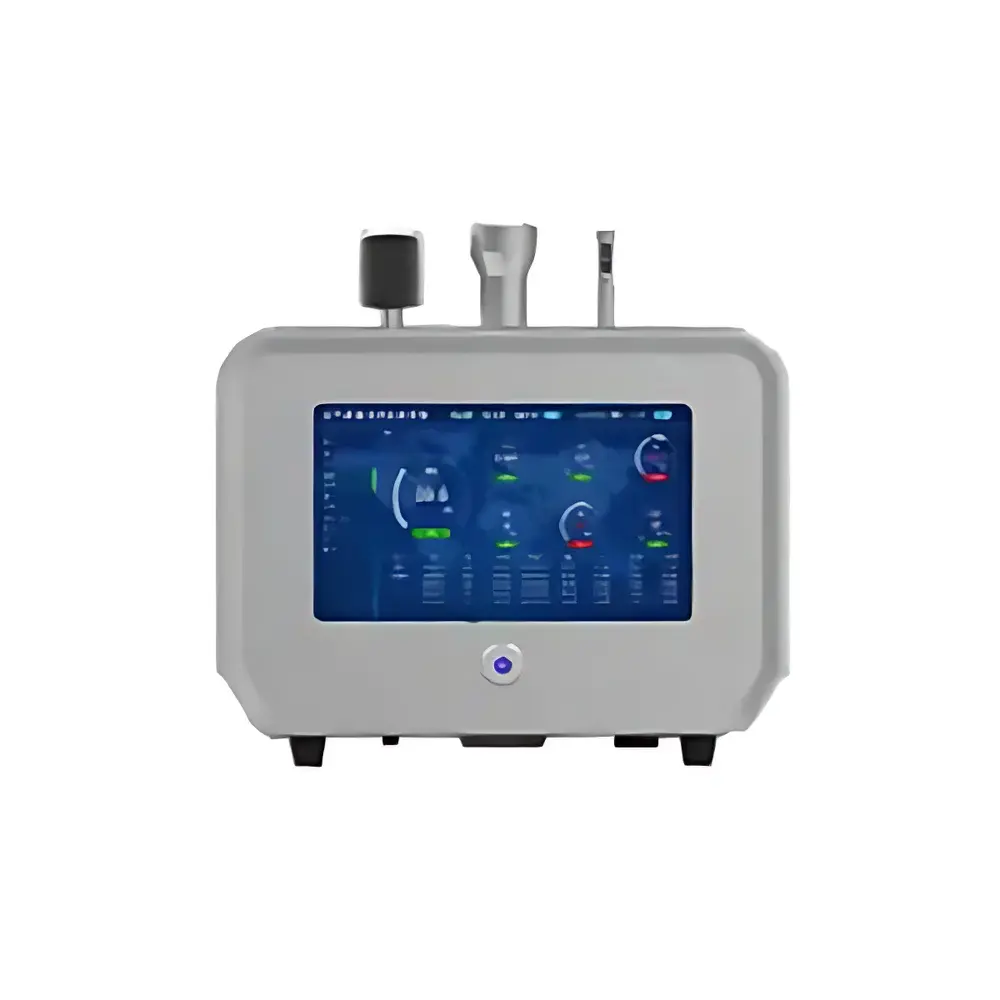
BJBY BY-CEM Multi-Parameter Indoor Environmental Online Monitoring System
| Brand | BJBY |
|---|---|
| Origin | Beijing, China |
| Manufacturer Type | Authorized Distributor |
| Country of Origin | China |
| Model | BY-CEM |
| Pricing | Available Upon Request |
| Particle Detection | PM2.5 (0–10,000 µg/m³, ±10% accuracy, 1 µg/m³ resolution) |
| Display | 7-inch capacitive touchscreen |
| Power | AC adapter + internal rechargeable battery |
| Connectivity | 4G LTE, Wi-Fi, USB, RS485, external antenna port |
| Enclosure | Ruggedized portable housing with tripod mount and wall-mount bracket |
| Data Storage | Local buffered storage + cloud-synchronized time-series database |
| Compliance | Designed for alignment with ISO 16000-23 (indoor air quality — sensor performance evaluation), GB/T 18883-2022 (China Indoor Air Quality Standard), and WHO Air Quality Guidelines (2021) |
Overview
The BJBY BY-CEM Multi-Parameter Indoor Environmental Online Monitoring System is an engineered solution for continuous, real-time assessment of indoor air quality (IAQ) in non-industrial, occupant-dense environments. Unlike ambient outdoor monitoring networks, the BY-CEM system applies calibrated electrochemical and optical scattering principles—specifically laser scattering for particulate mass concentration (PM₂.₅ and PM₁₀) and non-dispersive infrared (NDIR) spectroscopy for carbon dioxide—to deliver traceable, field-deployable measurements compliant with internationally recognized IAQ reference methodologies. Its architecture supports regulatory-grade data acquisition under variable thermal and humidity conditions (operating range: 0–40 °C, 10–90% RH non-condensing), making it suitable for fixed or semi-permanent deployment in dynamic indoor settings where spatial flexibility and audit-ready data integrity are critical.
Key Features
- Modular mounting configuration: Integrated wall-hang and freestanding tripod base enables rapid repositioning without structural modification.
- 7-inch industrial-grade capacitive touchscreen interface with localized UI navigation, supporting on-device calibration verification and real-time parameter visualization.
- Dual-power operation: Continuous mains-powered operation with automatic failover to internal Li-ion battery (≥8 h backup at full sensor load).
- Multi-protocol telemetry: Concurrent 4G LTE (CAT-M1/NB-IoT compatible) and dual-band Wi-Fi (2.4/5 GHz) ensure redundant network availability; RS485 and USB-C ports support legacy SCADA integration and local firmware updates.
- Expandable sensor architecture: Pre-wired expansion header accommodates future integration of VOC, formaldehyde, temperature/humidity, and NO₂ modules per ISO 16000-29 requirements.
- Embedded edge processing: Onboard microcontroller performs real-time median filtering, outlier rejection, and unit normalization prior to transmission—reducing cloud-side computational overhead.
Sample Compatibility & Compliance
The BY-CEM system is validated for use in enclosed spaces with airflow velocities <0.5 m/s and minimal particulate turbulence—typical of classrooms, hospital waiting areas, retail lobbies, transit hubs, and office atriums. All optical and electrochemical sensors undergo factory traceable calibration against NIST-traceable reference standards. The system design aligns with ISO 16000-23 for sensor response time (T₉₀ < 60 s for PM₂.₅), measurement uncertainty budgeting, and long-term drift compensation. Data logging intervals (1–60 min configurable) and metadata tagging (GPS-assisted location stamping, device ID, firmware version) satisfy GLP-aligned recordkeeping expectations for public health surveillance programs.
Software & Data Management
A secure, role-based web platform provides centralized access to time-series datasets, historical trend charts, and automated compliance reports. Each measurement event includes immutable audit trail metadata (timestamp, sensor status flags, signal-to-noise ratio). The backend implements AES-256 encryption for data-at-rest and TLS 1.3 for data-in-transit. API endpoints conform to RESTful conventions and support OAuth 2.0 authentication, enabling interoperability with municipal environmental dashboards, hospital facility management systems (FMS), and national air quality information platforms. Full export capability includes CSV, JSON, and NetCDF formats—preserving native resolution and uncertainty annotations. Mobile application (iOS/Android) delivers push notifications for threshold breaches and allows geolocated annotation of transient IAQ events.
Applications
This system serves as a foundational tool for occupational health officers conducting workplace exposure assessments per OSHA Technical Manual Chapter 2, Section III guidelines. It supports routine verification of HVAC filtration efficacy in healthcare facilities aligned with ASHRAE Standard 170. In educational institutions, it facilitates longitudinal studies correlating CO₂ concentrations with cognitive performance metrics under controlled ventilation protocols. Regulatory agencies utilize its grid-level aggregation capability to identify IAQ hotspots across municipal building portfolios, informing targeted retrofitting priorities and enforcement scheduling. The system also functions as a validation node during commissioning of demand-controlled ventilation (DCV) systems, providing third-party-verified input for BAS optimization logic.
FAQ
What regulatory standards does the BY-CEM system support for data submission?
It generates structured, timestamped datasets compatible with national reporting frameworks including China’s MEP Order No. 32 and EU Directive 2008/50/EC Annex IX requirements for supplementary monitoring.
Can sensor modules be recalibrated in-field without returning to the manufacturer?
Yes—zero-point and span adjustments for CO₂ and PM channels are accessible via authenticated technician mode using certified reference gases and aerosol generators.
Is raw sensor output available for custom algorithm development?
Yes—the REST API provides unprocessed ADC counts, temperature-compensated voltage readings, and diagnostic registers alongside calibrated values.
How is data integrity maintained during network outages?
Local flash memory buffers up to 30 days of 1-minute interval data with cyclic overwrite protection and CRC-32 checksum validation.
Does the system support multi-site fleet management?
Yes—the platform includes hierarchical organization trees, group-level alert policies, and consolidated SLA reporting across distributed deployments.
Related Products







