
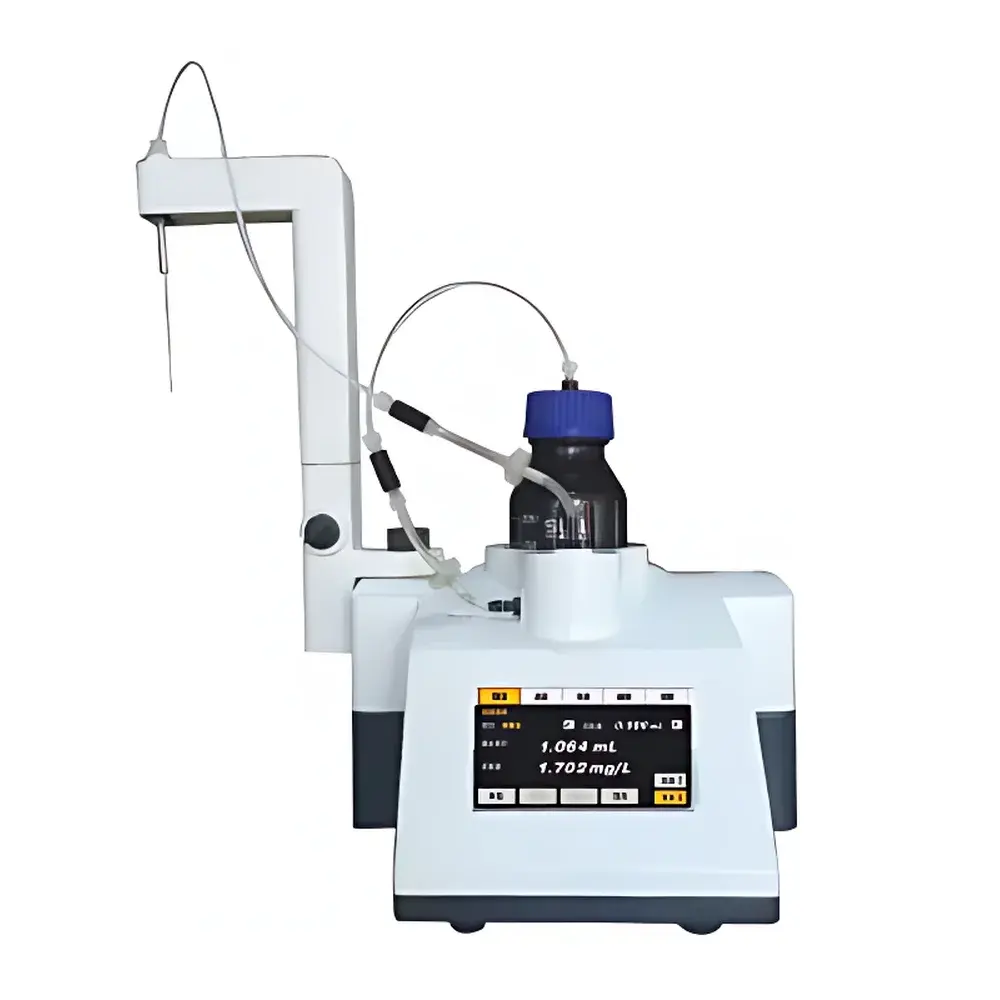
Beijing Baoyun SMART-COD Potassium Permanganate Index Analyzer
| Brand | Beijing Baoyun (BJBY) |
|---|---|
| Origin | Beijing, China |
| Manufacturer Type | Authorized Distributor |
| Country of Origin | China |
| Model | SMART-COD |
| Pricing | Upon Request |
Overview
The Beijing Baoyun SMART-COD Potassium Permanganate Index Analyzer is a fully automated, benchtop titration system engineered for precise and reproducible determination of the permanganate index (CODMn) in surface water, drinking water, groundwater, and low-organic-content wastewater. Based on the standardized acidified potassium permanganate oxidation method (ISO 8467:1993, GB/T 5750.7–2006, and APHA Standard Method 5210 B), the instrument performs controlled thermal oxidation followed by automatic potentiometric or colorimetric endpoint detection. Unlike manual titrations subject to operator variability, the SMART-COD integrates high-precision fluid handling, real-time reaction monitoring, and algorithm-driven endpoint recognition to deliver traceable, GLP-compliant results in under 15 minutes per sample.
Key Features
- High-Durability Precision Piston Pump: Engineered for >5 million actuation cycles — exceeding conventional glass or PTFE syringes by 15× — with dry-seal, silicone-free operation eliminating lubricant contamination and calibration drift.
- Sub-Milliliter Volumetric Accuracy: Photocell-based initial position sensing enables volumetric resolution of ≤0.005% of full-scale range (e.g., ±0.2 µL at 4 mL capacity), ensuring consistent reagent delivery across batches.
- Preloaded Regulatory Methods: Factory-configured protocols conforming to ISO 8467, Chinese National Standard GB/T 5750.7, and EPA-recommended MnO4− oxidation procedures — no user programming required.
- Integrated Sample Conditioning: Automated rinse-and-wet cycles between analyses minimize carryover; dual-path fluidic architecture isolates sample, oxidant, and titrant lines to prevent cross-contamination.
- Endpoint Detection Flexibility: Supports both redox potential jump detection (via Pt/AgCl electrode) and spectrophotometric endpoint recognition (at 525 nm), selectable based on matrix complexity and regulatory preference.
- Full Audit Trail Compliance: Internal database stores ≥1,000 complete analysis records with timestamp, operator ID, method version, raw sensor data, and final calculated CODMn (mg O2/L), supporting 21 CFR Part 11–aligned data integrity requirements.
Sample Compatibility & Compliance
The SMART-COD accepts aqueous samples with turbidity <20 NTU and chloride concentration <300 mg/L (pre-treatment recommended above this threshold). It accommodates standard 25 mL or 100 mL sample volumes, with optional dilution modules for elevated organic loads. All hardware and firmware comply with IEC 61326-1 (EMC for laboratory equipment) and GB/T 18268.1–2010 (electromagnetic compatibility for analytical instruments). Method validation documentation includes repeatability (RSD ≤2.1%, n=6), spike recovery (94–103%), and linearity (R² ≥0.999 over 0.5–10.0 mg O2/L range).
Software & Data Management
The embedded touchscreen interface runs a deterministic real-time OS with intuitive icon-driven navigation. Data export supports CSV, PDF report generation (with customizable headers), and direct USB transfer. Optional PC software (SMART-Link v3.2) enables remote method deployment, batch result trending, and integration with LIMS via ASTM E1384-compliant ASCII output. All electronic records include immutable digital signatures, session logs, and change history — satisfying GLP audit requirements for environmental testing laboratories accredited to CNAS-CL01:2018 (equivalent to ISO/IEC 17025).
Applications
- Regulatory monitoring of source water and finished drinking water per national drinking water standards
- Wastewater effluent compliance verification for municipal and industrial dischargers
- Long-term trend analysis in lake and reservoir management programs
- Method validation and reference lab cross-checks for CODMn interlaboratory studies
- Educational use in environmental chemistry laboratories requiring hands-on automation exposure
FAQ
Does the SMART-COD require periodic recalibration of the piston pump?
No. The dry-seal piston mechanism maintains volumetric accuracy without recalibration throughout its service life (≥5 million strokes); only routine cleaning and tubing replacement per manufacturer schedule are required.
Can the instrument handle high-chloride samples such as seawater-influenced estuaries?
Not directly. Samples with chloride >300 mg/L must undergo pre-treatment (e.g., AgNO3 precipitation per ISO 8467 Annex B) prior to analysis to avoid interference with permanganate oxidation.
Is the software validated for 21 CFR Part 11 compliance?
The embedded firmware supports ALCOA+ principles (Attributable, Legible, Contemporaneous, Original, Accurate); full Part 11 compliance requires implementation of site-specific electronic signature policies and audit trail review procedures — documented in the SMART-COD Validation Guide (Ref. BJBY-VG-2024-01).
What maintenance intervals are recommended for routine operation?
Daily: Rinse cycle verification and electrode cleaning.
Monthly: Tubing inspection and replacement if microcracking observed.
Annually: Full system performance verification using NIST-traceable KHP standards.







