
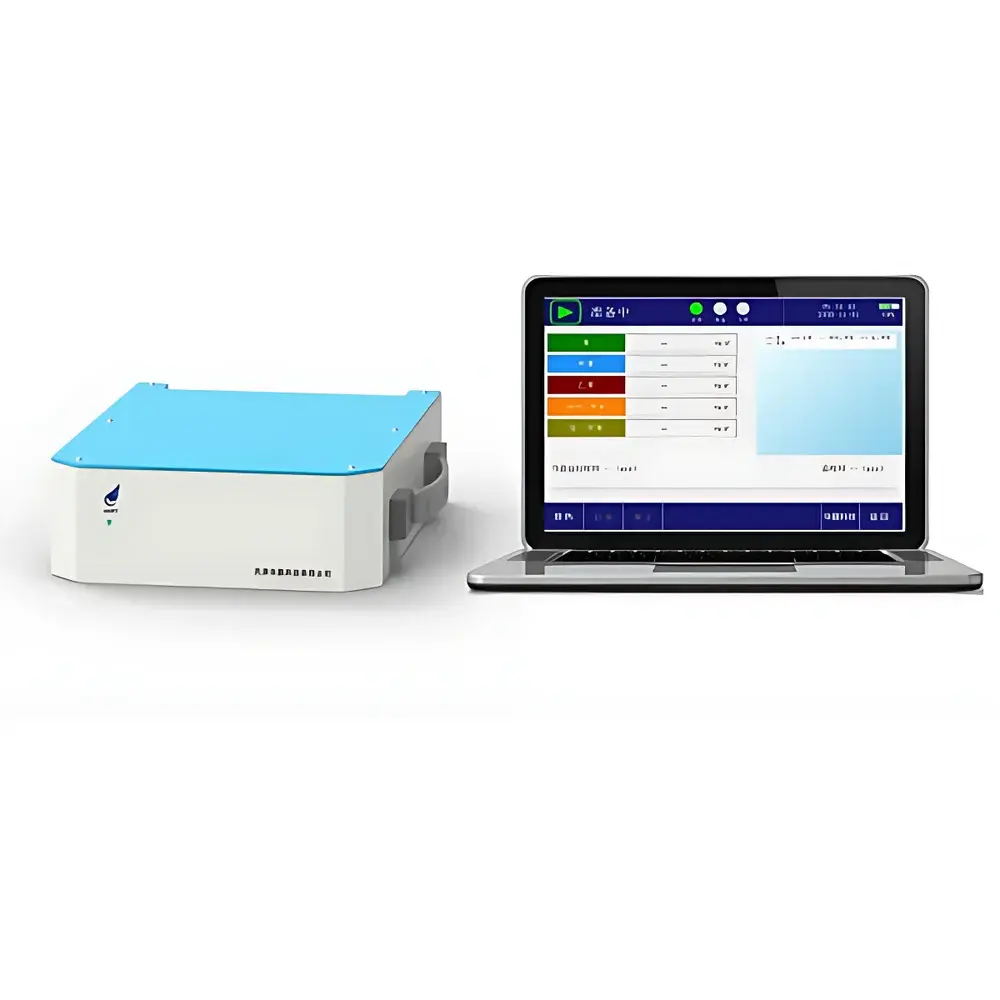
BJBY H5220(C) Portable Gas Chromatograph with PID Detector
| Brand | BJBY |
|---|---|
| Origin | Beijing, China |
| Model | H5220(C) |
| Detection Limit | <1 µg/m³ (for benzene) |
| Repeatability | 1% |
| Linear Range | 10⁵ |
| Column Oven Temperature Range | Ambient to 200 °C (programmable) |
| Zero Drift | ≤1% FS/month |
| Span Drift | <1% FS/24 h |
| Power Supply | Internal Li-ion battery (6 h operation) |
| Operating Environment | −20 °C to +45 °C, 20–90% RH |
| Gas Inlet | 1/8″ stainless steel Swagelok fitting |
| Detector | Photoionization Detector (PID) |
Overview
The BJBY H5220(C) Portable Gas Chromatograph is an engineered field-deployable analytical system designed for real-time, on-site quantification of volatile organic compounds (VOCs) in ambient and indoor air. It integrates capillary gas chromatography (GC) separation with a high-sensitivity photoionization detector (PID), enabling selective, interference-resistant detection of aromatic hydrocarbons (e.g., benzene, toluene, xylene), chlorinated solvents (e.g., trichloroethylene, tetrachloroethylene), aldehydes, light alcohols, and sulfur- or nitrogen-containing VOCs. Unlike benchtop GC systems requiring external carrier gas cylinders and laboratory infrastructure, the H5220(C) generates purified compressed air internally as carrier gas—eliminating dependency on helium or nitrogen supplies. Its compact form factor (≤3.2 kg), integrated rechargeable lithium-ion battery (6 h continuous runtime), and ruggedized housing meet MIL-STD-810G shock/vibration requirements for mobile environmental monitoring applications.
Key Features
- Carrier-Gas-Free Operation: Built-in air compressor and multi-stage filtration system deliver ultra-pure, moisture- and hydrocarbon-free compressed air as carrier gas—no external gas cylinders required.
- High-Sensitivity PID Detection: 10.6 eV lamp-based PID provides sub-ppb detection capability for benzene (detection limit <1 µg/m³; equivalent to ~0.26 ppb at 25 °C/1 atm), with linear dynamic range spanning five orders of magnitude (10⁵).
- Programmable Column Oven: Temperature-controlled capillary column oven (ambient to 200 °C, ±0.1 °C stability) supports rapid thermal ramping and isothermal hold protocols optimized for target VOC elution profiles.
- Field-Calibrated Workflow: Preloaded calibration curves for >40 priority VOCs per EPA TO-14/TO-15 and Chinese national standards (GB/T 18883–2022 Annex C); supports user-defined calibrations via embedded software interface.
- Robust Environmental Tolerance: Operates reliably across −20 °C to +45 °C and 20–90% relative humidity—validated for use in unconditioned indoor spaces, construction sites, and emergency response vehicles.
- Regulatory-Ready Data Integrity: Onboard audit trail logs instrument parameters, calibration events, sample IDs, operator inputs, and time-stamped chromatograms—supporting GLP-compliant documentation per ISO/IEC 17025 and CNAS requirements.
Sample Compatibility & Compliance
The H5220(C) is validated for direct analysis of undiluted ambient air samples collected via integrated pump aspiration (flow rate: 50–200 mL/min). No pre-concentration or thermal desorption is required for routine screening at regulatory action levels. It complies with multiple national and international method standards, including:
- China: GB/T 18883–2022 (Indoor Air Quality Standard, Annex C), GB 50325–2020 (Control Standard for Indoor Environmental Pollution of Civil Building Engineering), HJ/T 167–2004 (Technical Specification for Indoor Air Monitoring), JJF (Building Materials) 174–2020 (Calibration Specification for Portable GC-PID Instruments)
- United States: EPA Methods 501, 502.1, 502.2, 503.1, 506, 602, 8020, 8021, TO-14, TO-15
- International: OIML R113 (Measuring Instruments for Gaseous Pollutants)
All compliance testing was performed using NIST-traceable standard gas mixtures and certified reference materials. The instrument meets metrological requirements for field portable analyzers under Class II accuracy per ISO 8573-1 for compressed air purity and IEC 61000-4-2/3/4 for electromagnetic compatibility.
Software & Data Management
The embedded GC control and data acquisition software runs on a Linux-based ARM processor with a 5-inch capacitive touchscreen. Chromatograms are displayed in real time with peak integration, retention time locking, and automatic baseline correction. Export formats include CSV, PDF reports (with digital signature support), and native .cdf files compatible with OpenChrom and Chromeleon. Data synchronization occurs automatically via Wi-Fi or USB-C to secure cloud storage (AES-256 encrypted), satisfying FDA 21 CFR Part 11 requirements for electronic records and signatures when configured with user authentication and role-based access controls. Audit trails record all parameter changes, calibration verifications, and report generations with immutable timestamps.
Applications
- Indoor Air Quality (IAQ) Assessment: Routine monitoring in offices, schools, hospitals, and residential buildings per GB/T 18883–2022 and ASHRAE Standard 62.1.
- Occupational Health & Safety: Personal and area sampling for OSHA PEL and ACGIH TLV compliance during renovation, painting, solvent cleaning, or chemical handling.
- Post-Construction Verification: Clearance testing following building completion or remediation—quantifying residual VOCs against GB 50325–2020 Class I/II limits.
- Emergency Response: Rapid deployment during chemical spills, fire investigations, or hazardous material incidents to identify airborne threats within minutes.
- Public Health Surveillance: Field screening by CDC centers, environmental protection bureaus, and third-party inspection agencies conducting nationwide IAQ surveys.
FAQ
Does the H5220(C) require external carrier gas cylinders?
No—it features an integrated air purification system that generates carrier-grade compressed air from ambient air, eliminating logistical dependencies on helium or nitrogen supplies.
What is the typical analysis time per sample?
Full chromatographic separation and quantification for a 12-component VOC panel (including benzene, toluene, xylenes, TCE, PCE) is completed in ≤6 minutes under standard temperature-programmed conditions.
How is calibration verified in the field?
The instrument supports daily zero/span verification using certified permeation tubes or dynamic dilution standards; calibration stability is tracked via built-in drift compensation algorithms aligned with JJF (Building Materials) 174–2020.
Is the PID lamp replaceable in the field?
Yes—the 10.6 eV UV lamp is user-replaceable without tools and rated for ≥50,000 hours of operational life under normal duty cycles.
Can the H5220(C) be integrated into existing LIMS or EMS platforms?
Yes—via RESTful API and Modbus TCP protocol support, enabling bidirectional data exchange with laboratory information management systems (LIMS) and enterprise environmental monitoring systems (EMS) compliant with ISO 14001.
Related Products





