
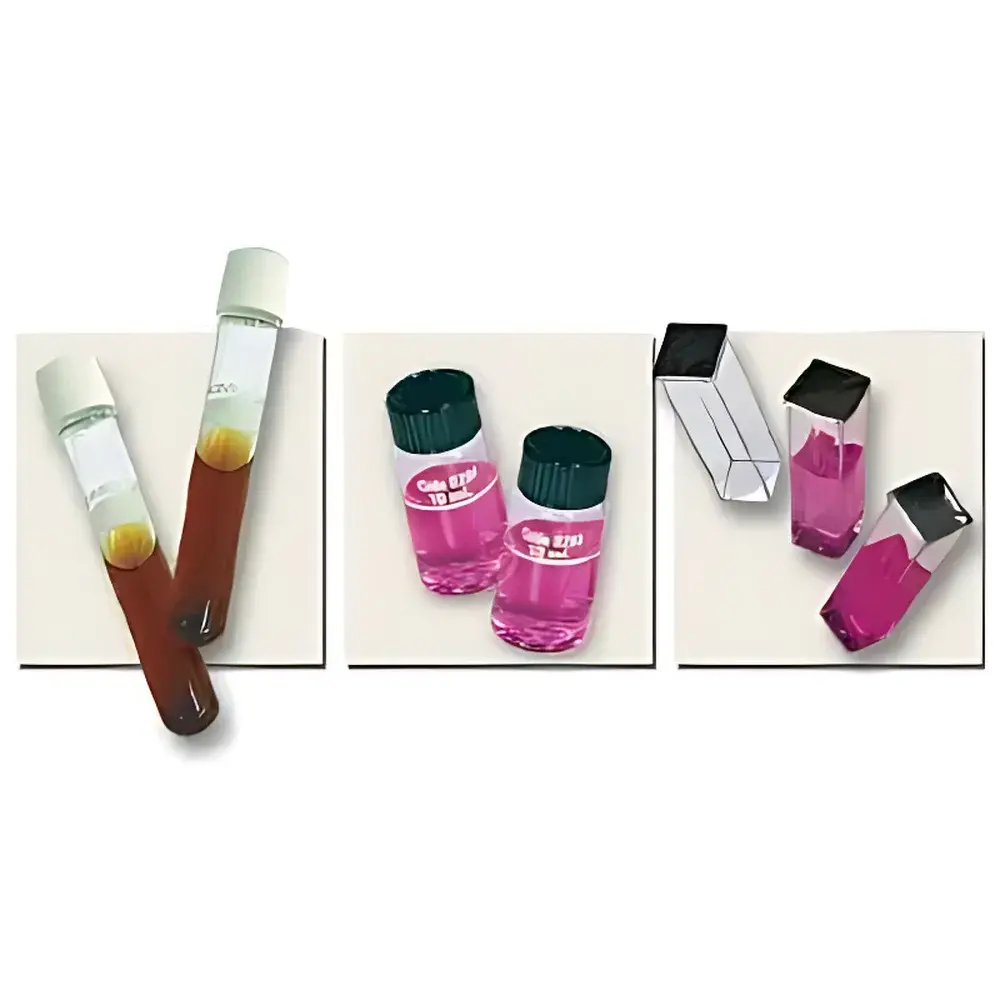
Lamotte Smart3 Reagent Set for Multi-Parameter Water Quality Analyzer
| Brand | Lamotte |
|---|---|
| Model | Smart3 Reagent Set |
| Instrument Type | Portable/Handheld Water Quality Analyzer |
| Test Parameters | Free Chlorine, Total Chlorine, pH, Hardness, Alkalinity, Nitrate, Nitrite, Ammonia, COD, Iron, Copper, Manganese, Phosphate, Silica, Chloride, Bromide, Ozone, Dissolved Oxygen, and over 75 additional parameters |
| Detection Principle | Colorimetric Analysis via LED-Based Photometry (Multiple Wavelengths) |
| Calibration Options | Pre-programmed Lamotte-specific calibrations (n > 75), plus user-defined calibration curves (up to 25) |
| Data Storage | 500 measurement records with timestamp |
| Connectivity | USB interface for real-time data transfer and firmware updates |
| Display | Backlit LCD with 7-language support (English, Spanish, French, German, Portuguese, Chinese, Arabic) |
| Compliance | Designed to support ASTM D1293 (pH), ASTM D1253 (Residual Chlorine), ISO 7888 (Electrical Conductivity), USP <643> (TOC—when paired with optional modules), and GLP-compliant data logging (audit trail enabled via software) |
Overview
The Lamotte Smart3 Reagent Set is a comprehensive, precision-engineered consumable system designed exclusively for use with the Lamotte Smart3 Multi-Parameter Water Quality Analyzer. This reagent portfolio enables field-deployable, laboratory-grade colorimetric analysis across more than 75 water quality parameters—including free and total chlorine, pH (via three indicator ranges: 5.0–6.8, 6.6–8.4, and 8.0–9.6), total hardness, alkalinity, nitrate-nitrogen, nitrite-nitrogen, ammonia (freshwater/saltwater variants), chemical oxygen demand (COD) in low-, standard-, and high-range configurations, orthophosphate, total phosphorus, silica, iron, copper, manganese, zinc, fluoride, bromide, iodide, cyanide, ozone, dissolved oxygen (Winkler method), and sulfide. Each reagent formulation adheres strictly to established analytical chemistry protocols—including DPD, phenol red, chlorophenol red, thymol blue, Nesslerization, salicylate, indophenol blue, molybdenum blue, vanadomolybdophosphoric acid, and PAN-based methodologies—ensuring metrological traceability and inter-laboratory reproducibility. The Smart3 platform employs a multi-LED optical system with automatic wavelength selection per test method, eliminating manual filter changes and minimizing operator-induced variability.
Key Features
- Pre-validated, lot-numbered reagents optimized for the Smart3’s photometric architecture—guaranteeing consistent absorbance response and minimal inter-batch deviation.
- Three packaging formats: single-dose vials (UDV*), tablet forms (with included tablet crusher, part #0175), and liquid reagent kits—each calibrated for 10 mL sample volume using standardized cuvettes (part #0290).
- Hazard-aware labeling: Reagents marked with asterisk (*) comply with OSHA HCS 2012 and carry full Safety Data Sheets (SDS); all hazardous components are classified per UN Transport Regulations (e.g., Class 6.1, Packing Group III).
- User-definable calibration capability: Supports up to 25 custom calibration curves using proprietary slope/intercept or polynomial regression inputs—essential for non-standard matrices or regulatory method deviations.
- GLP-ready data integrity: Timestamped measurements stored onboard (500 entries) include test ID, parameter, concentration, %T, date/time, and operator ID (if configured); USB export supports CSV and XML formats compatible with LIMS integration.
- Multi-language UI support (7 languages) and intuitive menu navigation reduce training burden for multinational field teams and municipal operators.
Sample Compatibility & Compliance
The Smart3 Reagent Set is validated for use with potable water, swimming pool/spa water, surface water (including turbid and colored samples), saline/brackish water (up to 35 ppt), and municipal/industrial wastewater effluents. Interference profiles are documented per parameter—for example, bromide, iodide, cyanide, sulfide, and orthophosphate are known interferents for chlorine assays; heavy metals such as mercury and lead require chelation pretreatment for accurate COD determination. All reagents meet EPA-approved methods where applicable (e.g., Method 334.0 for chlorine, Method 365.2 for phosphate) and align with ISO 5667-3 (sampling) and ISO 17025 (testing laboratory competence). For regulated environments, the system supports 21 CFR Part 11-compliant electronic signatures when used with Lamotte’s certified software suite (SmartLink v4.2+).
Software & Data Management
Data acquisition and management are facilitated through Lamotte SmartLink PC software (Windows 10/11 compatible), which provides real-time instrument control, calibration validation reports, trend charting, statistical summaries (mean, SD, CV%), and automated report generation compliant with ISO/IEC 17025 clause 7.8.2. Raw absorbance and concentration values are logged with metadata including environmental temperature, battery status, and cuvette ID (if barcoded). Audit trails record all calibration edits, method changes, and user logins—retained for ≥12 months per internal QA policy. Export formats include PDF (for regulatory submission), Excel (.xlsx), and delimited text for ERP/LIMS ingestion.
Applications
This reagent system serves critical monitoring functions across multiple sectors: municipal drinking water treatment (chlorine residual verification per WHO Guidelines), recreational water safety (CDC Model Aquatic Health Code compliance), environmental field surveys (EPA Region 4 watershed assessments), industrial process water control (pharmaceutical clean-in-place validation, power plant condensate monitoring), aquaculture health management (ammonia/nitrite stress indicators), and academic teaching laboratories (analytical chemistry curriculum alignment with AOAC and APHA standards). Its portability and rapid turnaround (<3 min per test) make it ideal for emergency response deployments and remote site characterization.
FAQ
Are Smart3 reagents compatible with instruments other than the Lamotte Smart3 analyzer?
No—reagents are chemically and spectrally matched to the Smart3’s LED wavelengths and firmware calibration algorithms. Cross-platform use voids accuracy guarantees and violates ISO 8655-6 traceability requirements.
How should reagents be stored to maintain stability?
Store unopened kits at 2–8 °C (refrigerated, not frozen); protect from light and moisture. Once opened, tablets retain potency for 6 months if kept in original desiccated vial; liquid reagents remain stable for 12 months under refrigeration.
Does the system support regulatory audits under FDA or EU Annex 11?
Yes—when deployed with SmartLink v4.2+, audit trail functionality, electronic signature capability, and secure user access controls satisfy FDA 21 CFR Part 11 and EU Annex 11 requirements for computerized systems in GMP environments.
What is the shelf life of the Smart3 Reagent Set upon receipt?
Minimum 18 months from manufacture date; lot-specific expiration is printed on each kit label and verified in the Smart3 firmware during initialization.
Can I develop my own calibration curve for an unconventional matrix (e.g., high-TDS geothermal water)?
Yes—the instrument supports entry of up to 25 user-defined calibrations using reference standards traceable to NIST SRMs; slope, intercept, and polynomial coefficients may be input manually or imported via CSV.







