
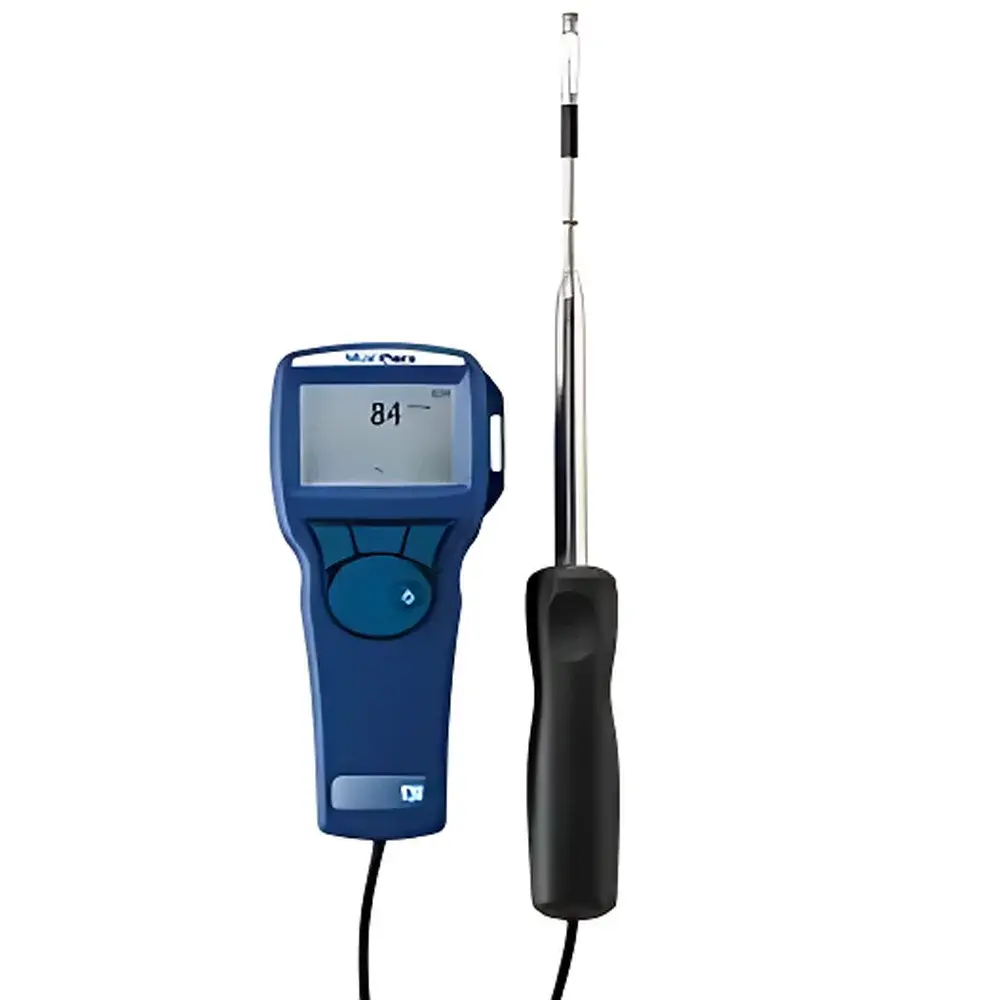
TSI Model 9515 Hot-Wire Anemometer
| Brand | TSI |
|---|---|
| Origin | USA |
| Model | 9515 |
| Air Velocity Range | 0–20 m/s |
| Resolution | 0.01 m/s |
| Accuracy | ±5% of reading or ±0.025 m/s (whichever is greater) |
| Temperature Range | –18 to 93 °C |
| Temperature Accuracy | ±0.3 °C |
| Temperature Resolution | 0.1 °C |
| Probe Length | 101.6 cm |
| Probe Tip Diameter | 7.0 mm |
| Probe Base Diameter | 13.0 mm |
| Host Dimensions | 8.4 × 17.8 × 4.4 cm |
| Operating Temperature (Host) | 5–45 °C |
| Storage Temperature | –20–60 °C |
| Weight (with batteries) | 0.27 kg |
| Power Supply | 4 × AA alkaline or NiCd batteries |
Overview
The TSI Model 9515 Hot-Wire Anemometer is a precision-engineered, handheld instrument designed for reliable and repeatable measurement of air velocity in low- to medium-velocity environments. Utilizing constant-temperature anemometry (CTA), the device maintains a heated sensing wire at a fixed temperature differential above ambient, enabling highly responsive detection of convective heat loss proportional to local airflow. This principle delivers superior sensitivity at low velocities (down to 0.01 m/s) and stable performance across turbulent or laminar flow regimes—critical for applications where spatial resolution and transient response matter. Unlike cup or vane anemometers, the hot-wire sensor offers minimal flow disturbance and negligible inertia, making it ideal for characterizing face velocity in biological safety cabinets (BSCs), airflow uniformity in fume hoods, and ventilation rates in HVAC ductwork and cleanroom environments.
Key Features
- Integrated telescoping probe (101.6 cm extended length) with ergonomic grip, enabling access to confined or elevated locations without repositioning the host unit.
- High-resolution digital display with dual-parameter capability: simultaneous real-time readout of air velocity (m/s) and ambient temperature (°C).
- Robust thermal sensor design featuring a 7.0 mm diameter probe tip and reinforced 13.0 mm base for mechanical stability during insertion into grilles, ducts, or BSC sashes.
- Field-calibrated hot-wire sensor with NIST-traceable calibration documentation available upon request—supporting audit readiness under ISO/IEC 17025 and GLP frameworks.
- Low-power electronics optimized for extended battery life; operates continuously for >20 hours on four standard AA alkaline cells.
- IP54-rated housing provides protection against dust ingress and water splashing—suitable for use in industrial laboratories, pharmaceutical manufacturing suites, and field-based IAQ assessments.
Sample Compatibility & Compliance
The Model 9515 is validated for use with non-corrosive, non-particulate-laden air streams typical of indoor environmental monitoring. It complies with ASTM D1896–21 (Standard Guide for Measurement of Air Velocity in Ventilation Systems) and supports adherence to NSF/ANSI 49–2022 requirements for biological safety cabinet certification. While not intrinsically rated for hazardous locations, its sensor architecture avoids spark-generating components, permitting safe operation in Class I, Division 2 areas when used per manufacturer guidelines. Data collection meets basic traceability needs for ISO 9001 internal audits; optional timestamped CSV export (via optional RS232 interface cable) facilitates alignment with FDA 21 CFR Part 11-compliant workflows when paired with validated third-party software.
Software & Data Management
The Model 9515 operates as a standalone instrument with no embedded firmware update capability or onboard data logging. However, analog output (0–5 V DC) and RS232 serial interface (available via accessory cable TSI Part No. 050-0001) enable integration with external DAQ systems, SCADA platforms, or custom Python/Matlab acquisition scripts. Users may configure sampling intervals from 1 Hz to 10 Hz, capturing time-series velocity profiles for turbulence intensity analysis or volumetric flow estimation. Calibration certificates include uncertainty budgets compliant with ISO/IEC 17025:2017 Annex A.5, supporting metrological traceability to NIST Standard Reference Materials (SRMs) for velocity and temperature.
Applications
- Face velocity verification and periodic testing of Class II biological safety cabinets per NSF/ANSI 49 protocols.
- IAQ investigations including supply/exhaust air balancing, diffuser performance evaluation, and cross-contamination risk assessment in healthcare facilities.
- Commissioning and recommissioning of HVAC systems—particularly in LEED-certified buildings requiring ASHRAE 62.1–2022 ventilation rate procedure validation.
- Occupational hygiene surveys measuring worker exposure to airborne contaminants in conjunction with tracer gas dilution methods.
- Educational laboratory use for teaching fluid dynamics principles, boundary layer development, and thermal anemometry fundamentals.
FAQ
What is the recommended recalibration interval for the Model 9515?
TSI recommends annual recalibration under normal use conditions; more frequent verification is advised after mechanical shock, exposure to condensation, or operation outside specified temperature/humidity ranges.
Can the probe be sterilized for use in aseptic environments?
The stainless-steel probe tip is compatible with 70% isopropyl alcohol wipe-down; autoclaving or ethylene oxide treatment is not permitted due to sensor element vulnerability.
Does the instrument meet FDA 21 CFR Part 11 requirements?
The standalone unit does not provide electronic signature or audit trail functionality; however, when interfaced with validated third-party data acquisition software, it may support Part 11 compliance within a controlled system environment.
Is the Model 9515 suitable for outdoor wind speed measurement?
It is not designed for unsheltered outdoor use—lack of weatherproofing and susceptibility to solar heating effects on the hot-wire element limit reliability beyond controlled indoor or semi-enclosed settings.
How does the accuracy specification account for combined velocity and temperature error?
Velocity accuracy is independent of temperature measurement; the ±5% or ±0.025 m/s tolerance applies solely to airspeed. Temperature error (±0.3 °C) does not propagate into velocity calculation, as CTA output is inherently compensated for ambient thermal drift.







