
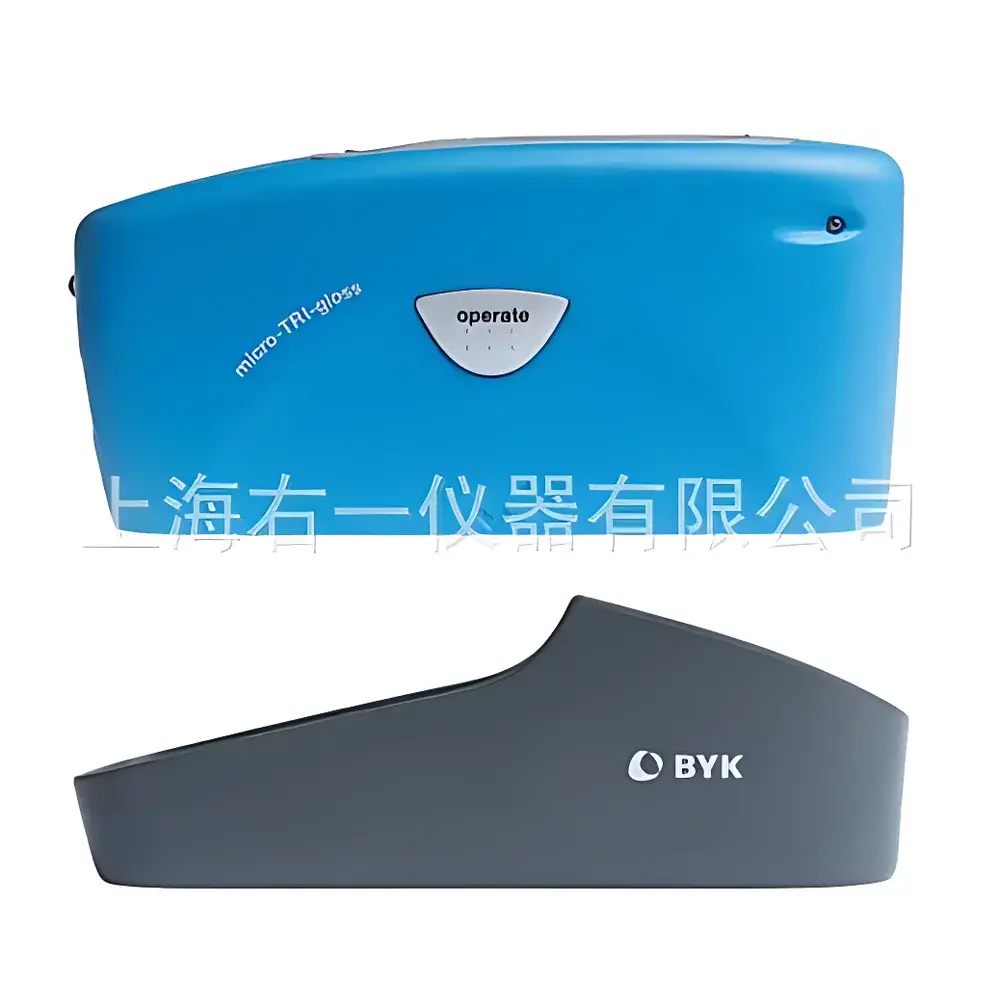
BYK-GARDNER BYK4561 60° Single-Angle Gloss Meter
| Brand | BYK-GARDNER |
|---|---|
| Origin | Germany |
| Model | BYK4561 |
| Type | Automatic |
| Gloss Measurement Angle | 60° |
| Gloss Range | 0–2000 GU |
| Repeatability | ±0.1 GU (0–20 GU), ±0.2 GU (20–100 GU), ±0.2% (100–2000 GU) |
| Reproducibility | ±0.2 GU (0–20 GU), ±0.5 GU (20–100 GU), ±0.5% (100–2000 GU) |
| Measurement Area | 9 × 15 mm |
| Compliance | ISO 2813, ASTM D523, DIN 67530, JIS Z8741 |
Overview
The BYK-GARDNER BYK4561 is a precision-engineered 60° single-angle gloss meter designed for reliable, repeatable surface gloss assessment in industrial quality control and R&D environments. Operating on the principle of specular reflectance measurement—defined as the ratio of reflected to incident light flux at a fixed geometry—the instrument conforms strictly to international standards including ISO 2813, ASTM D523, DIN 67530, and JIS Z8741. The 60° geometry represents the industry-standard angle for evaluating medium-gloss surfaces such as automotive clearcoats, architectural paints, molded plastics, and powder-coated metal substrates. Its compact, ergonomic design integrates a high-contrast color display, intuitive rotary navigation, and tactile feedback optimized for glove-compatible operation in production settings. Unlike generic photometric devices, the BYK4561 employs a stabilized tungsten-halogen light source with spectral output matched to the CIE standard illuminant A, ensuring metrological traceability and long-term stability across environmental fluctuations.
Key Features
- High-precision 60° gloss measurement with extended range (0–2000 GU) and segmented repeatability specifications: ±0.1 GU (0–20 GU), ±0.2 GU (20–100 GU), and ±0.2% (100–2000 GU)
- Ergonomic handheld form factor with 9 × 15 mm measurement aperture—engineered for consistent probe placement and minimal edge effects on curved or textured surfaces
- Integrated auto-diagnostic system that monitors calibration status, standard tile cleanliness, and optical path integrity—providing real-time alerts when recalibration is required
- Calibration traceability certified to national metrology institutes (e.g., PTB, NIST), with included certificate of calibration valid for 12 months
- Robust aluminum housing rated IP54 for dust and splash resistance—suitable for shop-floor deployment without protective enclosures
- Built-in rechargeable Li-ion battery supporting >10,000 measurements per charge and USB-C connectivity for firmware updates and data export
Sample Compatibility & Compliance
The BYK4561 accommodates diverse substrate types—including solvent-borne and waterborne coatings, thermoset and thermoplastic polymers, anodized and painted metals, and laminated composites—without requiring mode switching or accessory changes. Its optical geometry satisfies regulatory requirements for gloss verification under ISO 2813 (paints and varnishes), ASTM D523 (specular gloss of nonmetallic specimens), and DIN 67530 (gloss measurement of plastic surfaces). For industries subject to audit-driven quality systems—including automotive Tier-1 suppliers, medical device manufacturers, and FDA-regulated coating applicators—the instrument supports full GLP/GMP documentation workflows via optional Smart-Lab Gloss software with 21 CFR Part 11-compliant electronic signatures and audit trail generation. Surface curvature compensation algorithms minimize measurement deviation on radii ≥25 mm, and the instrument’s low thermal drift (<0.1 GU/°C) ensures stable performance across ambient temperatures from 10°C to 40°C.
Software & Data Management
Data acquisition and reporting are enabled through two dedicated software platforms: Smart-Lab Gloss (for laboratory-based statistical analysis) and Smart-Process Gloss (for inline SPC integration). Both applications support configurable measurement protocols—including multi-point averaging, pass/fail thresholding, and batch-level trend analysis—with export to CSV, PDF, and Excel formats. Raw data includes timestamp, operator ID, sample ID, environmental conditions (optional external hygrothermometer input), and full metadata per measurement. Audit trails record all user actions—including calibration events, parameter modifications, and report generation—with immutable timestamps and user authentication logs. Firmware updates are delivered via secure HTTPS channels and validated using SHA-256 checksums to ensure integrity. No cloud storage is required; local database encryption (AES-256) complies with GDPR and ISO/IEC 27001 data protection requirements.
Applications
The BYK4561 serves critical functions across multiple verticals: In automotive manufacturing, it verifies gloss uniformity across body panels and trim components prior to final assembly; in packaging, it quantifies varnish consistency on folding cartons and flexible films; in architectural coatings, it validates batch-to-batch reproducibility for façade systems; and in electronics, it assesses anti-glare finishes on display bezels and housings. Its ability to resolve sub-1 GU differences in the low-gloss range (0–20 GU) makes it suitable for evaluating matte-finish interior materials—such as soft-touch plastics and micro-textured leather substitutes—where visual perception thresholds demand metrological rigor. When deployed alongside thickness gauges compliant with ISO 2360 and ASTM B499, the BYK4561 enables correlated analysis of optical and dimensional coating properties—supporting root-cause investigations into curing defects, pigment dispersion anomalies, or spray application inconsistencies.
FAQ
What standards does the BYK4561 comply with?
ISO 2813, ASTM D523, DIN 67530, JIS Z8741, and BS 3900-P5.
Is the instrument suitable for measuring curved surfaces?
Yes—its 9 × 15 mm aperture and integrated curvature compensation algorithm support reliable measurements on convex surfaces with radii ≥25 mm.
How often must the instrument be recalibrated?
Calibration interval depends on usage frequency and environmental conditions; the auto-diagnostic system recommends recalibration when drift exceeds ±0.5 GU or standard tile contamination is detected.
Can the BYK4561 measure gloss on transparent substrates like glass or acrylic?
Yes—provided the substrate has sufficient inherent reflectivity or is backed with a non-reflective matte surface to prevent subsurface interference.
Does the device support statistical process control (SPC) integration?
Yes—via Smart-Process Gloss software, which exports real-time data to common SPC platforms (e.g., Minitab, InfinityQS) using OPC UA or Modbus TCP protocols.




