
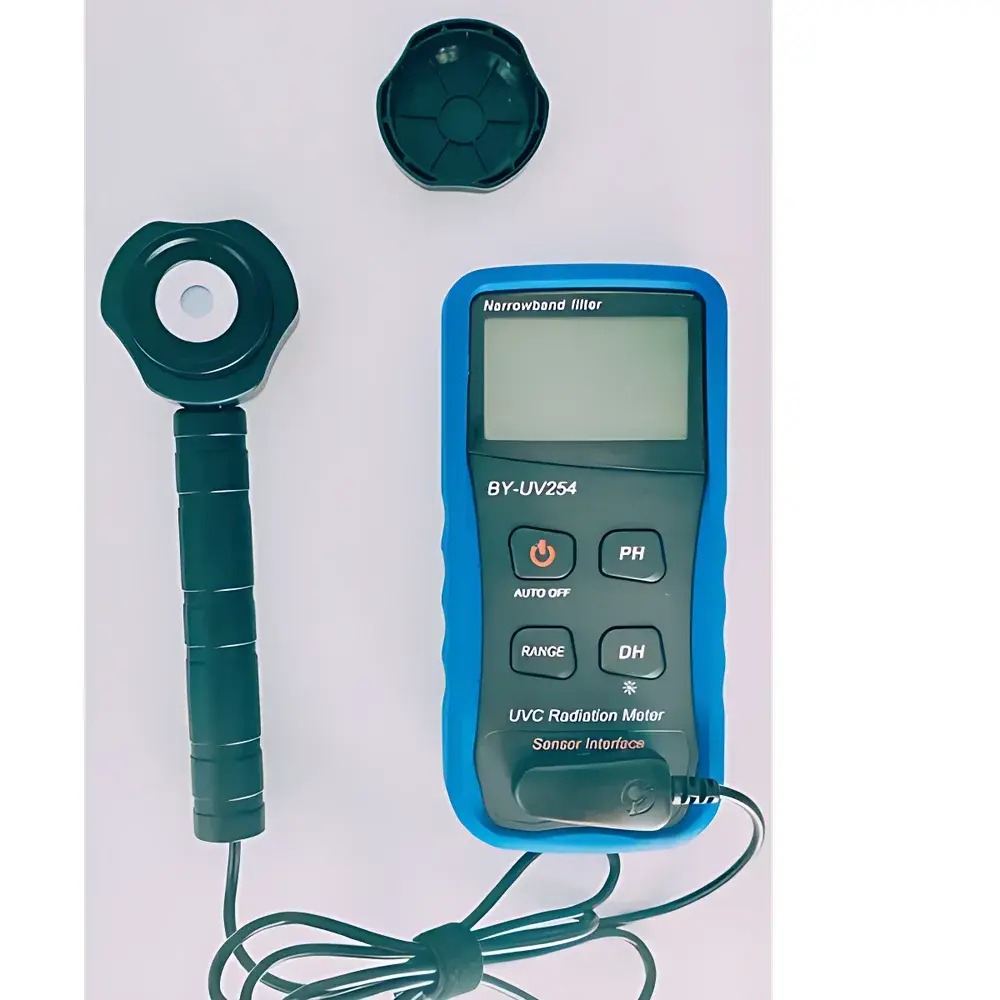
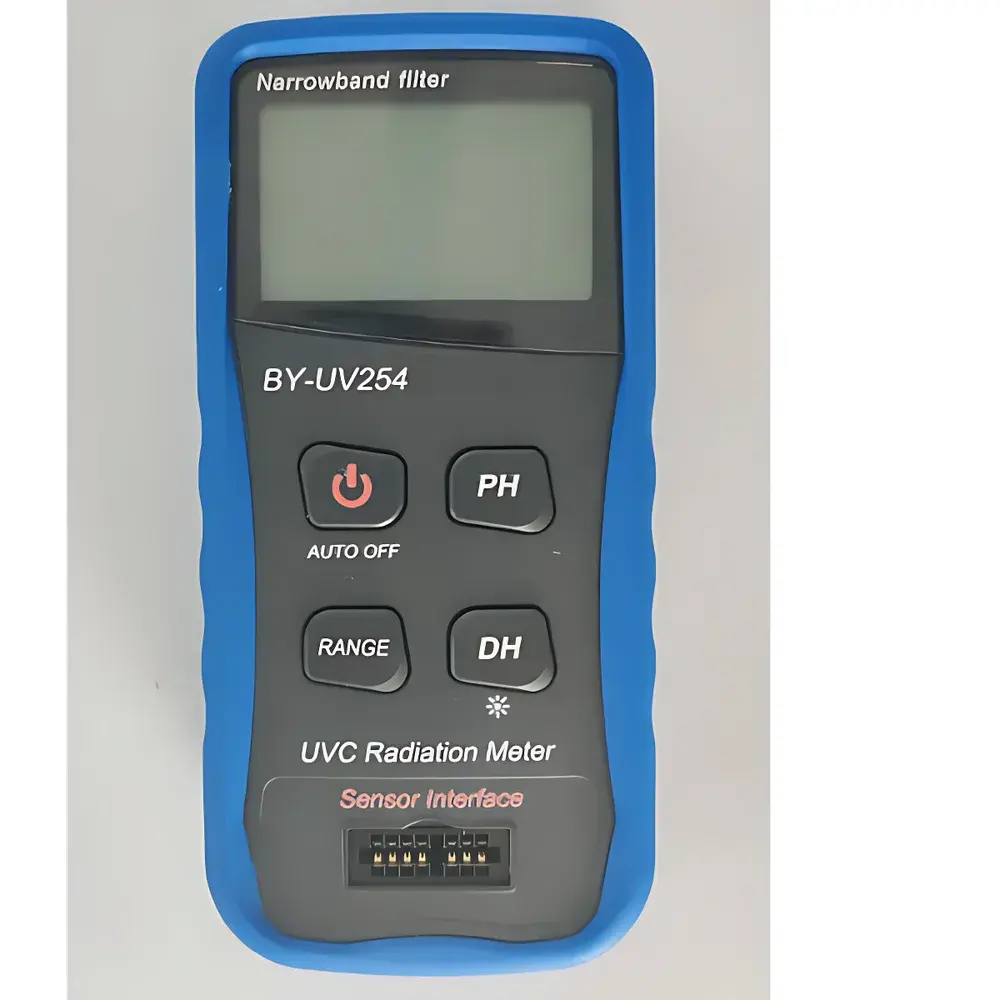
BJBY BY-UV254 Short-Wavelength UV Radiometer
| Brand | BJBY |
|---|---|
| Origin | Beijing, China |
| Model | BY-UV254 |
| Wavelength Range | 248–262 nm |
| Peak Wavelength | 254 nm |
| Measurement Range | 1 µW/cm² to 39.99 mW/cm² |
| Resolution | 1 µW/cm² |
| Spectral Band Rejection (Out-of-Band) | <0.1% |
| Accuracy | ±8% + 2 digits |
| Linearity Error | ±1% |
| Range Switching Error | ±1% |
| Sampling Rate | 2 Hz |
| Display | 3¾-digit LCD with backlight |
| Overload Indication | "OL" |
| Operating Temp./RH | 0–45 °C / 0–70% RH |
| Storage Temp./RH | −10–50 °C / 0–80% RH |
| Power | Three 3 V CR2032 coin cells |
| Battery Life | ~300 h (backlight off) |
| Auto Power-Off Delay | 5 min |
| Host Dimensions | 160 × 78 × 34 mm |
| Probe Dimensions | Ø50 × 40 mm |
| Telescopic Handle | 12 cm (single-stage), 24 cm (dual-stage) |
| Probe Cable Length | 1 m (including handle) |
| Weight | ~405 g (with batteries and probe) |
Overview
The BJBY BY-UV254 Short-Wavelength UV Radiometer is a precision handheld instrument engineered for quantitative measurement of ultraviolet irradiance in the germicidal UVC spectral band. It operates on the principle of photometric detection using a gallium arsenide (GaAs) photodiode coupled with a narrowband interference filter centered at 254 nm — the dominant emission line of low-pressure mercury vapor lamps widely used in disinfection, water/air purification, and biosafety cabinet validation. The device conforms to the fundamental radiometric framework defined in CIE S 017/E:2020 and ISO/IEC 17025–compliant calibration practices, ensuring traceability to national standards for UV-C radiometry. Its spectral response is rigorously constrained to 248–262 nm, minimizing contributions from visible or near-UV radiation, and features out-of-band rejection better than 0.1%, critical for accurate dosimetry in regulated environments.
Key Features
- High-selectivity GaAs photodetector with integrated 254 nm narrowband interference filter for optimal UVC responsivity and minimal spectral drift
- Dual-range analog-to-digital conversion architecture supporting full-scale measurement from 1 µW/cm² to 39.99 mW/cm² with 1 µW/cm² resolution
- Ergonomic telescoping handle (12 cm single-stage / 24 cm dual-stage) enabling flexible positioning in confined or elevated locations, including ductwork, UV lamp arrays, and laminar flow hoods
- Probe housing equipped with standardized M4 threaded mounting holes for rigid fixture integration or extension pole attachment
- Backlit 3¾-digit LCD display with peak-hold and data-hold functions for transient irradiance capture and comparative field measurements
- Low-power design powered by three CR2032 lithium coin cells, delivering approximately 300 hours of continuous operation without backlight activation
- Automatic power management including low-battery warning and programmable 5-minute auto-shutdown to preserve calibration stability and battery integrity
Sample Compatibility & Compliance
The BY-UV254 is designed exclusively for radiant flux density (irradiance) measurement of UVC-emitting sources—primarily 254 nm low-pressure Hg lamps, amalgam lamps, and UVC-LEDs with spectral output overlapping the 248–262 nm band. It is not suitable for broadband UV-A/UV-B sources or pulsed UV systems without verified temporal response characterization. While not certified to IEC 60601 or FDA 510(k), its optical design aligns with technical requirements outlined in NSF/ANSI 55 (Class A and B UV disinfection systems), EPA UV Disinfection Guidance Manual (2016), and ISO 15714:2018 for UV dose determination in water treatment applications. Calibration certificates (traceable to NIM, China) may be supplied upon request for GLP-compliant documentation.
Software & Data Management
The BY-UV254 operates as a standalone radiometric tool with no embedded Bluetooth, USB, or proprietary software interface. All measurements are displayed in real time on the integrated LCD; no external data logging or PC connectivity is supported. However, its stable analog front-end and repeatable sampling rate (2 Hz) enable manual recording into LIMS or Excel-based QA/QC logs. For laboratories requiring electronic audit trails, users may pair the instrument with third-party digital loggers via custom analog voltage output adapters (not included). The device supports basic metrological traceability workflows compliant with ISO/IEC 17025:2017 Clause 6.6 (Equipment) when calibrated annually against a NIST-traceable UVC reference radiometer.
Applications
- Validation and routine monitoring of UVC intensity in HVAC germicidal irradiation (UVGI) systems
- Verification of UV lamp output decay during scheduled maintenance in pharmaceutical cleanrooms per EU GMP Annex 1 and USP
- Field assessment of UV dose delivery in municipal wastewater and drinking water treatment plants
- Performance testing of UV sterilization chambers, biosafety cabinets, and laboratory surface decontamination units
- Quality control of UVC-LED modules during R&D and production screening
- Academic research involving UVC photobiology, material degradation studies, and ozone generation kinetics
FAQ
What is the spectral bandwidth specification of the BY-UV254?
The detector’s effective spectral response is limited to 248–262 nm, with peak sensitivity at 254 nm and out-of-band rejection <0.1% — meeting industry expectations for dedicated 254 nm germicidal radiometry.
Does the instrument comply with FDA 21 CFR Part 11 requirements?
No. The BY-UV254 lacks electronic signature capability, audit trail functionality, or secure user authentication — it is a non-networked, analog-output–equivalent radiometer intended for manual data entry into validated systems.
Can this radiometer measure pulsed UVC sources?
Not reliably. Its 2 Hz sampling rate and lack of peak-integration firmware preclude accurate measurement of microsecond- or millisecond-scale UVC pulses; dedicated fast-response radiometers with ≥10 kHz bandwidth are recommended.
Is calibration traceable to international standards?
Yes — optional factory calibration reports (available on request) provide traceability to the National Institute of Metrology (NIM), China, aligned with CIPM Mutual Recognition Arrangement (MRA) principles.
What is the maximum operating temperature for extended field use?
The specified operational limit is 45 °C (113 °F); prolonged exposure above this threshold may induce thermal drift in the GaAs sensor and compromise accuracy beyond ±8% + 2 digits.
Related Products





