
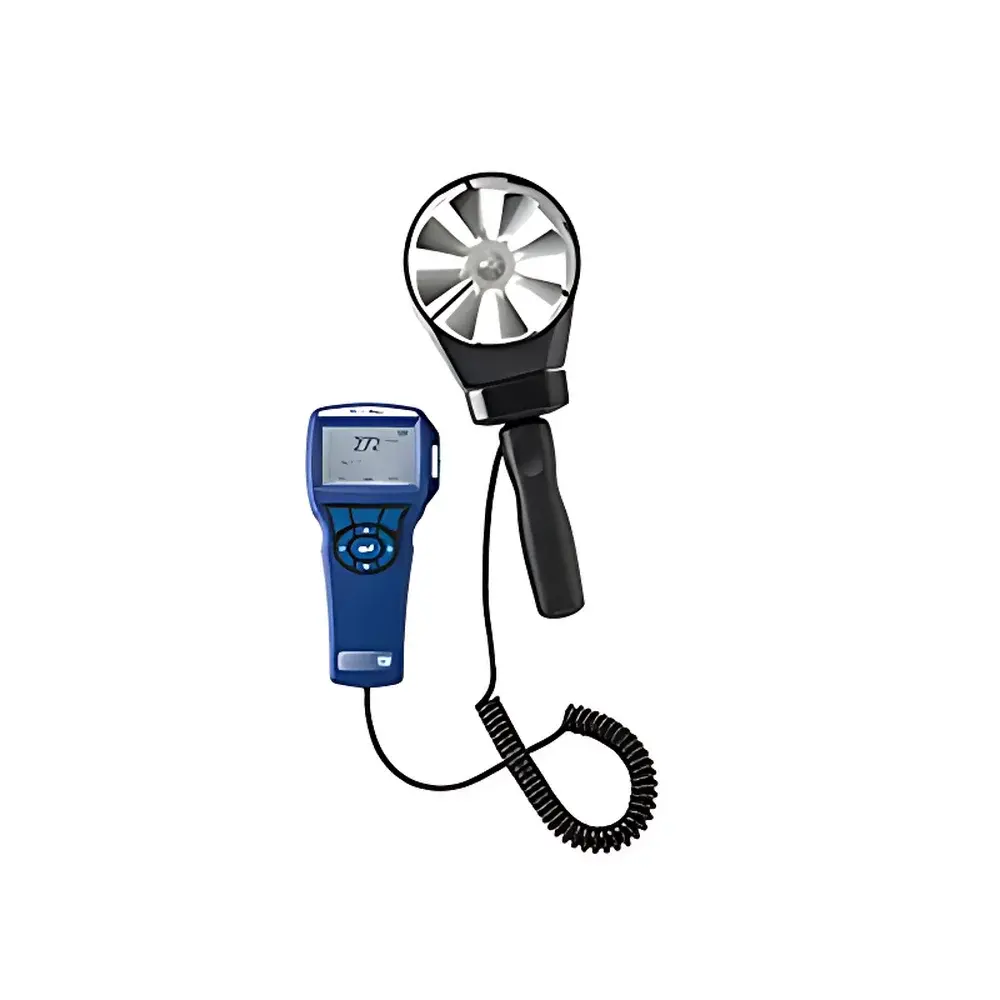
TSI Model 5725 Digital Vane Anemometer
| Brand | TSI |
|---|---|
| Origin | USA |
| Model | 5725 |
| Velocity Range | 0.25–30 m/s |
| Accuracy | ±1% of reading or ±0.02 m/s (whichever is greater) |
| Temperature Range | 0–60 °C |
| Temperature Accuracy | ±1 °C |
| Temperature Resolution | 0.1 °C |
| Duct Area Range | 0–16 m² |
| Data Storage | 12,700 readings across 100 data groups |
| Sampling Interval | 1 s – 1 h |
| Time Constant | User-adjustable |
| Operating Temperature | 5–45 °C |
| Probe Operating Temperature | 0–60 °C |
| Storage Temperature | −20–60 °C |
| Dimensions | 8.4 × 17.8 × 4.4 cm |
| Weight (with batteries) | 270 g |
| Power | 4 × AA alkaline batteries |
Overview
The TSI Model 5725 Digital Vane Anemometer is a precision-engineered handheld instrument designed for quantitative airflow characterization in HVAC, laboratory, and industrial hygiene applications. It operates on the principle of rotational vane anemometry—where airflow imparts torque to a calibrated axial vane assembly, and angular velocity is converted to linear velocity via factory-traceable calibration against NIST-traceable standards. Unlike thermal anemometers, the 5725 delivers high reproducibility in turbulent, low-velocity, or thermally unstable airstreams commonly encountered at cooling/heating coils, diffusers, fume hood faces, and filter banks. Its dual-sensor architecture simultaneously acquires air velocity and ambient temperature, enabling real-time volumetric flow calculation (Q = v × A) when cross-sectional area is entered—a critical capability for duct traverse validation and ASHRAE 111-compliant airflow verification.
Key Features
- High-fidelity vane probe with large-diameter rotor optimized for stable response in non-uniform and low-velocity flows (down to 0.25 m/s), minimizing underestimation errors typical of small-rotor anemometers.
- Integrated temperature sensor with ±1 °C accuracy over 0–60 °C range, supporting simultaneous velocity–temperature logging for thermal comfort and energy balance assessments per ISO 7730 and ANSI/ASHRAE Standard 55.
- User-configurable time constant (0.1–10 s) to dynamically adapt response dynamics—fast setting for transient event capture; slow setting for averaging turbulent fluctuations during duct traverses.
- Onboard statistical engine computes mean, min, max, and standard deviation across user-defined sampling intervals (1 s to 1 h), eliminating post-processing dependency for QA/QC reporting.
- Automatic averaging mode for volume flow rate during “sweep” operation—ideal for rapid assessment of grille or filter face velocities without manual point-by-point measurement.
- Rugged, ergonomic housing (8.4 × 17.8 × 4.4 cm; 270 g) with IP54-rated ingress protection, enabling reliable field use in dusty or humid mechanical rooms and cleanroom support zones.
Sample Compatibility & Compliance
The Model 5725 is validated for use with rectangular, round, and irregular duct geometries up to 16 m² cross-sectional area. Its vane probe exhibits minimal flow disturbance and negligible wake interference—critical for compliance with ISO 16813 (indoor air quality) and EN 12599 (HVAC system commissioning). The instrument supports GLP-aligned data integrity: all stored records include timestamp, probe ID (if paired), operator ID (user-entered), and environmental metadata (T, RH if external sensor connected). While not FDA 21 CFR Part 11–certified out-of-box, audit trails and exportable CSV logs meet baseline requirements for ISO/IEC 17025-accredited laboratories performing HVAC performance testing.
Software & Data Management
Data is stored onboard in non-volatile memory—up to 12,700 individual readings distributed across 100 named data groups. Each group retains full context: sampling interval, time constant, duct area, units, and annotation fields. Export is performed via USB interface using TSI’s TrakPro™ Lite software (Windows-compatible), which generates compliant reports with embedded calibration certificates, uncertainty budgets (per GUM), and graphical overlays (velocity contour maps, time-series plots). Raw data exports preserve native resolution and metadata structure, ensuring traceability for internal audits or third-party verification under ISO 9001 or ISO 14001 frameworks.
Applications
- Quantitative validation of coil face velocity uniformity per ASHRAE Guideline 12—detecting localized bypass or fouling-induced flow asymmetry.
- Diffuser and supply register balancing using multi-point traverse averaging to verify design airflow distribution per SMACNA HVAC Air Systems Handbook.
- Fume hood face velocity surveys meeting OSHA 1910.1450 and ANSI/AIHA Z9.5 requirements for containment verification.
- Filter bank integrity screening—identifying low-velocity zones indicative of media degradation or seal leakage in HEPA/ULPA systems.
- IAQ baseline studies involving spatial velocity–temperature correlation for thermal comfort modeling (PMV/PPD indices).
- Commissioning and retro-commissioning documentation supporting LEED EQ Credit 1 and BREEAM Hea 02 compliance.
FAQ
What is the minimum measurable velocity, and how is low-flow accuracy ensured?
The instrument resolves down to 0.25 m/s with ±1% of reading or ±0.02 m/s accuracy (whichever is greater), verified across its full range using calibrated wind tunnels per ISO 17025-accredited procedures.
Can the 5725 calculate volumetric flow without external area input?
No—volumetric flow (m³/s or CFM) requires manual entry of duct or grille cross-sectional area; the device performs real-time Q = v × A computation only after area is defined.
Is the temperature sensor interchangeable or field-calibratable?
The integrated thermistor is factory-calibrated and sealed; field recalibration is not supported, but periodic verification against a NIST-traceable reference thermometer is recommended annually.
Does the device support real-time data streaming to a PC or PLC?
No—the 5725 operates in standalone logging mode only; real-time serial output is not implemented to maintain measurement stability and battery longevity.
How does the sweep mode differ from standard averaging?
Sweep mode activates continuous sampling during physical probe movement across a surface, automatically computing spatially weighted mean velocity—eliminating operator-dependent dwell time bias inherent in discrete-point methods.
Related Products







